This professional educational article is not medical advice and is not legal or regulatory advice for a specific product.
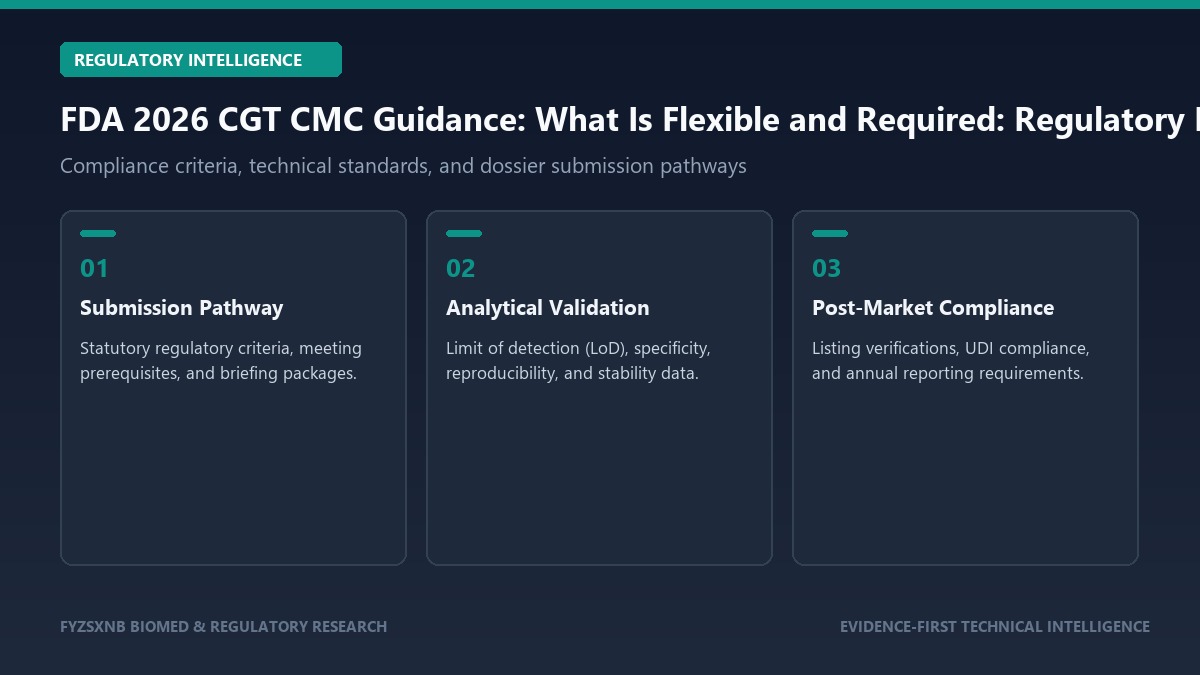
Document Status
- Title: Chemistry, Manufacturing, and Controls Flexibilities for Developing Human Cellular and Gene Therapy Products for a Biologics License Application
- Issuing Office: FDA/CBER, Office of Therapeutic Products (OTP)
- Date: May 5, 2026
- Status: Final Level 2 Guidance, immediate implementation
- Docket: FDA-2026-D-4692
- Binding: Nonbinding recommendations; does not establish legally enforceable responsibilities. Not a law, waiver, or deregulation.
- Official PDF: Download
| Date | Event |
|---|---|
| Jan 2026 | FDA press release announces push for CMC flexibilities in CGT |
| May 5, 2026 | Final guidance published; immediate implementation |
| Jun 4, 2026 | OTP town hall on BLA best practices (educational, not guidance) |
Flexibility at a glance: a three‑column matrix
| What became more flexible | What BLAs must still demonstrate | Decisions that remain product‑specific |
|---|---|---|
| Phase‑appropriate CGMP; early release criteria may be used in development if scientifically sound | Prequalification‑like process validation (PPQ) and a coherent CMC package | Exact number of PPQ batches; lot count for stability |
| Limited comparability data may support minor, low‑risk investigational changes after risk assessment | Validated analytical procedures and regulatory reporting commitments | Transferability of platform knowledge to a given product |
| Single‑representative‑lot method validation, limited‑lot specifications, stability‑bridging strategies may be considered | Adequate stability data to support the requested shelf life; distributed batches must meet approved specifications | Concurrent release or PPQ completion after licensure (only in constrained cases, FDA may consider) |
| Platform analytical procedures and prior knowledge from sufficiently similar compounds/components may support a BLA strategy | Product‑specific verification may still be required when critical attributes are not fully covered by platform data | Acceptability of rapid/noncompendial methods |
| Reserve‑sample exceptions may be granted with risk‑based justification | All licensed product must remain safe, pure and potent; changes must be reported through appropriate regulatory submissions | Post‑approval specification change category (PAS, CBE‑30, etc.) |
Development‑phase flexibilities
The guidance builds on the 2020 final IND CMC guidance for human gene therapy. Sponsors may adopt a phase‑appropriate approach to CGMP: manufacturing controls and release criteria can evolve from early clinical phases through licensure, provided patient safety is never compromised. Early‑phase release tests may differ from those used for commercial lots, and adjustments are acceptable as product knowledge grows.
Prior CMC knowledge—from comparable products, platform technologies, or shared components—may reduce the need to generate wholly new data. However, the agency does not view prior knowledge as a replacement for product‑specific demonstration. Where a platform analytical procedure has been qualified across several products, sponsors may still need to verify its suitability for the new product because matrix effects or process‑specific impurities can differ. This is not a “plug‑and‑play” approval tool.
When an investigational change is minor and carries low risk, limited comparability data may suffice after a documented risk assessment. The 2023 draft guidance on manufacturing changes and comparability (not for implementation, here) explores this concept, but the final 2026 guidance gives a clearer immediate pathway.
PPQ and process validation: the flexible batch count
One of the most anticipated clarifications: FDA does not impose a universal three‑PPQ‑batch rule. The guidance affirms that the number of PPQ batches must be “scientifically justified” based on process understanding, complexity, intrinsic variability, and the control strategy. A highly characterized, well‑controlled process may be adequately validated with fewer batches, while a more variable or complex process might require more. Sponsors should reference the 2011 Process Validation guidance and earlier BLA expectations.
For products addressing an urgent unmet medical need or those where manufacturing is severely constrained (e.g., autologous therapies), FDA may consider concurrent release or completion of some PPQ activities after licensure. This is not a routine option; it is reserved for specific, well‑justified circumstances. Even when concurrent release is permitted, every distributed batch must meet all approved specifications and be supported by a valid, ongoing stability program.
Specifications, methods, and stability: what can be compressed
The guidance opens the door to several data‑compression strategies, all of which demand rigorous justification:
- Limited‑lot specifications: Sponsors may propose release and stability specifications based on data from fewer representative lots if the limited dataset is statistically justified and risk‑based.
- Single‑representative‑lot method validation: In some cases, full method validation may be performed on one representative lot, particularly when the manufacturing process is highly consistent and the product is well characterized.
- Stability bridging: When a manufacturing change occurs, a bridging stability study may rely on a reduced number of lots if the change is well understood and does not introduce a new degradation mechanism.
- Rapid and noncompendial methods: These can be acceptable if they are appropriately validated. The guidance does not endorse any specific alternative method a priori; the validation data must demonstrate that the method is suitable for its intended use.
- Reserve sample exceptions: In certain risk‑based scenarios, FDA may grant exceptions to standard reserve sample requirements.
All these flexibilities come with a clear boundary: the stability‑supporting package must still be adequate to assign the requested shelf life, and all analytical procedures must be validated. A BLA that lacks convincing stability data or relies on unvalidated tests will not meet the CMC standard.
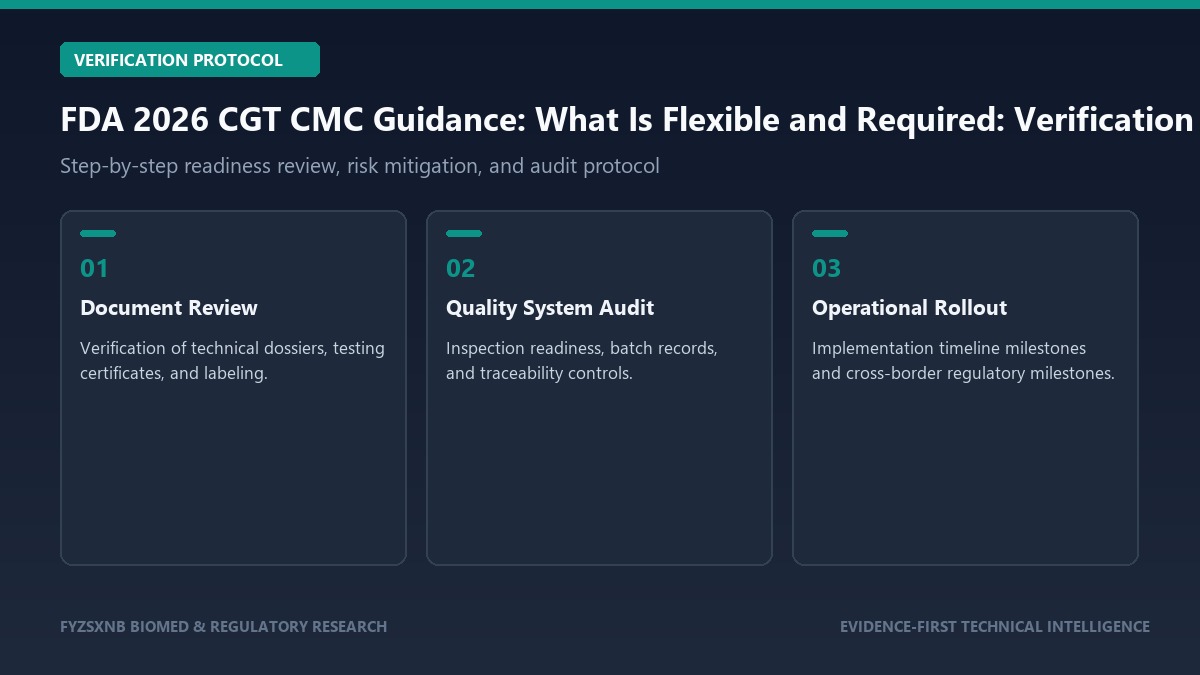
Prior knowledge and platform technology: a tool, not a shortcut
The guidance encourages the use of prior CMC knowledge—from the same sponsor, from public domain, or from sufficiently similar products—to inform a BLA. Platform manufacturing processes and platform analytical procedures that have been used across multiple products may reduce the burden of repeat characterization. For instance, a shared viral vector production platform might allow leveraging existing container‑closure or extractables data.
Nevertheless, the agency retains the right to request product‑specific verification. A platform’s proven track record does not automatically eliminate the need to confirm that the new product does not introduce unforeseen risks. The final word is always product‑specific.
BLA readiness question list
Before submitting a CGT BLA that relies on these flexibilities, sponsors should ask:
- Have we scientifically justified the number of PPQ batches based on process understanding, variability, and controls?
- Does our comparability strategy for any post‑investigational change include a documented risk assessment?
- Are all analytical methods—including any rapid or noncompendial tests—fully validated for the commercial process?
- If we are requesting concurrent release or post‑licensure PPQ completion, have we demonstrated that our constraint is genuine and that patient safety will not be affected?
- Does our stability package, even if bridged or limited‑lot, provide robust support for the proposed shelf life?
- Have we identified every place where we rely on platform or prior knowledge, and are we ready to supply product‑specific verification if asked?
- Do we have a clear regulatory plan for any anticipated post‑approval specification changes, including the correct submission type (PAS, CBE‑30, etc.)?
Common overinterpretations to avoid
“The guidance lets me skip PPQ.”
False. PPQ is still required. The flexibility is about batch number, not the obligation to validate the process.
“Prior knowledge replaces product data.”
Misleading. Platform knowledge reduces certain burdens but does not substitute for the product‑specific demonstration that the licensed product is safe, pure, and potent.
“FDA will accept any number of stability lots.”
Not correct. Stability data must still be adequate; bridging or limited‑lot approaches require robust justification and are not a default.
“Concurrent release is a routine option.”
It is not. FDA may consider concurrent release in constrained cases; sponsors should not assume it is a right or a common outcome.
“Limited comparability is always acceptable.”
Only for low‑risk changes, and only after a thoughtful risk assessment. Higher‑risk changes will demand more extensive comparability.
FAQ: quick answers to sponsor queries
Q: Does the guidance allow a BLA to be submitted without PPQ data?
PPQ data are expected in the BLA, but the guidance allows FDA to consider post-licensure completion of some PPQ activities when production limitations exist. This is a case-specific flexibility, not permission to omit PPQ.
Q: Can I use a platform method without any product‑specific validation?
A sponsor may propose leveraging platform data, but FDA may request product-specific verification when differences could affect method performance. The guidance creates no blanket waiver.
Q: What is the minimum number of PPQ batches?
The guidance does not set a minimum. Sponsors must provide a scientific rationale for whatever number they propose, taking into account process knowledge, complexity, and control.
Q: Are accelerated or stress‑only stability studies acceptable for shelf‑life assignment?
The guidance generally recommends real-time stability data but allows FDA to consider alternative lot strategies and representative clinical-lot or similar-product supporting data. It does not create a blanket acceptance of stress-only data for shelf-life assignment.
Q: Do post‑approval specification changes automatically become CBE‑0?
No. For the post-approval specification changes discussed in this guidance, FDA states that the change must be submitted in a prior approval supplement. The article does not generalize that statement to every other manufacturing change.
Sources and status notes
This article is based on the FDA final guidance “Chemistry, Manufacturing, and Controls Flexibilities for Developing Human Cellular and Gene Therapy Products for a Biologics License Application,” issued May 5, 2026 (Docket FDA‑2026‑D‑4692). It is a nonbinding Level 2 guidance. The content does not constitute legal or regulatory advice, and it does not predict any individual Agency decision. All statements are paraphrased from the guidance, its docket page, or the supporting documents listed below. The 2023 Manufacturing Changes and Comparability guidance remains in draft; references are for context only.
Further reading on FYZSXNB: For broader industry context, see our analysis of China’s pharmaceutical export shifts in 2026 and the Tempus‑Personalis MRD cancer testing collaboration. Visit the China & Global Biomed section for more regulatory explainers and market analysis.