Last checked: August 7, 2026
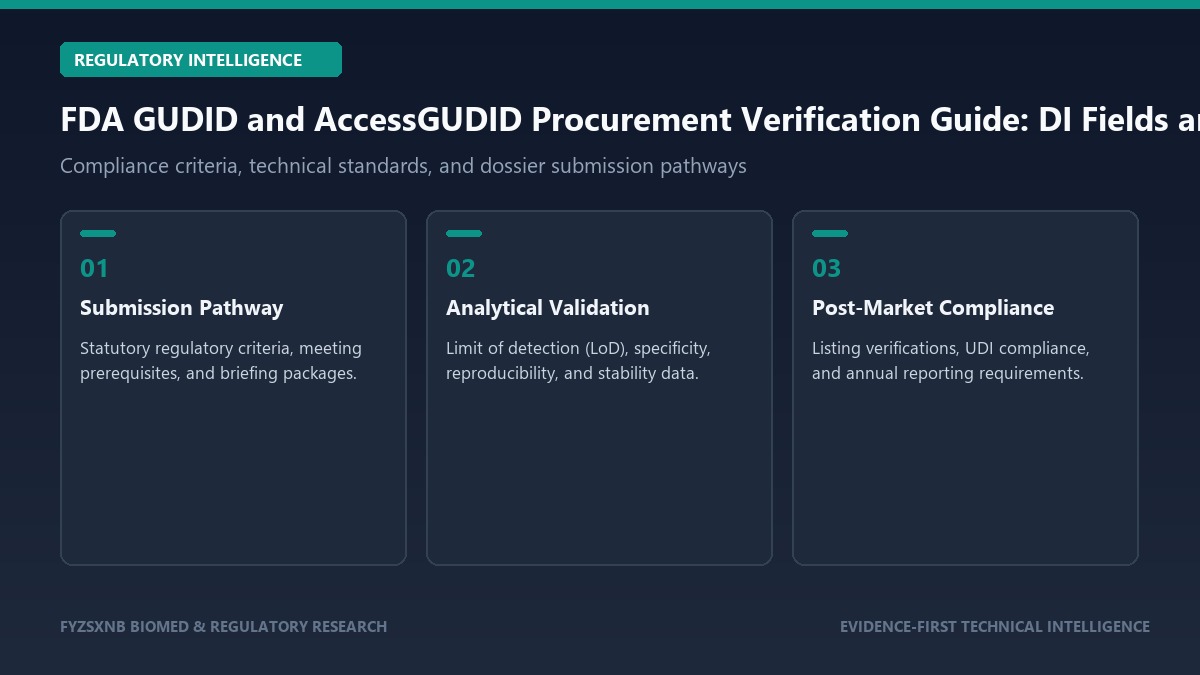
The FDA Global Unique Device Identification Database (GUDID) and its public search portal, AccessGUDID, are valuable tools for verifying medical device identification data during procurement. However, a GUDID entry is a device identification record, not proof of FDA approval, clearance, establishment registration, inspection status, or legal-marketing authorization. This guide teaches a structured procurement verification workflow that uses GUDID for what it is — an FDA-administered device identifier (DI) reference catalog — and explains how to independently cross-check premarket authorization through the appropriate FDA databases.
1. What GUDID Is: FDA-Administered DI Reference Catalog Under 21 CFR Part 830
The Global Unique Device Identification Database (GUDID) is the FDA-administered repository for device identification data submitted under 21 CFR Part 830. It serves as a reference catalog for the Device Identifier (DI) portion of the Unique Device Identifier (UDI) system. The DI identifies the specific version or model of a device and the labeler responsible for it.
Key characteristics of GUDID that procurement teams must understand:
- Identification, not authorization. GUDID stores device identification attributes submitted by labelers. The presence of a device in GUDID means the labeler has submitted required identification data; it does not mean the device has received FDA premarket authorization.
- Self-reported data. The information in GUDID is submitted by the device labeler. FDA does not independently verify the accuracy of every field before the record appears in the public database.
- DI portion only. GUDID contains the DI portion of the UDI, not the full UDI (which also includes a production identifier such as lot number, serial number, or expiration date).
FDA describes GUDID as a device-identification reference catalog, while its separate consumer guidance explains that registration and listing do not constitute approval, clearance, or authorization. Together, those sources establish a critical procurement boundary: a GUDID record identifies a device, but authorization must be verified in the appropriate FDA database.
2. AccessGUDID: Public Search Tool and Available Fields
AccessGUDID, hosted by the National Library of Medicine at accessgudid.nlm.nih.gov, is the public search interface for GUDID. It allows anyone — including procurement teams, healthcare providers, and patients — to search for device records by DI, device name, labeler name, or other identifying attributes.
When searching AccessGUDID, the following fields may appear in a device record. The word may is deliberate: not every record contains every field. Field availability depends on what the labeler has submitted and what is applicable to the specific device:
| Field | What It Tells You | Procurement Use |
|---|---|---|
| Primary DI | The device identifier code (may be a GTIN or HIBCC code) | Primary lookup key; confirms device identity in the catalog |
| Labeler Name | The name of the company that submitted the record | Identifies the responsible labeler; cross-check against establishment registration |
| Commercial Distribution Status | Whether the device is currently in commercial distribution | Flags devices no longer on the market; does not confirm authorization |
| Version/Model Number | The specific version or model of the device | Confirms the exact product being procured matches the catalog record |
| FDA Product Code | The classification code assigned to the device type | Useful for determining device classification and applicable regulatory requirements |
| Premarket Submission Number | Where present, a reference to premarket submission data | Must be independently verified in FDA CDRH premarket databases; presence in GUDID is not proof of authorization |
It is important to note that not all of these fields are populated in every record. A premarket submission number, in particular, may be present for some devices and absent for others. The absence of this field does not necessarily mean the device lacks premarket authorization, just as its presence does not confirm authorization. Both situations require independent verification.
What GUDID Does Not Include
GUDID is not an establishment registration database. It does not contain Facility Establishment Identifier (FEI) numbers, inspection records, or current Good Manufacturing Practice (GMP) compliance status. These are maintained in separate FDA systems. Similarly, GUDID does not provide quality certification, adverse event histories, or recall information. Procurement teams must consult the appropriate FDA databases for these data points.
3. Step-by-Step Procurement Verification Workflow
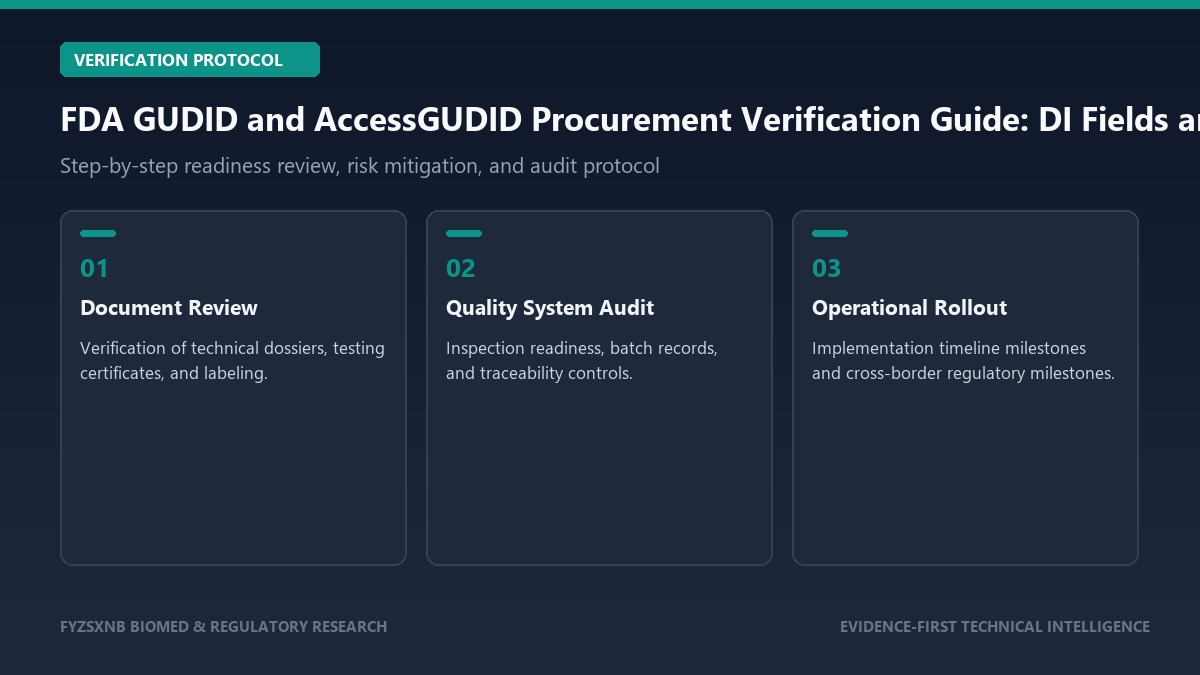
The following five-step workflow uses GUDID for device identification and independently verifies premarket authorization through the appropriate FDA channels:
Step 1: Look Up the Device in AccessGUDID
Search by Primary DI, device name, or labeler name in AccessGUDID. Confirm that a record exists and that the device name, version/model number, and labeler match the product being procured. If no record exists, the device may not be in commercial distribution in the United States, or the labeler may not have fulfilled UDI submission requirements.
Step 2: Record Key Identification Fields
From the GUDID record, capture the Primary DI, labeler name, FDA product code, and commercial distribution status. These fields establish the device identity baseline for subsequent cross-checks. Note which fields are present and which are absent — missing fields are not necessarily red flags, but they define what additional verification steps are needed.
Step 3: Verify Premarket Authorization Independently
If a premarket submission number appears in the GUDID record, use it to search the relevant FDA CDRH premarket database. If no premarket submission number appears, determine the device’s classification using the FDA product code, then identify whether the device requires premarket authorization and which database to search. The presence of a premarket submission number in GUDID is a reference field, not proof of authorization; the actual authorization record must be found in the corresponding FDA database.
Devices are classified into different regulatory categories, and not all devices require the same type of premarket authorization. Consult the FDA UDI Basics page and FDA classification databases to determine the applicable requirements for the specific device being procured.
Step 4: Verify Establishment Registration
Separately verify that the labeler (manufacturer or importer) has a current FDA establishment registration. Establishment registration is maintained in the FDA registration and listing database, not in GUDID. A current establishment registration confirms that the facility has registered with FDA as required under 21 CFR Part 807; it does not certify product quality or approve any specific device.
For the separate checks, use the site’s FDA establishment registration verification guide and FDA labeler code checklist for foreign companies. These are companion workflows, not substitutes for the live FDA records.
Step 5: Document the Verification Chain
Record the GUDID record details, premarket database search results, and establishment registration status in a procurement verification file. This documentation creates an auditable trail that separates device identification (from GUDID) from premarket authorization (from CDRH databases) and establishment registration (from the registration database).
4. Procurement Red Flags: Common Misinterpretations of GUDID
Understanding what GUDID is not is as important as understanding what it is. The following table summarizes common misinterpretations that can lead to procurement failures:
| Misinterpretation | Correct Understanding |
|---|---|
| A GUDID entry proves the device is FDA-approved or cleared | GUDID is an identification catalog; premarket authorization must be verified in FDA CDRH databases |
| A GUDID entry confirms establishment registration compliance | Establishment registration is a separate process under 21 CFR Part 807; GUDID does not contain registration status |
| A premarket submission number in GUDID means the device has active premarket authorization | The number is a reference field; the actual authorization status must be confirmed in the corresponding FDA database |
| A GUDID entry certifies product quality or GMP compliance | GUDID does not contain quality certification, inspection records, or GMP compliance data |
| Every GUDID record contains the same set of fields | Field availability varies by device and labeler submission; not every record contains every field |
The FDA provides clear guidance on the distinction between database listings and actual authorization. The FDA consumer page on registered vs. approved devices explicitly states that registration and listing do not constitute FDA approval or clearance. This same principle applies to GUDID: data submission into the catalog is a labeling and identification requirement, not an authorization determination.
5. Limitations and What GUDID Does Not Cover
Procurement teams should be aware of the following limitations when using GUDID:
- No quality data. GUDID does not contain quality system audit results, GMP compliance records, or post-market surveillance data.
- No inspection records. Facility inspection outcomes are maintained separately by FDA and are not part of the GUDID record.
- No adverse event data. Medical device reports (MDR) and adverse event histories are in the MAUDE database, not GUDID.
- No recall information. Device recalls are tracked in the FDA recall database, not in GUDID.
- Self-reported by labelers. The accuracy of GUDID data depends on labeler submissions. FDA does not pre-verify every field before publication.
These limitations reinforce the principle that GUDID is one tool in a multi-database procurement verification workflow. It answers the question “what device is this and who labels it?” but does not answer “is this device authorized for marketing?” or “does the manufacturer meet quality system requirements?”
6. Conclusions
GUDID and AccessGUDID are essential reference tools for medical device procurement verification, but they are identification catalogs, not authorization records. A GUDID entry confirms that a labeler has submitted device identification data as required under 21 CFR Part 830; it does not confirm FDA approval, clearance, establishment registration, inspection status, or quality certification. Procurement teams should use GUDID for device identification and independently verify premarket authorization, establishment registration, and quality compliance through the appropriate FDA databases. By maintaining this separation, procurement teams can avoid the common trap of treating a GUDID listing as proof of regulatory authorization.
Sources and References
- FDA — Global Unique Device Identification Database (GUDID) — Official overview of GUDID under 21 CFR Part 830. Accessed August 7, 2026.
- NLM AccessGUDID — AccessGUDID public search portal — Public interface for searching GUDID device records. Accessed August 7, 2026.
- FDA — UDI Basics — Overview of UDI system, DI, and PI components. Accessed August 7, 2026.
- FDA — Are There FDA-Registered or FDA-Certified Medical Devices? — FDA guidance on the distinction between registration/listing and approval. Accessed August 7, 2026.