h2 class=”wp-block-heading”>Best Budget Robot Vacuum in 2026: A Durable Buyer’s Framework
The promise of a robot vacuum is simple: clean floors without the labor. A Reddit thread in r/BuyItForLife reveals the reality. Shoppers worry about cheap models breaking within a year, replacement parts disappearing, and apps collecting location data. This guide turns those concerns into a durable buying framework for 2026.
What the Reddit Community Gets Wrong About Budget Robot Vacuums
Many buyers focus only on suction power and price. Durability, part availability, and software longevity matter more over a three-year ownership period. A CAD $250 robot vacuum that lasts 18 months and cannot be repaired costs more per month than a CAD $400 unit that runs for five years with replacement brushes.
The Real Cost of Ownership: Maintenance and Parts
Budget robot vacuums need regular maintenance. Side brushes, main brushes, filters, and mop pads wear out. Some brands lock replacement parts behind proprietary subscriptions or regional restrictions. Before buying, check whether brushes and filters are sold individually on Amazon Canada or through the manufacturer’s domestic store.
| Part | Replacement Interval | Approximate Annual Cost (CAD) | Availability Risk |
|---|---|---|---|
| Side brushes (pair) | 3-6 months | $15-25 | Low for major brands |
| Main brush / roller | 6-12 months | $20-35 | Medium for off-brands |
| HEPA filter | 2-3 months | $15-30 | High if proprietary |
| Mop pads / plates | 3-6 months | $20-40 | Medium |
| Battery | 2-3 years | $40-80 | High for discontinued models |
Mapping, Navigation, and the Pet Hair Problem
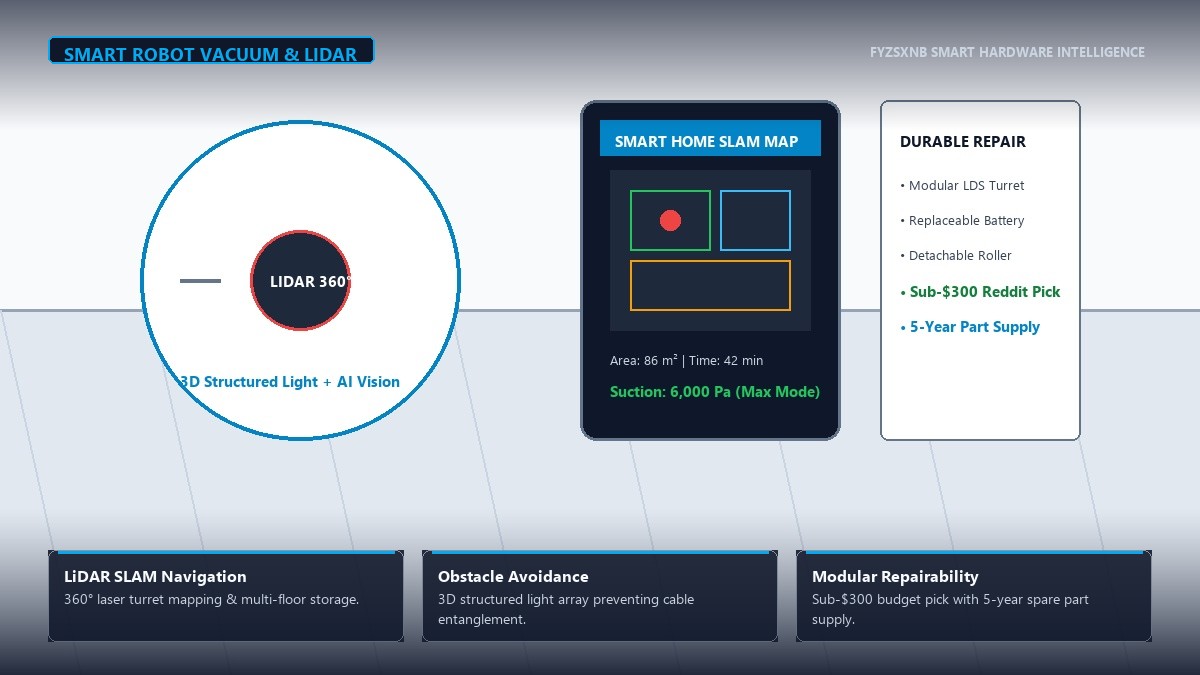
Random-bounce navigation belongs in the past. In 2026, even budget models should offer LiDAR or gyroscopic mapping. LiDAR creates accurate room maps, lets you set no-go zones, and reduces cleaning time. Gyroscopic systems are cheaper but less precise and struggle in complex floor plans.
Pet hair is the make-or-break test. Long hair wraps around brush rollers and clogs suction inlets. Look for anti-tangle roller designs or rubber-fin brushes that resist wrapping. If you have multiple shedding pets, prioritize strong suction (measured in Pascals, Pa) over mopping features.
| Feature | Budget Tier (<CAD 300) | Mid Tier (CAD 300-500) |
|---|---|---|
| Navigation | Gyroscopic or basic LiDAR | LiDAR + obstacle avoidance |
| Mapping | Basic room division | Multi-floor, no-go zones |
| Pet hair handling | Standard brush roller | Anti-tangle rubber roller |
| Self-empty dock | Rare | Optional add-on |
| Mopping | Basic damp cloth | Vibrating or rotating mop |
Thresholds, Rugs, and When Your Home Is Not Robot-Ready
Robot vacuums struggle with transitions higher than 15-20 mm. Thick shag rugs, loose cables, and cluttered floors trap or tangle most budget units. Measure the tallest threshold in your home before buying. If you have floor-to-ceiling curtains that pool on the ground, expect entanglement.
Dark-colored high-pile carpets confuse cliff sensors, causing some models to avoid the area entirely. If your home has many of these obstacles, a stick vacuum may be the better investment.
Privacy, App Risk, and Data Handling
Most robot vacuums require a smartphone app for setup, scheduling, and firmware updates. Those apps request Wi-Fi credentials, home layout data, and sometimes camera feeds. In 2026, several manufacturers faced scrutiny for storing floor-plan data on overseas servers or sharing it with third-party analytics firms.
Check the manufacturer’s privacy policy for data-retention periods and opt-out options. Brands that support local-only operation or Matter-over-Thread connectivity reduce cloud exposure. If privacy is a top concern, avoid models with onboard cameras unless the manufacturer offers explicit local storage.
When Not to Buy a Robot Vacuum
Skip the purchase if your home has frequent small obstacles (children’s toys, pet bowls, loose shoes), transitions over 20 mm on every doorway, or if you expect hands-free deep cleaning. Robot vacuums maintain cleanliness; they do not replace periodic deep cleans with a traditional vacuum.
If your budget is under CAD $200, the available models often lack reliable mapping and replacement parts. Save for a higher tier or buy a quality cordless stick vacuum instead.
FAQ
How long should a budget robot vacuum last?
With proper maintenance, three to five years. Battery degradation is usually the first failure point. Replaceable batteries extend useful life significantly.
Do I need a self-emptying dock?
It is convenient but not essential. Manual emptying every two to three cleans is normal for budget models. Self-empty docks add CAD $150-250 to the total cost.
Can a budget robot vacuum handle long human hair?
Most struggle. Hair wraps around brush rollers and requires weekly cutting or detangling. Rubber-fin rollers handle hair better than bristle brushes but are more common above the CAD $300 mark.
Are robot vacuum apps safe to use?
They carry privacy risks. Use a separate guest Wi-Fi network if possible. Review the app’s permissions and disable analytics sharing if the settings allow it.
References
Sources used in this framework: