Winterizing Chinese EVs in Russia: Extreme Cold Battery Preheating, Heat Pump Performance at -35°C, and Aftermarket Supply Chains
01 The Arctic Operating Window: Why Russian Winters Break Standard EV Assumptions
In Russia’s automotive market, Chinese new energy vehicles (NEVs)—encompassing pure electric vehicles (BEVs) and extended-range/plug-in hybrids (EREVs/PHEVs) from brands such as Zeekr, Li Auto (Lixiang), Voyah, BYD, and Avatr—have captured over 65% of imported passenger car sales.
However, winter operations across Moscow, Saint Petersburg, the Urals, and Siberia present an extreme thermodynamic challenge fundamentally distinct from the temperate climate zones (such as Shanghai, Guangzhou, or Shenzhen) where standard domestic calibrations originate. When ambient temperatures plummet between -15°C and -35°C, an electric vehicle is no longer merely a transportation device; it becomes a mobile thermal equilibrium battleground.
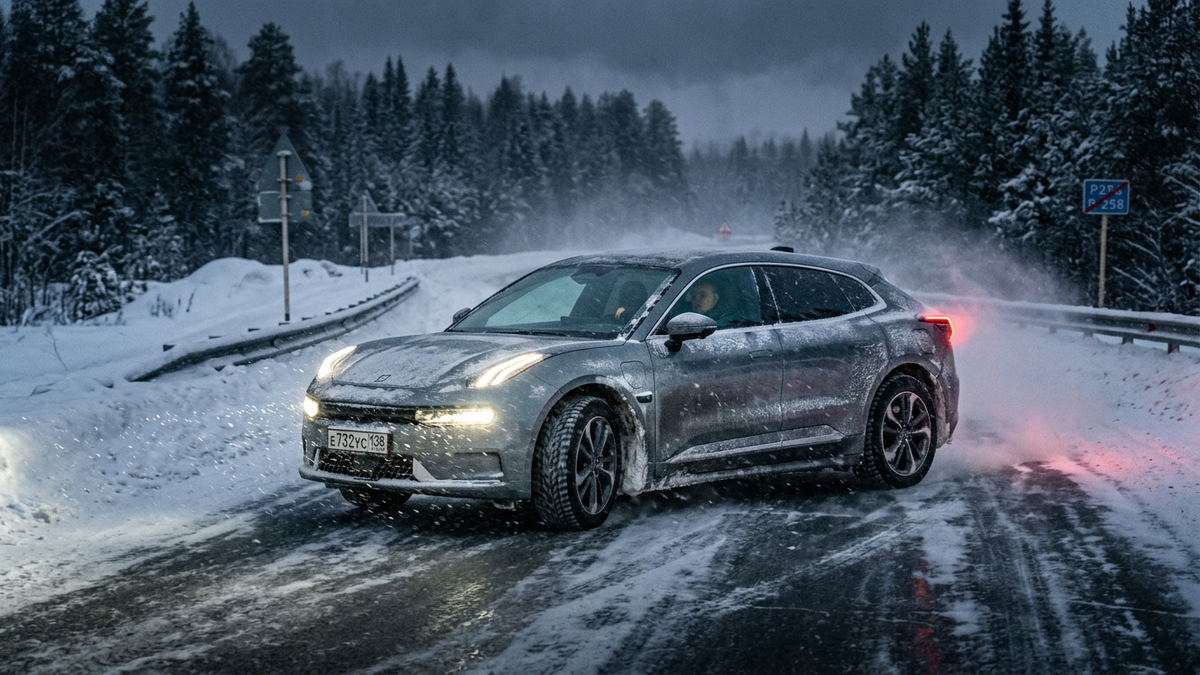
Figure 1: Documentary photograph of a premium Chinese electric crossover (Zeekr 001) operating in severe sub-zero blizzard conditions outside Moscow, demonstrating exterior thermal preservation and LED matrix visibility (FYZSXNB Tier V4 Industrial Asset).
02 Battery Electrochemistry at Sub-Zero: LFP vs NCM Kinematics
The primary concern among Russian EV owners is winter driving range degradation. To diagnose this loss accurately, automotive engineers must separate reversible electrochemical suppression from parasitic auxiliary heating loads.
┌────────────────────────────────────────────────────────────────────────────────────────┐
│                   COLD-CLIMATE ELECTROCHEMICAL KINETICS (< -20°C)                       │
├────────────────────────────────────────────────────────────────────────────────────────┤
│                                                                                        │
│   [ELECTROLYTE VISCOSITY SURGE]                                                        │
│   • Organic carbonate solvents thicken exponentially as temperatures approach -25°C    │
│   • Lithium-ion (Li+) desolvation energy barriers increase drastically at SEI layer    │
│                                                                                        │
│   [INTERNAL IMPEDANCE ELEVATION]                                                       │
│   • Bulk cell internal resistance (R_i) spikes by 300% to 520%                         │
│   • Severe Ohmic voltage drop (IR drop) causes BMS to reach cutoff voltage prematurely │
│                                                                                        │
│   [CHEMISTRY DISPARITY: LFP vs NCM TERNARY]                                            │
│   • NCM (Nickel-Cobalt-Manganese): High cold open-circuit voltage; retains 60–70%      │
│     inherent chemical capacity at -20°C before heating                                 │
│   • LFP (Lithium Iron Phosphate): Steep voltage plateau collapse; retains only 42–52%  │
│     inherent chemical capacity at -20°C without active continuous thermal injection    │
│                                                                                        │
│   [METALLIC LITHIUM PLATING HAZARD]                                                    │
│   • Attempting DC high-current fast charging when cell core is < +5°C leads to solid   │
│     metallic lithium dendrites on graphite anodes, risking internal micro-shorts       │
│                                                                                        │
└────────────────────────────────────────────────────────────────────────────────────────┘
2.1 Field Range Degradation Realities
Extensive winter proving ground telemetry (conducted at Heihe and Hulunbuir test tracks at -30°C to -38°C) reveals that with cabin climate control maintained at +22°C:
- NCM 811 / 622 Packs (e.g., Zeekr 001 100kWh, Voyah Free): Real-world highway range drops to 48%–58% of their nominal CLTC ratings (delivering ~310–380 km actual range from a nominal 650–700 km spec).
- LFP Blade / Prismatic Packs (e.g., BYD Han EV, entry-level Changan Deepal): Real-world range drops to 38%–46% of CLTC if parked outside overnight without an active grid preconditioning connection.
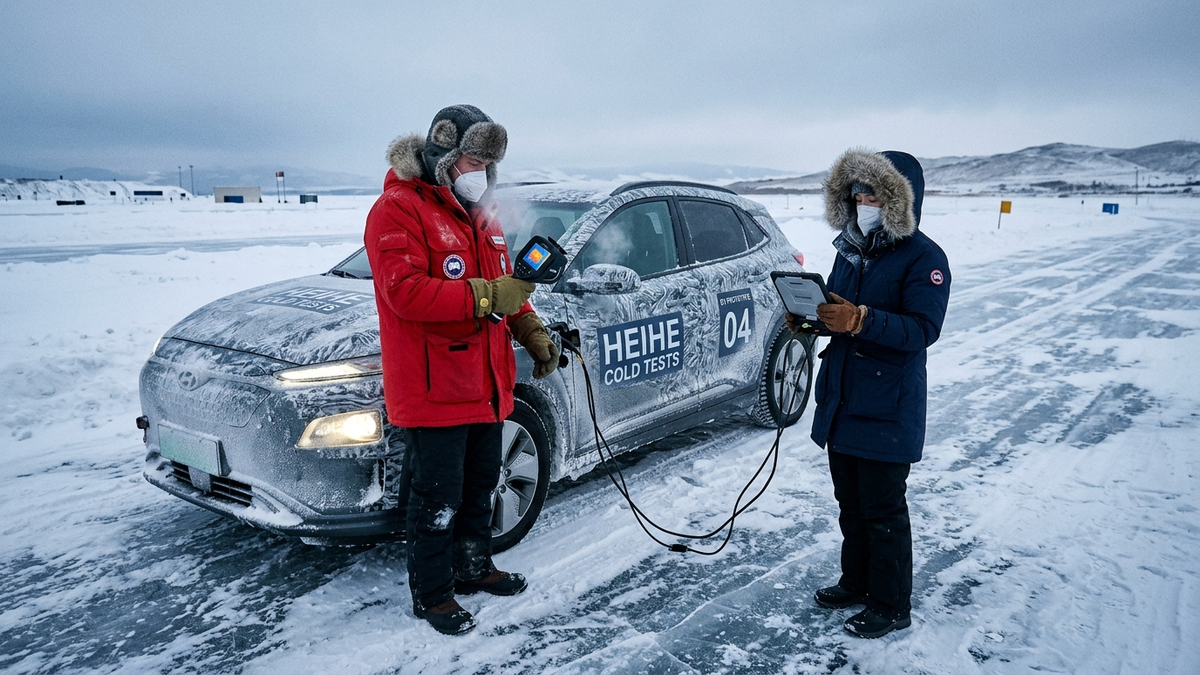
Figure 2: Test engineers conducting thermal gradient scans with FLIR cameras on an all-wheel-drive EV chassis during high-speed frozen lake handling trials, verifying bottom pack insulation integrity.
03 Thermal Architecture Teardown: Broad-Temperature Heat Pumps vs High-Voltage PTC
Cabin heating represents the single largest consumer of auxiliary electrical power in sub-zero climates, drawing anywhere from 3 kW to 8 kW of continuous power.
| Heating Architecture Component | Operating Principle | COP at -10°C | COP at -25°C | Average Power Draw (Steady Cabin 22°C) | Impact on Range per 100km |
|---|---|---|---|---|---|
| High-Voltage PTC Ceramic Heater | Pure electrical resistance heating (Joule effect) | 0.95–0.98 | 0.95–0.98 | 5.5–7.5 kW continuous | Consumes 9–14 kWh/100km (Severely reduces range by 25–35%) |
| Standard R134a Heat Pump | Refrigerant vapor compression cycle | 1.8–2.2 | 0.98–1.1 (Compressor cuts out, falls back to PTC) | 3.5–5.0 kW mixed | Consumes 6–8 kWh/100km (Moderate winter savings) |
| Broad-Temperature Heat Pump (R1234yf / CO2 with EVI) | Enthalpy vapor injection (EVI) scroll compressor + waste heat recovery | 2.4–2.9 | 1.5–1.85 | 2.2–3.4 kW | Consumes 3.8–5.5 kWh/100km (Preserves up to 60–90 km extra range) |
3.1 Motor Waste Heat Harvesting
Second-generation integrated thermal platforms (such as Zeekr's SEA architecture and BYD's e-Platform 3.0 Evo) utilize multi-way proportional valves to scavenge stator and inverter waste heat. Even at 100 km/h in -25°C blizzard conditions, the electric drive system generates 1.2 kW to 2.5 kW of thermal energy. By piping this heat directly into the battery liquid circuit via brazed plate exchangers rather than dissipating it through the front radiator, modern Chinese EVs maintain battery cell temperatures above +12°C with minimal battery drain.
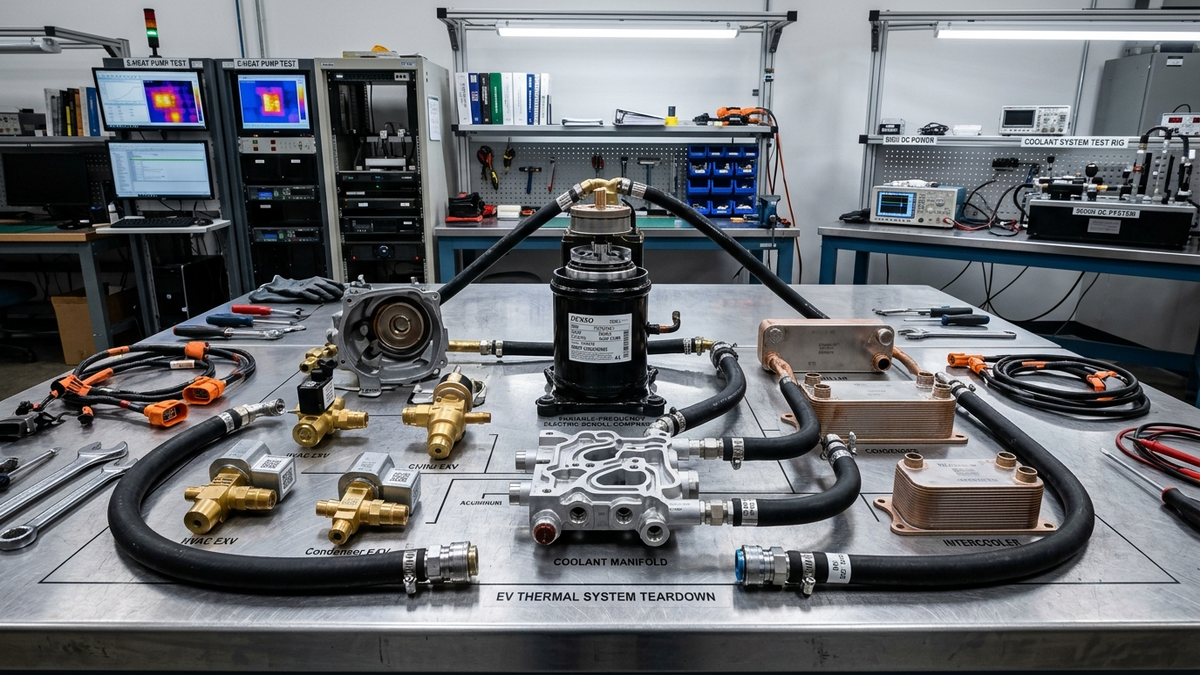
Figure 3: Hardware teardown of a third-generation integrated broad-temperature heat pump assembly on an engineering workbench, highlighting the 800V variable-frequency scroll compressor and high-precision electronic expansion valves.
04 Chassis Armor and Corrosion Defense Against Municipal Road Reagents
A severe operational failure point specific to Russian winter driving is the chemical aggression of municipal snow-melting chemicals, predominantly "Bionord" (a granular cocktail of sodium chloride, calcium chloride, and formic acid inhibitors).
4.1 The Essential "Antikor" (Антикор) Protocol
For parallel-imported vehicles ("grey market" cars lacking factory Nordic/Arctic cold-weather packages), Russian professional EV specialty centers mandate an immediate multi-stage anti-corrosion treatment:
- Battery Armor Disassembly & Cleaning: Removal of plastic aerodynamic belly pans to inspect factory e-coat integrity.
- Zinc-Rich Primer Application: Re-coating all exposed high-tensile steel mounting studs and suspension knuckles.
- Elastic Bitumen-Wax Barrier: Spray application of high-durability wax (Dinitrol / Tectyl) across the structural aluminum battery casing to prevent stone-chip impingement and electrolyte seal degradation.
- Cavity Wax Injection: Treating hollow rocker panels and suspension subframes with penetrating anti-rust compounds.
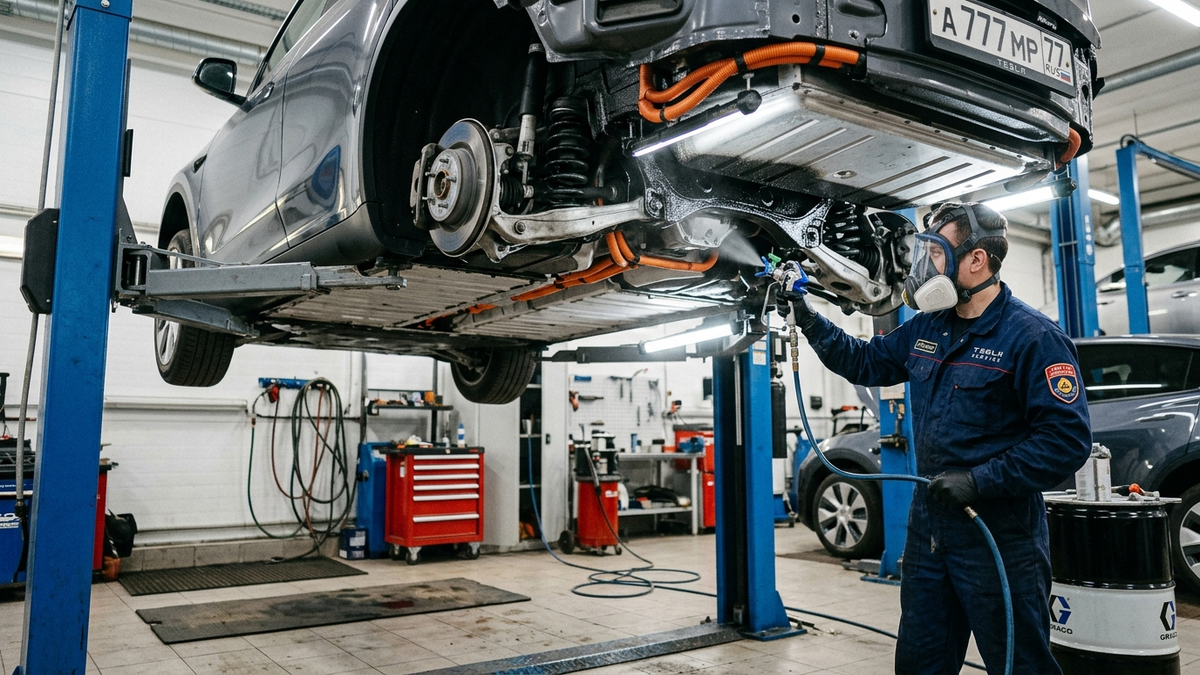
Figure 4: Specialized service technician on a two-post hydraulic lift applying protective anti-corrosive wax barrier coatings to an EV battery underbody tray, preventing salt brine intrusion and structural oxidation.
05 Public Charging Hardware: The GB/T to CCS2 / Type 2 Reality
All Chinese domestic electric vehicles utilize China's national GB/T 20234 charging standard (featuring separate AC slow-charge and DC fast-charge ports). In Russia, the public fast-charging infrastructure (operated by Rosseti, Sitronics, Punk E, and 2Chargers) predominantly features European CCS Combo 2 (CCS2) and Japanese CHAdeMO plugs.
5.1 Managing High-Power DC Charging Adapters at -30°C
Russian EV drivers rely heavily on external DC adapters (such as FastWay, ENERGETIX, or OEM units rated at 150 kW to 250 kW). In extreme freeze conditions, this interface introduces critical failure modes:
- Contact Resistance Spikes: Ice or condensation inside the GB/T female connector creates elevated electrical contact resistance. At 200A charging currents, this causes localized thermal heating, prompting the charger's temperature sensors to trigger emergency shutdowns.
- Insulation Resistance Faults (Изоляция батареи): Road brine slush dripping into the charging port causes the vehicle's onboard insulation monitoring device (IMD) to detect leakage currents below the mandatory 100 Ω/V threshold, locking out DC charging entirely until the port is thawed and dried.
- Frozen Port Flap Locks: Motorized push-to-open charging door actuators freeze solid after car washes; retrofitting silicone moisture seals is mandatory.
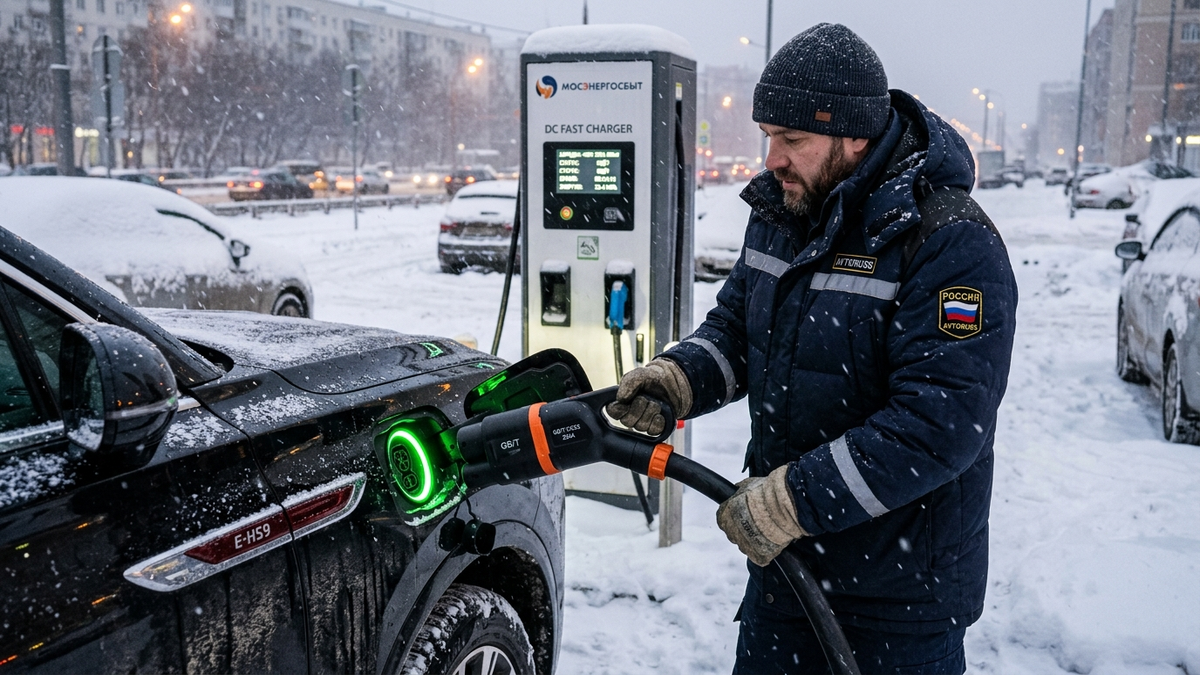
Figure 5: Field documentary photograph of a high-power DC charging session during a heavy snowstorm, showing the heavy-duty CCS2-to-GB/T conversion adapter and weather-sealed cable connection.
06 Telematics, Digital Cockpit Russification, and Aftermarket Supply Chains
Operating a smart electric vehicle in Russia requires software localization alongside mechanical hardening.
6.1 Telematics Connectivity and Remote Preconditioning
The ability to schedule battery and cabin preheating 20 minutes before departure while connected to a 220V/380V home wallbox preserves up to 18% of total driving range. However, parallel-imported Chinese vehicles rely on Chinese telecom eSIMs (China Mobile/Unicom) that lack international roaming in Russia. Specialized Moscow and Saint Petersburg engineering centers physically solder local Russian nano-SIM slots onto the vehicle's telematics control unit (T-Box) and install modified software certificates to re-enable mobile app control.
6.2 Spare Parts Availability and Winter Collision Logistics
Russian insurance claims data indicates that winter collision repairs for Chinese EVs present distinct supply chain profiles:
- Suspension Components (Air Springs & Dampers): Rapid wear of rubber air suspension bladders below -30°C has led independent distributors to stock aftermarket polyurethane replacement bladders with 2–4 day local delivery.
- Exterior Body Panels and Matrix Headlights: High-tech components (such as lidar units and adaptive laser headlights) frequently require 3 to 6 weeks for express air/rail delivery from Shenzhen or Ningbo distribution warehouses.
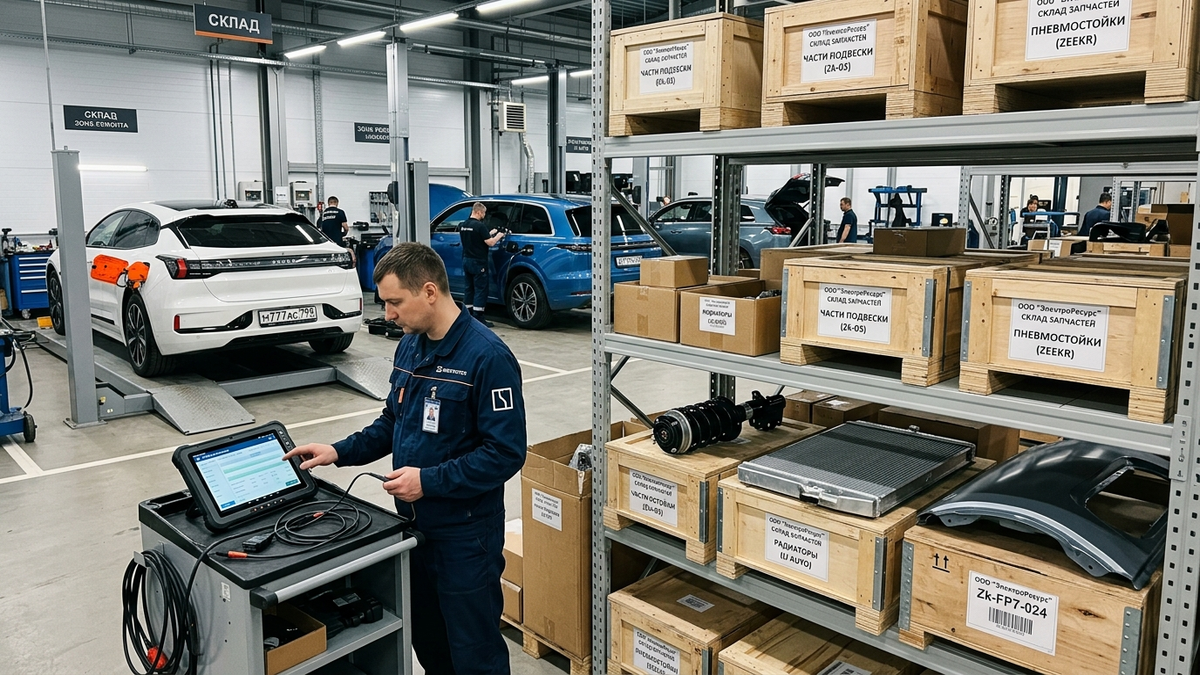
Figure 6: Operational service facility specialized in Chinese new energy vehicles, showing battery health diagnostic terminals, air suspension replacement inventory, and body repair logistics bays.
07 Buyer Due Diligence & Winter Preparation Checklist
For fleet managers and private buyers acquiring Chinese electric vehicles for cold-climate Russian operations, FYZSXNB recommends the following five-point commissioning checklist:
- Prefer NCM Chemistry for Sub -25°C Northern Zones: If regular outdoor parking without constant grid connection is unavoidable, select ternary lithium packs with active pulse self-heating.
- Verify Heat Pump Specification (EVI / CO2): Ensure the vehicle is equipped with a broad-temperature heat pump rather than a pure PTC resistance element.
- Execute Professional Underbody Anti-Rust Treatment (Антикор): Apply zinc primers and bitumen-wax protective films prior to the first snowfall.
- Invest in a Certified 250A DC Charging Adapter: Avoid unbranded adapters; choose models with integrated temperature monitoring and IP67 weather seals.
- Implement T-Box Telematics Adaptation: Install local SIM hardware to guarantee remote cabin preheating and battery thermal preparation via smartphone.
08 Related High-Tech Automotive Engineering Dossiers
Continue exploring FYZSXNB's verified technical investigations into advanced clean tech supply chains:
- BYD Blade Battery 2.0 & Commercial Vehicle Tech Teardown — In-depth cell safety, pulse heating, and thermal runaway prevention.
- China's Autonomous Driving Chips: NIO, XPENG & BYD Silicon Architecture — Automotive-grade microcontrollers and domain controllers under temperature stress.
- China-Russia Cross-Border Trade Payments in 2026: VTB Shanghai and Settlement Due Diligence — How automotive importers execute secure component payments.