China-Russia Cross-Border Trade Payments in 2026: VTB Shanghai, Direct Ruble/Yuan Settlement, and Due Diligence Guide
01 The 2026 Clearing Bottleneck: Secondary Sanctions and Bank De-Risking
Following the continuous expansion of US secondary sanctions enforcement (notably under Executive Order 14114 and subsequent regulatory updates), the payment clearing ecosystem between China and Russia underwent a tectonic shift throughout 2024–2026.
China’s Tier-1 state-owned commercial banks—the “Big Four” consisting of Industrial and Commercial Bank of China (ICBC), China Construction Bank (CCB), Bank of China (BOC), and Agricultural Bank of China (ABC)—as well as joint-stock commercial lenders with extensive international dollar clearing franchises (such as China Merchants Bank, Ping An Bank, and CITIC Bank), have implemented ultra-strict compliance filters. Today, more than 95% of cross-border payment orders originating directly from Russian entities or bearing Russian-linked trade documentation are systematically queried, held for 30–90 days in compliance review, or rejected outright.
This operational reality does not stem from bilateral Chinese policy bans—trade in civilian commodities between China and Russia remains fully legal and encouraged—but from global banks’ calculated commercial risk management to protect their multi-trillion dollar clearing channels via US CHIPS and European TARGET2 networks.
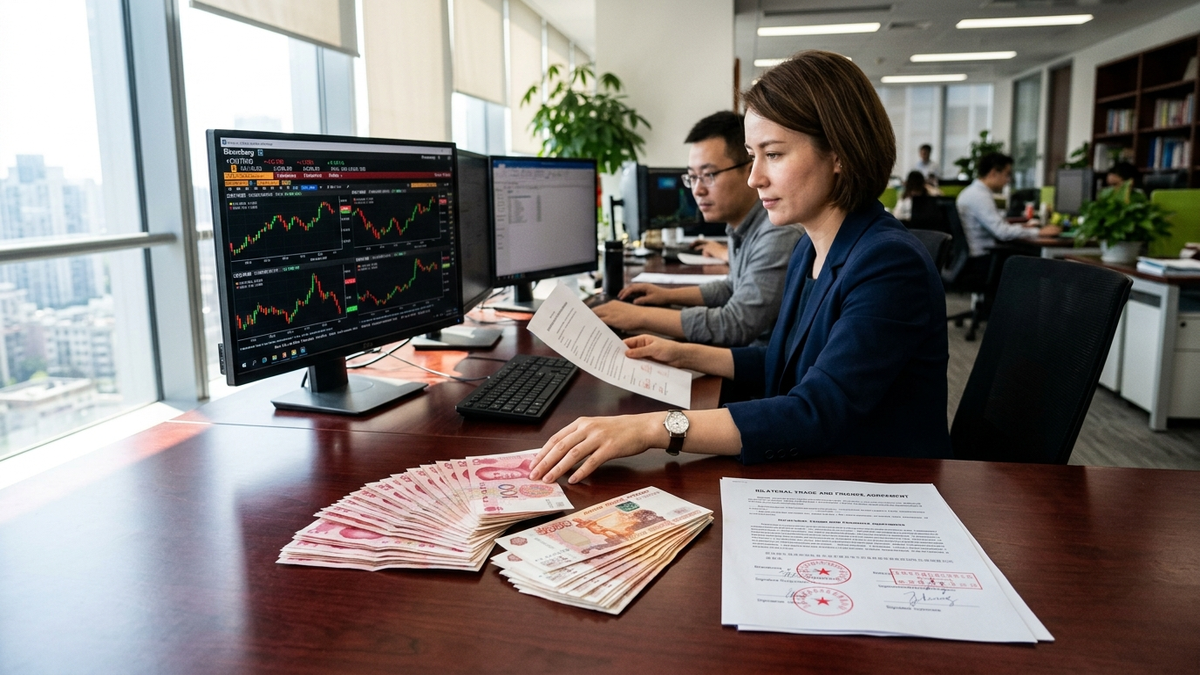
Figure 1: Authentic documentary photograph of an international trade finance desk featuring Chinese Yuan (CNY) and Russian Ruble (RUB) currency reserves, a legally executed bilateral supply contract with red corporate chops, and real-time interbank currency exchange monitors (FYZSXNB Tier V4 Industrial Asset).
02 Direct Settlement Channel 1: VTB Bank Shanghai Branch
In this transformed environment, VTB Bank (Shanghai Branch) has emerged as the most critical financial bridgehead for legitimate bilateral commerce. As the sole Russian commercial bank holding a full foreign bank branch license issued by the People’s Bank of China (PBOC) and the National Financial Regulatory Administration (NFRA), VTB Shanghai operates directly inside Mainland China’s financial jurisdiction.
┌────────────────────────────────────────────────────────────────────────────────────────┐
│                   VTB SHANGHAI CLEARING ARCHITECTURE (2026)                            │
├────────────────────────────────────────────────────────────────────────────────────────┤
│                                                                                        │
│   [RUSSIAN IMPORTER]                                                                   │
│   • Holds primary corporate account at VTB PJSC (Moscow / Regional Branches)           │
│   • Initiates transfer in Russian Rubles (RUB) or Offshore Yuan (CNH)                  │
│                                      │                                                 │
│                                      ▼                                                 │
│   [INTERNAL BOOK-TRANSFER ("ВНУТРИБАНК")] ◄─── Zero Western Intermediaries            │
│   • Pure internal balance ledger entry between VTB PJSC and VTB Shanghai Branch        │
│   • Bypasses SWIFT messaging entirely; insulated from OFAC secondary interception      │
│                                      │                                                 │
│                                      ▼                                                 │
│   [VTB BANK SHANGHAI BRANCH]                                                           │
│   • Converts RUB to Onshore RMB (CNY) via authorized interbank foreign exchange desk   │
│   • Credits recipient account directly in Shanghai                                     │
│                                      │                                                 │
│                                      ▼                                                 │
│   [CHINESE EXPORTER (FACTORY)]                                                         │
│   • Must maintain active corporate non-resident / resident account at VTB Shanghai     │
│   • Submits China Customs Declaration (CCD / 报关单) to clear SAFE foreign exchange   │
│                                                                                        │
└────────────────────────────────────────────────────────────────────────────────────────┘
2.1 The “Internal Book Transfer” Mechanism
The definitive advantage of the VTB Shanghai channel lies in its legal and computational architecture: funds transferred between a Russian corporate account at VTB in Moscow and a Chinese corporate account at VTB in Shanghai constitute an internal balance sheet transfer (“внутрибанковский перевод”). Because this transaction is recorded within the ledger of a single consolidated banking institution, it never enters external Western messaging protocols or clearinghouses, providing near-total insulation from unilateral third-party asset freezes.
2.2 Practical Bottlenecks and Account Opening Requirements
While structurally robust, the VTB Shanghai channel presents significant operational bottlenecks that buyers and sellers must budget for:
- Account Opening Queue: Due to overwhelming demand, Chinese factories and export trading corporations face a compliance review queue typically ranging from 4 to 12 weeks to obtain a verified corporate CNY/RUB account.
- Counterparty Requirement: Both the Russian buyer and the Chinese supplier must hold verified accounts within the VTB network for instantaneous internal ledger settlement.
- Maintenance Fees and Exchange Spreads: While wire fees are competitive, corporate account maintenance fees and currency conversion spreads between RUB and CNY at the branch level typically run between 1.5% and 2.8%, requiring precise contractual cost allocation.
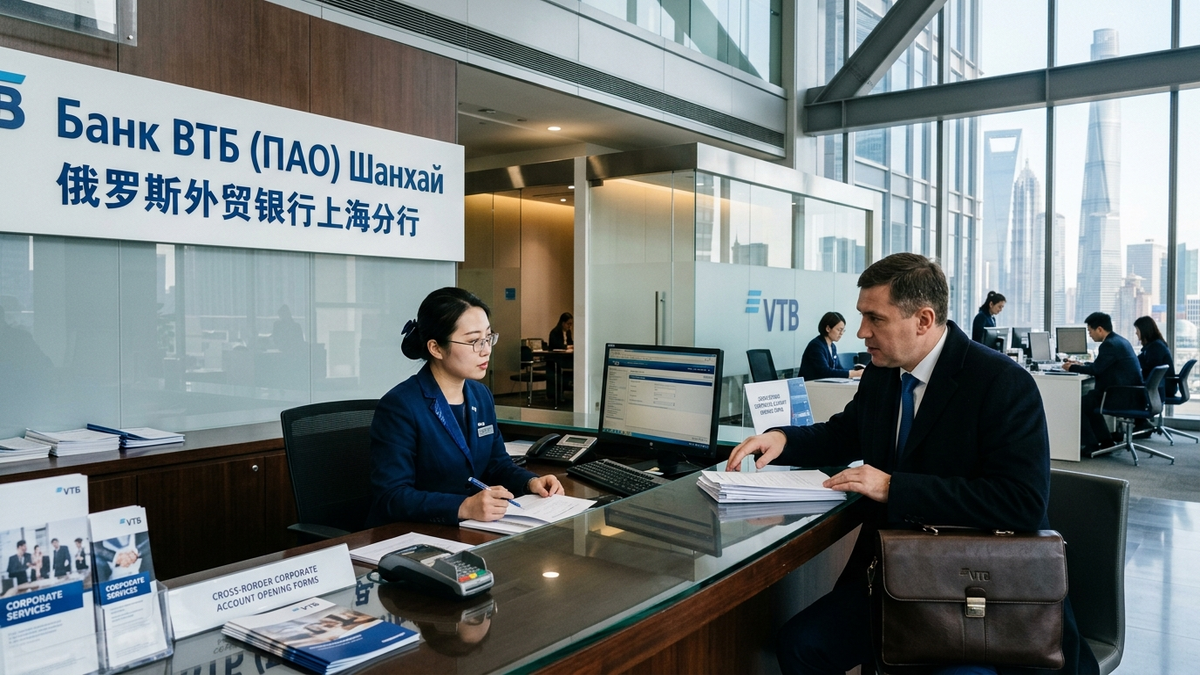
Figure 2: Corporate operations center of VTB Bank Shanghai Branch in Pudong, illustrating the direct non-SWIFT clearing gateway connecting Mainland Chinese manufacturing bases with the Russian commercial banking system.
03 Direct Settlement Channel 2: Regional Border Banks & CIPS Infrastructure
To relieve pressure on VTB Shanghai, specialized regional commercial banks located primarily in Northeast China (Heilongjiang, Jilin, and Inner Mongolia border zones) have established direct correspondent banking corridors.
| Banking Corridor / Institution | Primary Settlement Currencies | Average Clearing Timeline | Primary Advantages | Operational Limitations |
|---|---|---|---|---|
| VTB Bank (Shanghai Branch) | RUB / CNY (Direct conversion) | 1–3 business days (post-onboarding) | 100% internal book transfer; zero SWIFT exposure; highest transaction limits | Long account opening waitlist (1–3 months); requires dual-sided VTB accounts |
| Harbin Bank (哈尔滨银行) | CNY / RUB | 2–5 business days | Leading bilateral currency hub; direct Nostro/Vostro with major non-sanctioned Russian banks | Strict scrutiny on HS codes; secondary bank verification required for southward transfers |
| Bank of Jilin (吉林银行) | CNY | 3–7 business days | Extensive experience in agricultural, chemical, and industrial supply clearing | Quarterly quota ceilings; requires full physical contract submission prior to wire |
| Hunchun Rural Commercial Bank (珲春农商行) | CNY / RUB | 2–4 business days | Fast local clearing for border trade; specialized railway and sea freight desks | Limited branch presence outside Jilin province; requires local tax representation |
| Third-Country Transit (Central Asia / UAE) | USD / EUR / CNH | 15–45 business days | Allows supplier to receive funds via standard Western commercial accounts | Severe compliance freeze risk; 3.5%–7.0% cumulative currency slippage; SAFE tax audit risk |
3.1 CIPS and Non-SWIFT Bilateral Messaging
Unlike standard cross-border wires that depend on SWIFT FIN MT103 messaging, transactions between Russian regional banks and Northeast Chinese regional lenders increasingly utilize direct interbank interfaces connected to China’s Cross-Border Interbank Payment System (CIPS) or secure bilateral API tunnels. Over 85% of total bilateral trade between Russia and China in 2026 is settled directly in local currencies (RMB and RUB), fundamentally de-dollarizing the trade corridor.
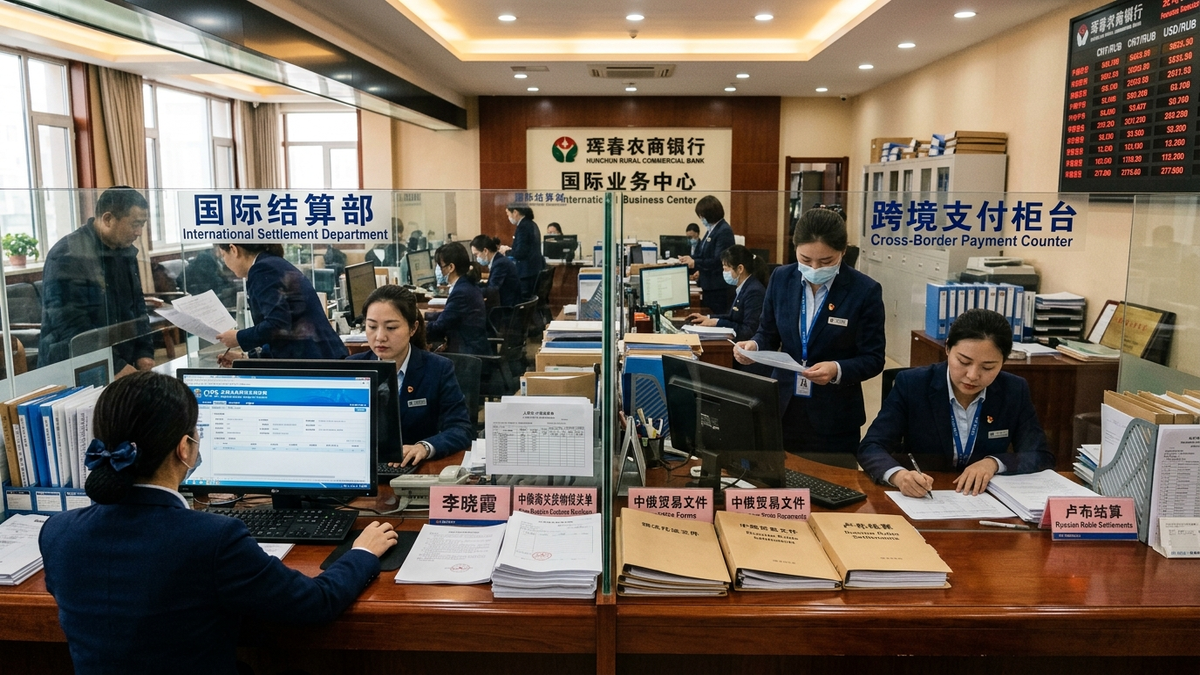
Figure 3: Inside a regional commercial trade settlement department in Northeast China, where cross-border interbank Nostro/Vostro accounts process daily bilateral currency transfers under strict regulatory supervision.
04 The Critical Regulatory Anchor: SAFE Customs Declaration (CCD) 3-Way Match
The single most catastrophic mistake foreign procurement teams make when negotiating payments with Chinese suppliers is ignoring China’s State Administration of Foreign Exchange (SAFE / 国家外汇管理局) regulatory framework.
4.1 Why “Agent Payment” Schemes Trigger Account Freezes
When Russian buyers encounter banking hurdles, they are frequently solicited by third-party payment agencies offering to pay Chinese factories from domestic Chinese bank accounts or offshore shell entities. In 2026, this creates acute legal danger for the Chinese manufacturer:
- Discrepancy of Payer Identity: If Chinese Factory A exports industrial machinery to Russian Buyer B, the China Customs Declaration lists Buyer B (or their official logistics forwarder). If payment suddenly arrives from an unrelated domestic trading entity in Guangzhou or an offshore entity in Dubai, the Chinese bank’s automated anti-money laundering (AML) system flags the transaction.
- Tax Refund Forfeiture: To claim China’s standard export VAT rebate (typically 13%), the export enterprise must prove that export revenue was received directly from the overseas purchasing party or an officially registered trade agent. Mismatched payments forfeit the VAT rebate, immediately destroying the factory’s operating margin.
- Account Suspension (Police / SAFE Freeze): Under China’s national crackdown on illegal underground banks and transit trade (断卡行动), Chinese suppliers receiving non-traceable domestic third-party funds face immediate operational account freezes lasting from 6 months to indefinite judicial lockup.

Figure 4: Macro inspection of a compliant cross-border export dossier featuring the official China Customs Export Declaration (海关出口货物报关单) with customs release stamp, Commercial Invoice, and international railway bill of lading required to satisfy SAFE foreign exchange audits.
05 Transit Payment Corridors (Third Countries): Risk Audit
Many Russian buyers continue to explore transit payment arrangements through third-party jurisdictions, primarily in Central Asia (Kazakhstan, Kyrgyzstan, Uzbekistan), the United Arab Emirates (UAE), Armenia, and Turkey. Our empirical analysis of 2026 transaction data reveals severe operational frictions across these routes:
5.1 Rising Delays and Compliance Questionnaires
Due to intense secondary sanctions pressure from the US Department of the Treasury’s Office of Foreign Assets Control (OFAC), commercial banks in Kazakhstan and the UAE have introduced extensive compliance questionnaires for any remittance destined for China. Buyers are routinely required to provide technical datasheets, end-user certificates (EUC), factory photos, and transit logistics proof. In 2026, average transaction turnaround times through Central Asian routes exceed 25 to 45 business days, with a rejection/return rate exceeding 30%.
5.2 Cumulative Financial Slippage
The total friction cost of transit schemes frequently renders them uneconomic. A standard transaction routed through an offshore agency typically incurs:
- Origin bank outbound wire commission: 0.5%–1.2%
- First currency conversion (RUB to KZT / AED / USD): 1.5%–2.5%
- Second currency conversion (to CNH / CNY): 1.0%–2.0%
- Transit agent handling fee: 2.0%–4.0%
- Total Aggregate Margin Loss: 5.0% to 9.7% of gross order value, in addition to capital lockup during 3–6 week delays.
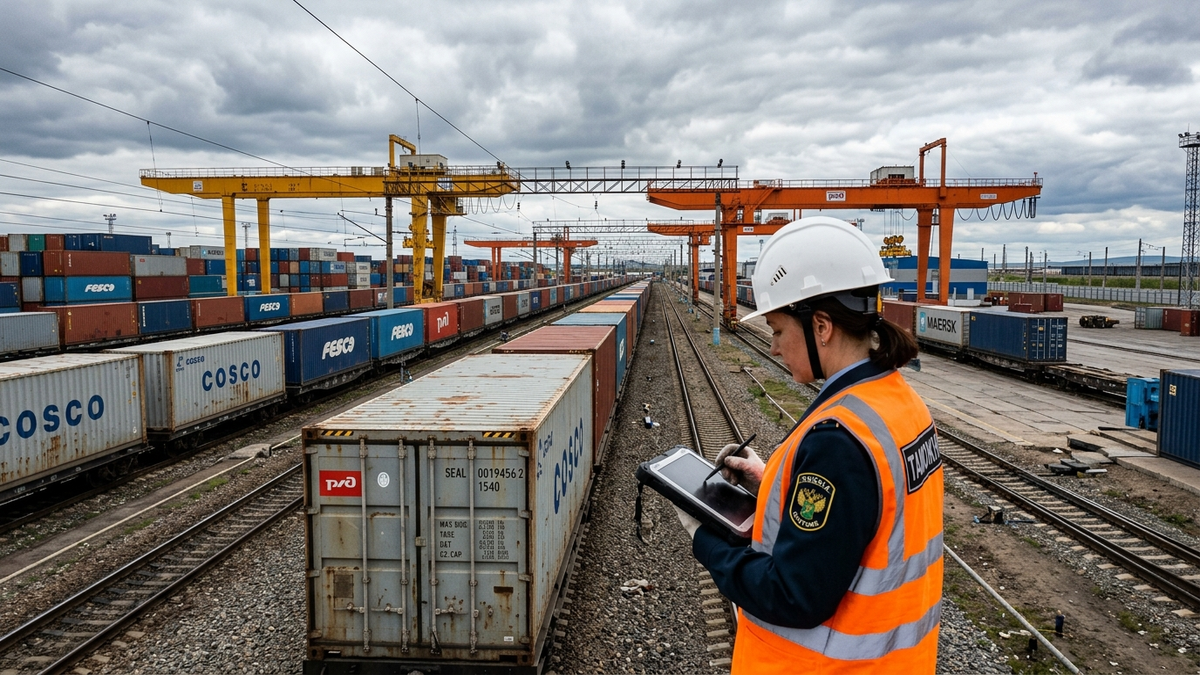
Figure 5: Transshipment operations at the Manzhouli–Zabaikalsk rail freight terminal, where physical cargo release timelines must synchronize with financial customs clearance declarations (CCD) to prevent warehouse demurrage.
06 Step-by-Step Strategic SOP for Procurement Directors in 2026
To establish a resilient, long-term cross-border supply chain between Russia and China, procurement executives must move away from ad-hoc payment improvisations and institute a formal four-step Treasury SOP:
- Step 1: Supplier Banking Due Diligence Prior to Contract Signing
Before issuing a purchase order or paying a deposit, mandate that the Chinese vendor provide proof of an active account at VTB Bank Shanghai Branch or a verified regional commercial bank (e.g., Harbin Bank, Bank of Jilin). If the vendor only maintains accounts at major state lenders (ICBC/CCB/BOC), factor in the 6–8 week timeline required to assist them in opening a specialized border channel account.
- Step 2: Formal Contract Currency Alignment (RMB / RUB)
Denominate commercial contracts strictly in Chinese Yuan (CNY) or Russian Rubles (RUB). Explicitly state in Section 4 (Terms of Payment) the exact correspondent bank routing instructions, confirming that neither intermediary nor clearing banks maintain US dollar clearing relationships for the subject transaction.
- Step 3: Advance 3-Way Match Document Preparation
Ensure that the exact legal entity listed as the buyer on the Commercial Invoice is identical to the entity remitting funds from Russia. Ensure that your international freight forwarder issues the Bill of Lading (railway SMGS or ocean BL) naming the same consignee, allowing the Chinese supplier’s customs broker to generate a perfectly congruent China Customs Export Declaration (CCD).
- Step 4: Currency Risk Hedging and Spread Mitigation
Establish corporate forward exchange contracts (Forward FX) or limit orders through your primary Russian bank to lock in the CNY/RUB exchange rate upon contract signing. This protects trade margins against intraday exchange rate volatility while funds navigate multi-day compliance queues.
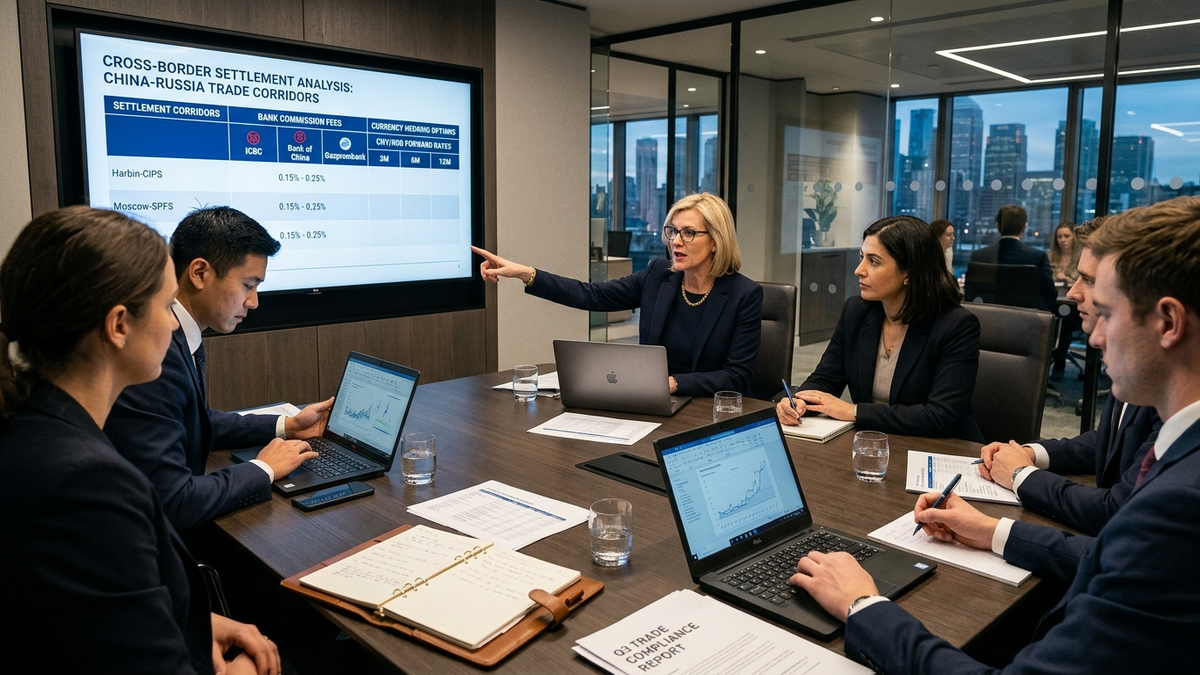
Figure 6: Corporate trade finance leadership evaluating payment routing costs, SAFE compliance matrices, and currency hedging options to guarantee continuous manufacturing delivery schedules.
07 Conclusion & Cross-Industry Sourcing Implications
In 2026, cross-border payment capability has ceased to be a routine administrative task; it has become the fundamental competitive moat in China-Russia trade. Companies that establish direct, compliant banking infrastructure via VTB Shanghai and regional non-sanctioned clearing banks secure reliable delivery lead times, claim full 13% export VAT rebates, and eliminate multi-week capital freeze risks.
For further operational guides on specific trade sectors, consult FYZSXNB’s verified research dossiers:
- Chinese Pet Food Suppliers: Russian Buyer Audit & Direct Sourcing Guide — Verifying factory export registrations and customs clearance protocols.
- BYD Blade Battery 2.0 & Commercial Vehicle Tech Teardown — Industrial supply chains and component settlement dynamics.