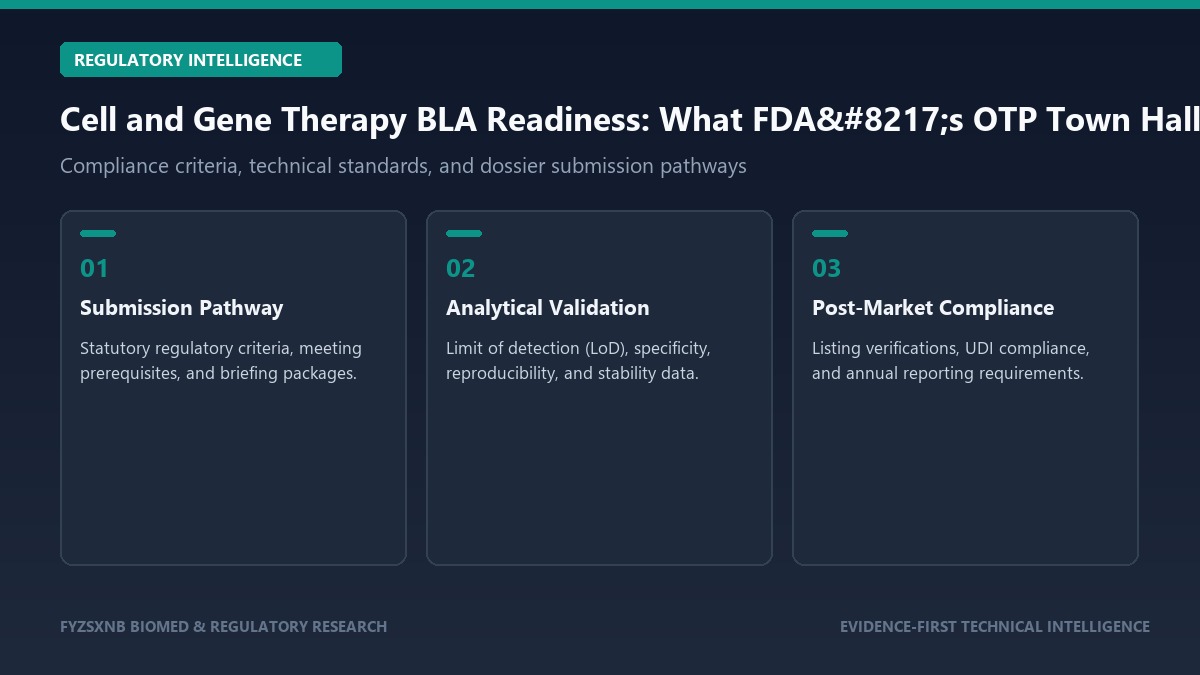
Executive Summary: Key Takeaways for Sponsors
If you are preparing a Biologic License Application (BLA) for a cell or gene therapy product, FDA’s June 2026 OTP Town Hall offers a practical set of administrative guidance points. The town hall, hosted by the Office of Therapeutic Products (OTP) within CBER, featured experts from the Office of Review Management & Regulatory Review (ORMRR) who answered sponsor questions about BLA readiness. The published town hall transcript is now available as a downloadable PDF.
The four actions sponsors should take based on the town hall’s scope and FDA’s listed resources:
- Request a pre-BLA meeting with OTP to discuss your planned application content before submission. This is an established FDA procedure, not a new requirement introduced at the town hall.
- Use CBER Discipline Filing Checklists (Appendix B) as your internal filing-readiness tool. FDA lists these checklists alongside its SOPPs as core preparation resources.
- Confirm electronic submission format compliance by consulting the FDA resource “Regulatory Submissions in Electronic Format for CBER-Regulated Products,” which covers the eCTD framework applicable to BLA filings.
- Treat town hall Q&A as attributed FDA staff explanations, not as binding rules. The town hall series is explicitly described as a question-and-answer format for providing regulatory information, not for issuing new regulations.
Inference: Pre-BLA meetings and discipline filing checklists function as the primary administrative safeguards against refuse-to-file outcomes. This inference is drawn from FDA’s decision to feature these tools at a BLA readiness event, not from an explicit guarantee that using them prevents refusal in every case.
Event Context: Post-June 2026 Status and Published Transcript
On June 4, 2026, FDA’s Center for Biologics Evaluation and Research (CBER), Office of Therapeutic Products (OTP) hosted a virtual town hall titled “Best Practices for Preparing BLA Submissions for Cell and Gene Therapy Products.” The session ran from 11:00 a.m. to 12:00 p.m. ET and featured experts from OTP’s ORMRR answering questions about BLA readiness, including how to request pre-BLA meetings, best practices for preparing submission packages, and tools to navigate the application process.
Attributed event explanation: The town hall was part of OTP’s virtual town hall series, launched to engage with product developers and researchers on topics related to OTP-regulated products. According to the OTP Town Hall event page, the series uses a question-and-answer format with the goal of providing regulatory information to advance drug development.
The town hall transcript (PDF, 356.13 KB) has been published on the FDA website. The event page content was current as of July 23, 2026. Sponsors with event-related questions can contact OTPEvents@fda.hhs.gov.
Pre-BLA Interaction Strategy: Requesting and Preparing for ORMRR Meetings
Guidance: Prior to BLA submission, sponsors may request a pre-BLA meeting with OTP to discuss the planned content of the marketing application. This is an established FDA procedure described on the event page, not a new requirement introduced at the town hall.
The pre-BLA meeting is the primary mechanism for sponsors to align with FDA on application content before the formal submission. Based on the town hall’s focus on BLA readiness and the ORMRR panel’s role in answering filing-related questions, sponsors should approach the pre-BLA meeting with the following preparation priorities:
| Preparation Step | What It Addresses | Evidence Basis |
|---|---|---|
| Draft a meeting request package | Outlines the product, development stage, and specific questions for FDA | Established FDA procedure (S01) |
| Compile a draft table of contents for the BLA | Maps application modules to expected content areas | Inference from town hall scope (S02) |
| Identify discipline-specific gaps | Flags areas where product-specific requirements may differ from general expectations | Approved boundary: product-specific requirements remain outside this article’s promise |
| Prepare questions on filing completeness | Targets refuse-to-file risk areas before submission | Inference from town hall framing (S02) |
Inference: The pre-BLA meeting serves as the most direct opportunity to surface filing-completeness issues before FDA receives the formal application. Sponsors who skip this step forgo the chance to identify gaps that could trigger a refuse-to-file decision.
Unknown: The specific pre-BLA meeting request requirements, timelines, and formatting expectations are not detailed on the event page. Sponsors should consult the full OTP Learn resource and CBER SOPPs for procedural specifics.
BLA Submission Package Completeness under 21 CFR 601.2
Current rule: A BLA is a request for permission to introduce, or deliver for introduction, a biologic product such as a cell or gene therapy into interstate commerce. Under 21 CFR 601.2, a BLA must contain comprehensive data from preclinical and clinical studies and detailed information about manufacturing processes and facilities, demonstrating the product’s safety, purity, and potency.
The event page explicitly states this regulatory definition, confirming that the town hall operated within the framework of existing law rather than introducing new substantive requirements. Sponsors preparing a CGT BLA should understand the following completeness dimensions:
- Clinical and preclinical data: The BLA must include comprehensive study data. The town hall did not supply universal clinical or nonclinical data requirements; these remain product-specific and are determined through IND and pre-BLA dialogue.
- Manufacturing information: Detailed information about manufacturing processes and facilities is required. CMC requirements are product-specific and outside the town hall’s administrative scope.
- Electronic format compliance: The event page lists “Regulatory Submissions in Electronic Format for CBER-Regulated Products” as a resource, pointing sponsors to the eCTD framework that governs submission formatting and validation.
- Application form: Form FDA 356h is the established cover form for BLA submissions. Sponsors should ensure it is completed and included as part of the submission package.
Attributed event explanation: The town hall addressed “best practices for preparing submission packages” and “tools to navigate the application process,” as described on the event page. The transcript provides the detailed Q&A record of how ORMRR staff explained these practices.
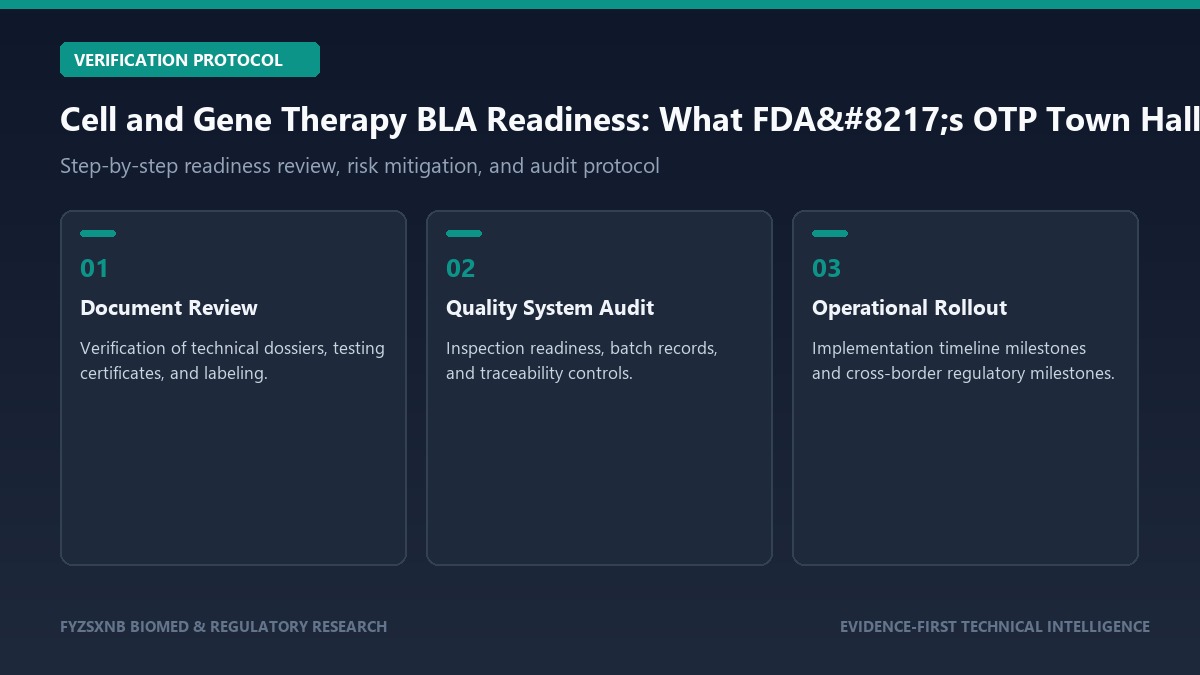
Leveraging CBER SOPP Appendix B Discipline Filing Checklists
Guidance: The FDA event page lists “CBER Discipline Filing Checklists (see Appendix B)” and “Biologics Procedures (SOPPs)” as resources for BLA preparation. These are FDA-published procedural documents that outline filing expectations by discipline.
The discipline filing checklists serve as an internal audit tool that sponsors can use to verify submission completeness before filing. The event page places these checklists alongside the SOPPs, indicating that FDA considers them integral to the filing-readiness workflow.
| Resource | Purpose | How Sponsors Use It |
|---|---|---|
| CBER Discipline Filing Checklists (Appendix B) | Discipline-specific filing completeness verification | Internal pre-submission audit by CMC, clinical, nonclinical, and facilities teams |
| Biologics Procedures (SOPPs) | Standard operating Procedures and Policies for CBER | Reference for submission procedures, meeting request processes, and review timelines |
| OTP Learn | BLA review timelines, filing procedures, regulatory actions | Orientation for sponsors new to the BLA process |
| Regulatory Submissions in Electronic Format | Electronic submission (eCTD) requirements for CBER products | eCTD validation and module assembly before submission |
Inference: The placement of discipline filing checklists at the top of FDA’s resource list for this town hall signals that FDA views checklist-driven completeness verification as a primary filing-readiness practice. Sponsors who align their internal review with Appendix B checklists before submission are following the workflow FDA itself recommends.
The FDA event page also links to “Interactions with Office of Therapeutic Products,” which provides additional procedural guidance for engaging with OTP throughout the development and submission process.
Distinguishing Informal Town Hall Q&A from Binding Regulatory Standards
A central boundary for this article is the distinction between what the town hall clarified and what constitutes binding regulatory authority. The following framework helps sponsors interpret the evidence correctly:
| Evidence Type | What It Means | Example in This Article |
|---|---|---|
| Current rule | Binding regulation with legal force | 21 CFR 601.2 defines what a BLA is and what it must contain |
| Guidance | FDA-published procedures and policies that describe how FDA operates | CBER SOPPs, Discipline Filing Checklists (Appendix B), OTP Learn |
| Attributed event explanation | FDA staff answers given in a Q&A session; informative but not binding | ORMRR experts’ answers on pre-BLA meetings and submission packages at the June 2026 town hall |
| Inference | Analytical conclusion drawn from the evidence by this article’s author | Pre-BLA meetings and checklists are the primary administrative tools for refuse-to-file prevention |
| Future event | The OTP town hall series is ongoing; future sessions may address additional topics | OTP may host future town halls on related CGT regulatory topics; no specific date is confirmed |
| Unknown | Information not available in the evidence reviewed | Product-specific CMC, clinical, and nonclinical data requirements; individual filing outcomes |
Attributed event explanation: According to the event page, the OTP town hall series has a “question-and-answer format with the goal of providing regulatory information to advance drug development.” This framing confirms that the town hall’s content should be read as informative guidance from FDA staff, not as new binding rules that supersede existing regulations or formal guidance documents.
The published transcript should be consulted for the specific Q&A exchanges. Sponsors should cross-reference any town hall explanation against the relevant SOPP, guidance document, or regulation before making filing decisions.
Blocked Claims and Regulatory Uncertainty Boundaries
This article operates within explicit boundaries approved for this topic. The following claims are outside the scope of what the evidence supports and are not made in this article:
- Blocked: Claiming that the town hall established new binding regulations. The town hall is a Q&A session, not a rulemaking proceeding.
- Blocked: Guaranteeing filing acceptance or BLA approval based on town hall recommendations. Filing outcomes depend on product-specific data and review, which the town hall did not address.
- Blocked: Promising a single universal checklist that replaces product-specific IND or pre-BLA dialogue. The Discipline Filing Checklists are a tool, not a substitute for individualized regulatory engagement.
Unknown: Product-specific requirements for any individual CGT product remain outside this article’s promise. Sponsors must determine these through their own IND interactions, pre-BLA meetings, and product-specific FDA dialogue. The town hall did not supply substantive universal CMC, clinical, or nonclinical data requirements.
Filing-Readiness Checklist for CGT BLA Sponsors
The following checklist synthesizes the administrative actions described or implied by the town hall scope and FDA’s listed resources. It is not a substitute for the full CBER Discipline Filing Checklists (Appendix B).
- Request a pre-BLA meeting with OTP to discuss planned application content
- Obtain and review the CBER Discipline Filing Checklists (Appendix B) for each discipline
- Review relevant CBER SOPPs for submission and meeting procedures
- Consult the OTP Learn resource for BLA review timelines and filing procedures
- Verify eCTD compliance using the “Regulatory Submissions in Electronic Format for CBER-Regulated Products” resource
- Prepare Form FDA 356h as the BLA cover form
- Confirm that the submission addresses 21 CFR 601.2 requirements (safety, purity, potency)
- Conduct an internal completeness audit using the discipline filing checklists before submission
References
- S01: FDA OTP Town Hall Event Page: Best Practices for Preparing BLA Submissions for Cell and Gene Therapy Products (June 4, 2026) — U.S. Food and Drug Administration. Content current as of 2026-07-23.
- S02: FDA CBER OTP Town Hall Transcript: Best Practices for Preparing BLA Submissions for Cell and Gene Therapy Products (PDF, 356.13 KB) — U.S. Food and Drug Administration.
- S03: FDA Event Page — Resources Section (SOPPs, CBER Discipline Filing Checklists Appendix B, OTP Learn, Electronic Submission Format) — U.S. Food and Drug Administration.
- S04: OTP Town Hall Transcript — Pre-BLA Meeting and Submission Package Q&A — U.S. Food and Drug Administration.
Scope: This article covers administrative and filing-readiness practices for cell and gene therapy BLA submissions based on FDA’s June 2026 OTP Town Hall. It does not address product-specific CMC, clinical, or nonclinical data requirements, which remain determined through IND and pre-BLA dialogue with FDA. The town hall answers are attributed FDA staff explanations, not new binding rules.
Not medical advice: This article provides regulatory process information for industry professionals preparing BLA submissions. It does not constitute medical advice, clinical recommendations, or legal counsel. Sponsors should consult qualified regulatory and legal professionals for product-specific guidance.
Update trigger: This article should be reviewed and updated if FDA publishes new BLA filing guidance, revises CBER SOPPs or Discipline Filing Checklists, issues a refuse-to-file rulemaking affecting cell and gene therapy products, or hosts a subsequent OTP town hall on BLA readiness topics.