FDA requires owners or operators of covered medical device establishments to register annually and list the devices made at those establishments. These administrative records do not constitute FDA approval, clearance, authorization, or official certification. This guide gives exporters, importers, distributors, and procurement buyers a four-step workflow for checking establishment registration, device listing, and any relevant premarket record in FDA public databases.
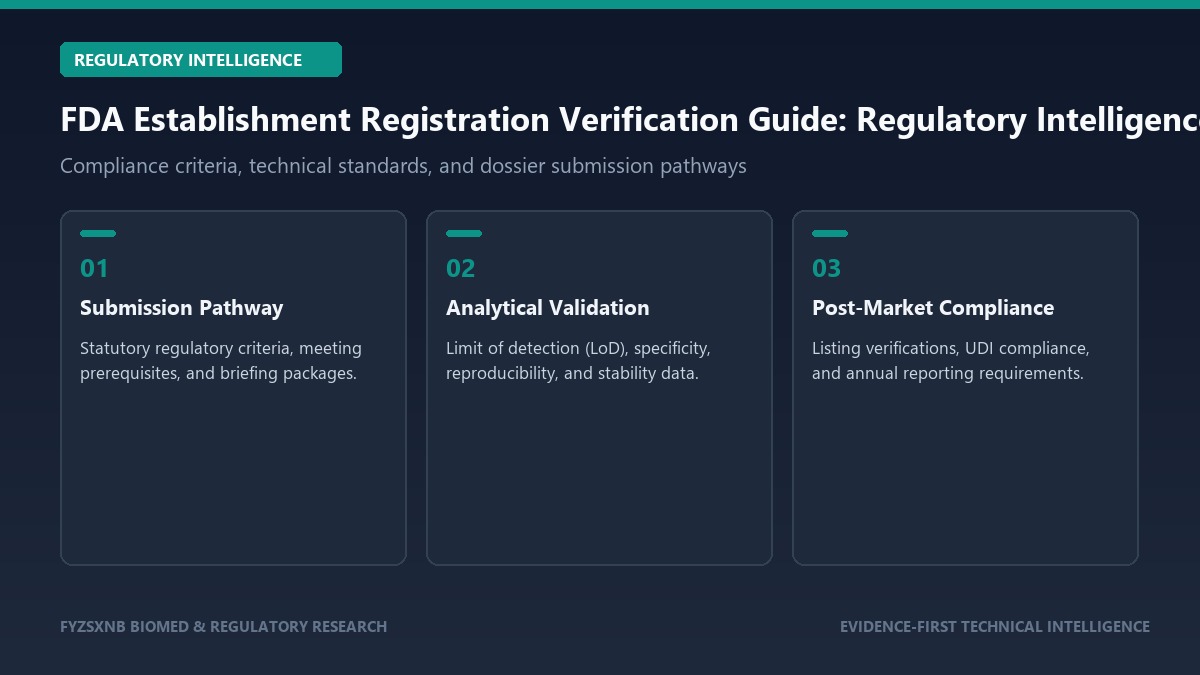
Establishment Registration
Establishment registration is a mandatory administrative reporting duty under 21 CFR Part 807. It requires medical device manufacturers, contract sterilizers, contract manufacturers, repackagers, relabelers, specification developers, single-use device reprocessors, initial distributors (importers), and remanufacturers that produce or import devices into the United States to register their facilities with FDA. Registration assigns the facility an Establishment Registration Number and links it to a Facility Establishment Identifier (FEI) number. Registration tells FDA who the establishment is and where it is located; it does not evaluate the safety or effectiveness of any device.
Device Listing
Device listing is the companion administrative duty under the same regulation. Registered establishments must list each device they manufacture, prepare, propagate, compound, or process for commercial distribution in the United States. A device listing record identifies the product, its product code, and the establishment that places it into distribution. Listing tells FDA what a registered establishment markets; it is not a determination that the device is safe or effective.
Premarket Authorization
Premarket authorization is separate from establishment registration and device listing. When a device requires marketing authorization before US marketing, verify the relevant FDA premarket submission number or record. Consult FDA guidance documents and qualified regulatory counsel for device-specific determinations.
| Dimension | Establishment Registration | Device Listing | Premarket Authorization |
|---|---|---|---|
| Regulatory basis | 21 CFR Part 807, Subpart B | 21 CFR Part 807, Subpart B | Separate from 21 CFR Part 807 (when required) |
| What it identifies | The facility (who and where) | The product placed in distribution (what) | Separate from registration and listing (when required) |
| Key identifier in FDA databases | FEI Number; Establishment Registration Number | Device Listing Number | Device-specific (when required) |
| Frequency | Annual renewal (October 1 to December 31) | Updated as products are added, changed, or removed | When required by the device |
| Equals FDA approval or clearance? | No | No | Separate determination; not established by registration or listing alone |
| Public verification database | CDRH Registration and Listing Database | CDRH Registration and Listing Database | Applicable FDA premarket database (when required) |
2. The Annual Registration Rule and FEI/Owner-Operator Identifier Verification
Establishment registration is not a one-time filing. FDA states that covered establishments must register annually, with annual registration occurring between October 1 and December 31. Verification should therefore use the current FDA database record rather than an old certificate or screenshot. For a related checklist on labeler codes and foreign company obligations, see our FDA labeler code foreign company checklist.
Each registered establishment is associated with several identifiers that auditors should collect and verify:
- FEI Number (Facility Establishment Identifier): A unique number assigned by FDA to a physical location. The FEI is the primary search key in the CDRH Registration and Listing Database.
- Establishment Registration Number: The number assigned to the establishment upon successful registration, formatted to distinguish it from premarket authorization numbers.
- Owner-Operator Number: Identifies the entity that owns or operates one or more registered establishments, useful when a company operates multiple facilities under a single ownership structure.
Verification principle: before accepting a supplier claim of FDA registration, record the FEI number and Establishment Registration Number and check them in the public CDRH Registration and Listing Database. A self-issued document or third-party certificate bearing these numbers is not a substitute for the current FDA database record.
3. Step-by-Step Audit Workflow in FDA Public CDRH Databases (Establishment vs. Listing)
The CDRH Registration and Listing Database is FDA’s public search resource for establishment registration and device listing records. The following four-step workflow separates establishment-level verification from product-level verification so that auditors do not conflate the two.
Step 1: Verify Establishment Registration
- Obtain the supplier’s FEI number or Establishment Registration Number (or the establishment name and address if no number is provided).
- Open the CDRH Registration and Listing Database.
- Search by FEI number, registration number, or establishment name.
- Confirm the establishment record shows an active registration status for the current registration year.
- Record the owner-operator name, establishment name, address, and registration year for your audit file.
Step 2: Verify Device Listing
- From the establishment record, navigate to the associated device listings.
- Confirm the specific device or product code appears in the listing records for that establishment.
- Record the Device Listing Number, product code, and device name.
Step 3: Distinguish Registration and Listing from Premarket Status
An active establishment registration and a valid device listing confirm that the facility has fulfilled its administrative reporting obligations and that the product has been listed for US distribution. They do not confirm that the device has been cleared, approved, or granted market authorization. Registration and listing entries do not denote approval, clearance, or authorization. This is the single most important distinction in the workflow.
Step 4: Escalate to Premarket Database Checking When Required
If the specific device requires premarket authorization, proceed to check the relevant FDA premarket record. Registration and listing entries do not denote approval, clearance, or authorization.
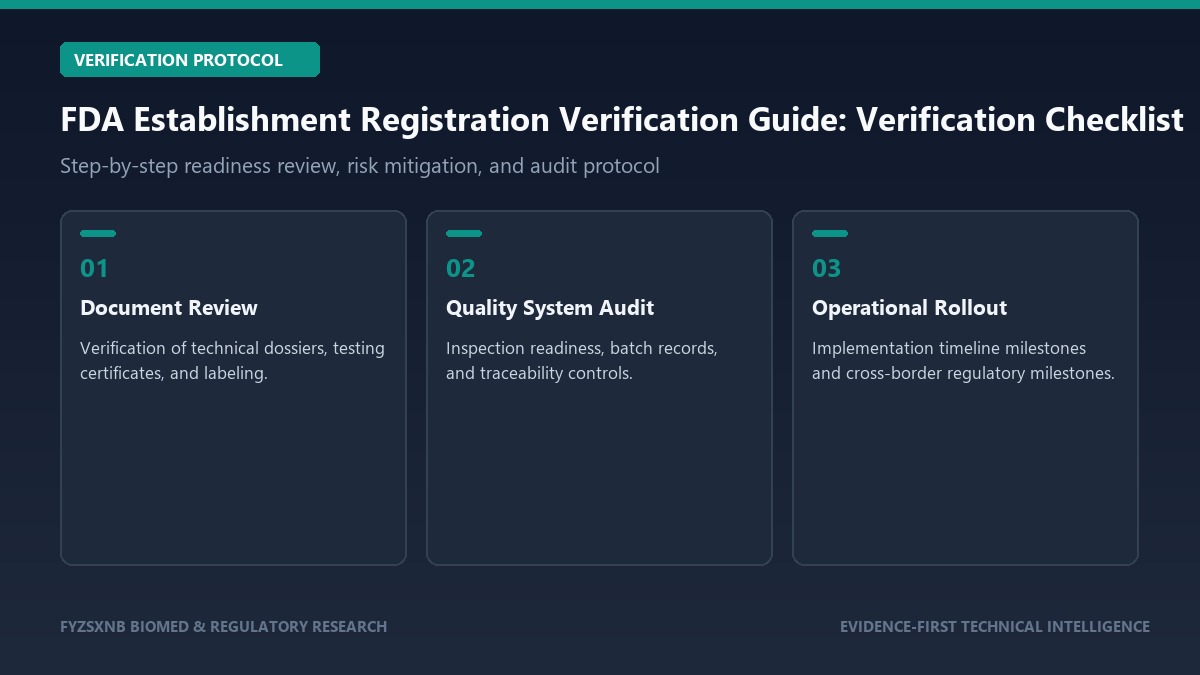
4. Verifying Premarket Records When Required
When the specific device requires premarket authorization, verify the relevant premarket record in the appropriate FDA database. Verify both the establishment registration record and, when required, the relevant premarket record. Registration and listing entries do not denote approval, clearance, or authorization. Consult FDA guidance documents and qualified regulatory counsel for device-specific determinations.
5. Verification Red Flags: Certificates and Unsupported Claims
The following red flags should trigger a direct database check during a supplier audit or procurement review. For procurement teams evaluating specific instrument platforms, see our fully automated molecular POCT system procurement guide.
Red Flag 1: “FDA Registration Certificate” Displayed as Proof of Approval
FDA explicitly does not issue “FDA Registration Certificates.” A registered establishment receives a registration number, not a certificate of approval or quality. Displaying a third-party certificate that claims to represent official FDA certification is misleading. FDA does not issue registration certificates. Any document styled as an official FDA registration certificate should be treated as suspect.
Red Flag 2: Registration Number Presented as Clearance or Approval
An FDA establishment registration number or device listing entry does not denote FDA approval, clearance, or authorization. If a supplier presents one of these administrative records as a premarket decision, request the relevant FDA premarket submission number and verify that separate record when the device requires marketing authorization.
Red Flag 3: Listing Number Used to Imply Quality Certification
FDA states that registration and listing do not denote approval, clearance, or authorization, and that FDA does not issue registration certificates. Procurement teams should therefore evaluate quality documentation and any applicable premarket record separately instead of treating a listing entry as a certification.
Red Flag 4: Active Listing Without Premarket Clearance When Authorization Is Required
When a device requires premarket authorization, the listing record should be cross-checked against the appropriate premarket database. Registration and listing entries do not denote approval, clearance, or authorization.
Audit Action: Always Verify in Official Databases
Auditors should treat any document that resembles an “FDA certificate,” “FDA approval certificate,” or “FDA registration certificate” as a red flag unless it can be corroborated by a matching record in the official FDA databases. When in doubt, verify directly in the CDRH Registration and Listing Database and the relevant premarket database, and consult qualified regulatory counsel for device-specific determinations.
Sources
- U.S. Food and Drug Administration (FDA) / CDRH. Device Registration and Listing. Available at: https://www.fda.gov/medical-devices/how-study-and-market-your-device/device-registration-and-listing. Accessed 2026-08-10.
- U.S. Food and Drug Administration (FDA) / CDRH. CDRH Registration and Listing Database. Available at: https://www.accessdata.fda.gov/scripts/cdrh/cfdocs/cfrl/rl.cfm. Accessed 2026-08-10.
This article is provided for regulatory compliance reference and educational purposes only and is not medical advice. Always consult the official FDA guidance documents and qualified regulatory counsel for device-specific compliance determinations.