A foreign drug facility that sends products to the United States has distinct administrative obligations: register the establishment, provide the required U.S. agent and importer information in the SPL submission, renew that registration every year, and list its drug products in commercial distribution. Registration is an administrative filing and does not constitute drug-product approval. This guide separates those filing duties from product approval.
/p>
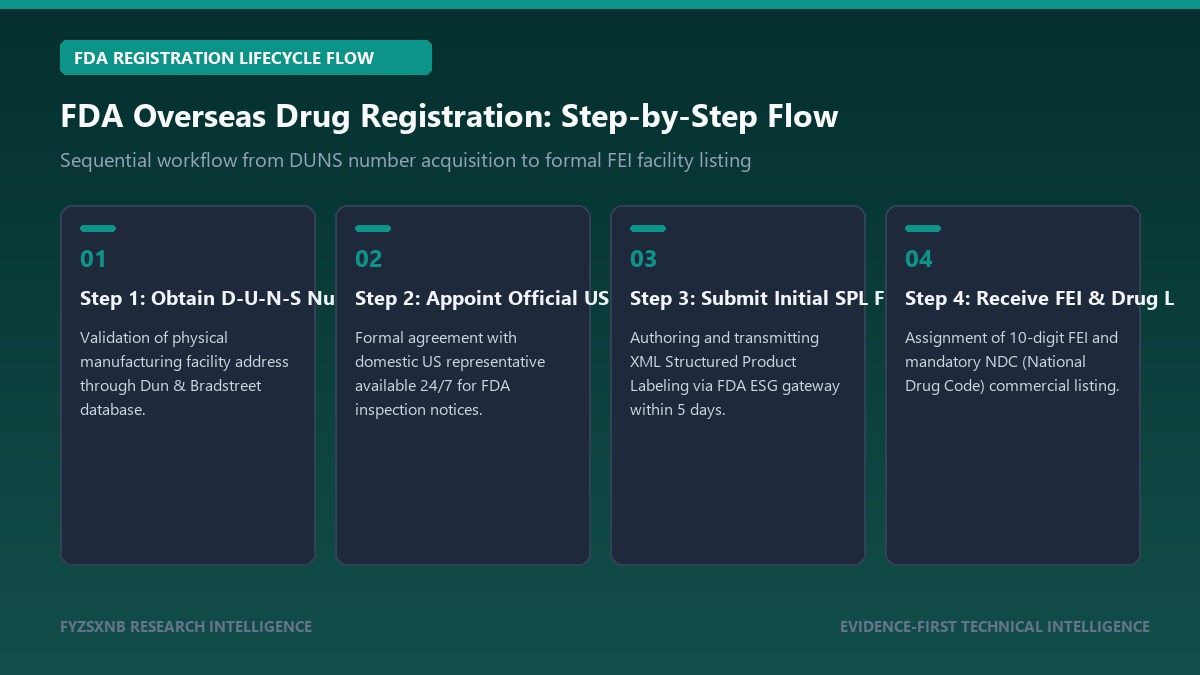
For a foreign facility, the practical difference from a domestic one is timing and the U.S. agent. U.S. establishments must register within five days of introducing drugs into commercial distribution. Foreign establishments must complete registration before the drug is offered for import. For a foreign establishment, the SPL includes the name and DUNS of a U.S. agent and all importers. Annual registration information is due on or before December 31.
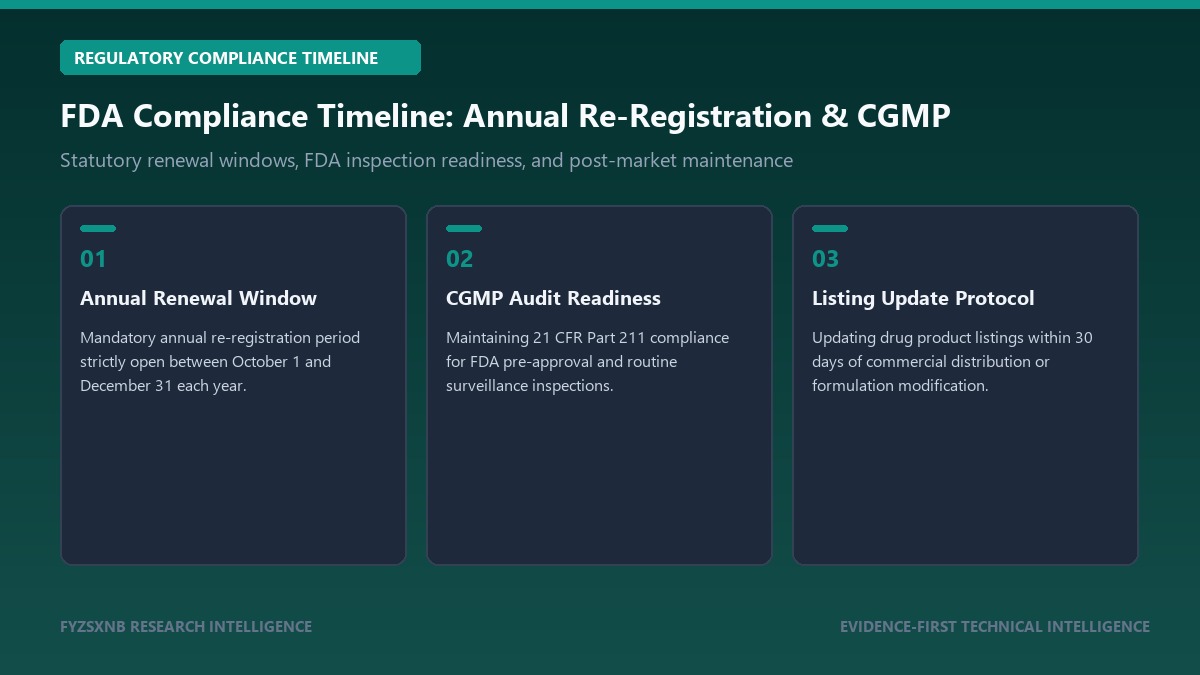
Registration Timing and Annual Renewal
The timing rules differ by where the facility sits and by the stage of the product lifecycle. Domestic facilities trigger registration when they begin covered operations, while foreign facilities trigger it before import. After the initial registration, every establishment must renew annually and keep listing information current.
Compliance Timeline for Establishment Registration
| Obligation or event | Timing | Regulatory basis |
|---|---|---|
| Domestic establishment begins manufacturing, repacking, or relabeling drugs for commercial distribution | Register within five days of introducing drugs into commercial distribution | FDA registration guidance |
| Foreign establishment offers a drug for import into the United States | Complete registration before the drug is offered for import | FDA registration guidance |
| Annual registration renewal | October 1 through December 31 (information due on or before December 31) | FDA registration guidance |
If an establishment makes no changes during the renewal window, it still submits a no-change notification so that its registration stays current. A successfully submitted registration generally appears in FDA’s drug establishment current registration site (DECRS) by the end of the next business day and carries an expiration date of December 31 of the following year.
The U.S. Agent Requirement
For foreign establishments, the SPL includes the name and DUNS of a U.S. agent and all importers.
Providing the required U.S. agent and importer information is part of the foreign-establishment registration SPL. The current FDA instructions describe registration as an administrative filing and do not make it product approval.
Drug Listing, Labeler Codes, and DUNS: Distinct Requirements, Not a Fixed Sequence
Obtaining a site-specific DUNS number, submitting establishment registration, requesting a labeler code, and listing drug products are distinct administrative compliance requirements under 21 CFR Part 207. They are often handled together in practice, but they are not a single mandatory universal sequence that every facility must follow in one fixed order. FDA describes three core submission types for registering an establishment and listing a drug: establishment registration, labeler code request, and drug listing, each requiring an initial submission followed by periodic updates.
What each component does
- Establishment registration: identifies the facility, its business operations, and (for foreign facilities) a U.S. agent.
- Labeler code request: obtains the code used to build National Drug Codes (NDCs) for the firm’s listed drugs.
- Drug listing: records each drug in commercial distribution as a separate submission type.
- Site-specific DUNS number: a Dun & Bradstreet identifier for the establishment (not one linked to the corporate headquarters) used within the SPL submission.
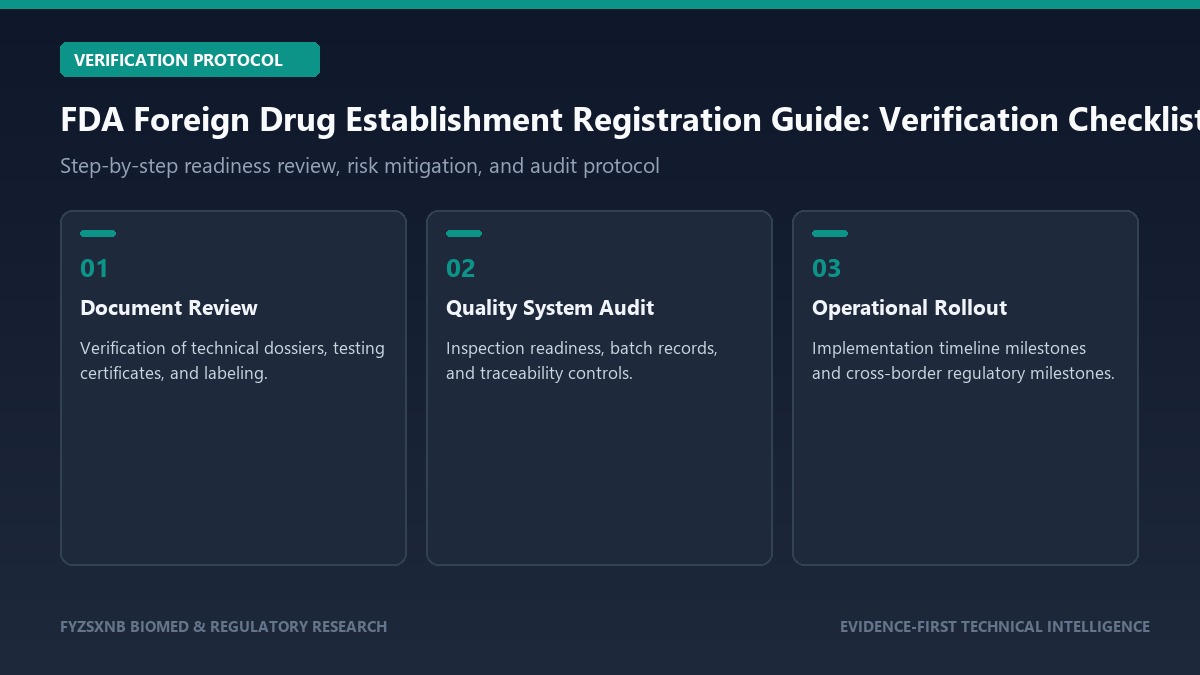
Because these are separate requirements, a firm should confirm it has the correct site-specific DUNS, the appropriate business operations listed, and accurate contact information rather than treating the steps as an automatic chain where one filing guarantees the next.
What Registration Does Not Prove
The most common confusion is assuming that an active FDA establishment registration means the drug product is approved. It does not. The current FDA instructions describe registration as an administrative filing and do not make it product approval. The table below sets out the boundary clearly.
What an Establishment Registration Number Does and Does Not Establish
| What registration is sometimes assumed to prove | What FDA registration actually establishes |
|---|---|
| Drug product approval (NDA or ANDA) | The current FDA instructions describe registration as an administrative filing and do not make it product approval. |
For a wider view of how registration and listing sit alongside other FDA drug compliance steps, see our FDA drug registration and listing compliance map. Facilities pursuing generic drug development may also find the GDUFA III controlled correspondence decision map and the FDA MIE generic drug meeting checklist useful for planning pre-submission interactions that are separate from establishment registration.
Submission Channels and How to Verify Status
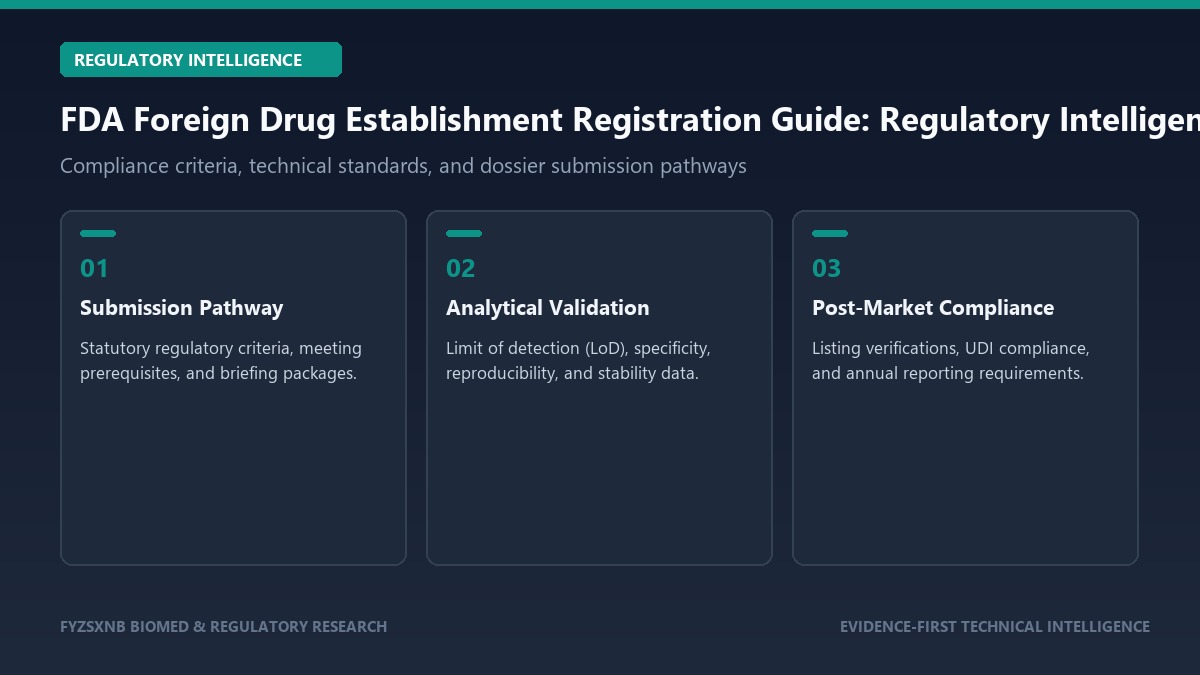
FDA requires registration and listing submissions in SPL (XML) format that comply with FDA validation rules. Establishments can prepare and submit SPL files through FDA Direct, SPL Xforms, or commercial and in-house tools. Submissions made outside FDA Direct and Xforms must be transmitted through the FDA Electronic Submissions Gateway (ESG). Annual renewal and no-change notifications follow the same SPL pathway.
After a successful submission, the establishment’s name and information appear in the drug establishment current registration site (DECRS). Registrants can confirm status there and should keep a copy of each accepted SPL submission for their records.
Sources
- FDA, Drug Registration and Listing Instructions — https://www.fda.gov/drugs/electronic-drug-registration-and-listing-system-edrls/drug-registration-and-listing-instructions
- FDA, How to Register a Drug Establishment (subpage of the Drug Registration and Listing Instructions) — https://www.fda.gov/drugs/drug-registration-and-listing-instructions/how-register-drug-establishment
Important Boundary
This article is educational information, not legal/regulatory or medical advice. It is not medical advice, not legal advice, and not regulatory counsel. Registration requirements change, and foreign facilities should confirm current obligations directly with FDA guidance and qualified regulatory counsel before filing.
Explore Global Regulatory Intelligence
Statutory roadmaps for FDA 21 CFR 207, NMPA UDI 2027 mandates, and molecular POCT procurement.