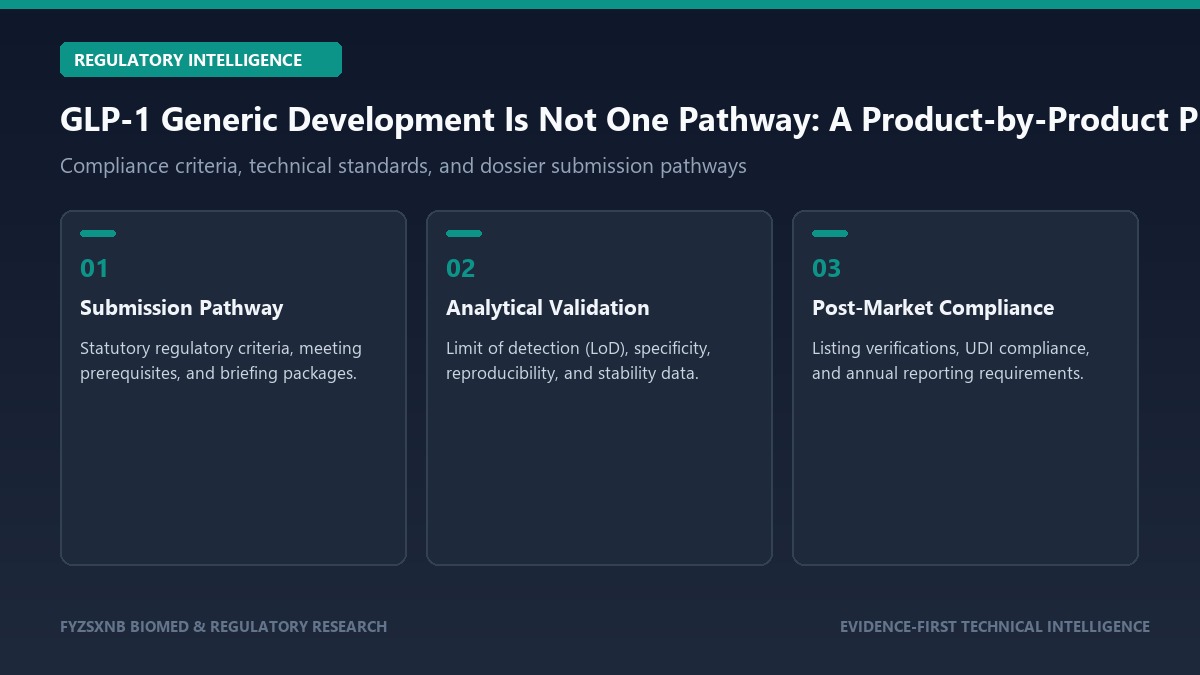
What is verified: The FDA/CRCG workshop dates, scope, and topic areas are confirmed against the primary regulator page (S01) and the co-organizer page (S02), both fetched on 2026-07-30.
What must be checked live: Patent status, exclusivity, reference-listed-drug identity, and biosimilar approval status for any named product. These change over time and require direct queries to the Orange Book (S03) and Purple Book (S04).
Update trigger: This checklist should be revised on or after September 25, 2026 (the day after the workshop ends) to incorporate any public outcomes, clarifications, or new guidance discussed during the event.
There is no single “GLP-1 generic” development route. The FDA/Center for Research on Complex Generics (CRCG) workshop on September 23-24, 2026 covers generic GLP-1 agonist products, but its own agenda splits the topic across at least five dimensions that diverge per product: the exact reference product, the regulatory database that applies to it, the peptide manufacturing route, the dosage form, and the device constituent. A developer who treats these as one universal pathway will miss product-specific requirements.
The checklist below organizes the pre-workshop questions a developer or regulatory affairs professional should resolve for each GLP-1 product individually, not as a class. It is built entirely from the frozen evidence provided for this article and makes no predictions about launch timing, patent freedom, substitutability, interchangeability, or what the workshop will conclude.
A. Identify the exact reference product
Every generic or biosimilar pathway starts from a specific reference listed drug (RLD) or reference product. The workshop scope includes an overview of currently available GLP-1 products for generic development (S02), which signals that the reference-product landscape is itself a topic of clarification, not a settled list.
Fact (C02): The workshop scope covers multiple GLP-1 product types, including orally administered peptides and injectable drug-device combination products (S01, S02).
Checklist questions
- What is the exact RLD or reference product name, strength, and dosage form for the GLP-1 agonist you intend to develop a generic or biosimilar for?
- Is that reference product named in a current FDA Product-Specific Guidance (PSG)? The workshop addresses PSG development for GLP-1 products (S02).
- Which GLP-1 products are identified as currently available for generic development? Confirm against workshop materials once they are public.
Do not assume that all GLP-1 agonists share the same reference-product status, exclusivity profile, or guidance coverage. Verify each product individually.
B. Determine the regulatory database: Orange Book vs. Purple Book
This is the single most consequential fork in GLP-1 generic development. Some GLP-1 agonist products are approved under the Federal Food, Drug, and Cosmetic Act (FD&C Act) and are listed in the Orange Book, which covers small-molecule generics via the Abbreviated New Drug Application (ANDA) pathway. Other GLP-1 products may be licensed as biologics under the Public Health Service Act (PHS Act) and appear in the Purple Book, which covers biosimilars via the 351(k) pathway.
These are distinct regulatory routes. They have different submission types, different standards for demonstrating sameness, and different databases for checking patent and exclusivity information. They must not be merged.
Checklist questions
- Is the reference product listed in the Orange Book (S03) as an approved drug product under the FD&C Act? The Orange Book must be checked for any named drug product.
- Is the reference product listed in the Purple Book (S04) as a licensed biological product under the PHS Act? The Purple Book must be checked separately for biologic or biosimilar status.
- If a product appears in one database but not the other, which regulatory pathway (ANDA or 351(k)) applies to a follow-on developer?
- What patents and exclusivities are recorded for the product in the applicable database? This determines what can be certified or addressed in a follow-on application. This article does not assess freedom to operate.
- Has FDA published a Product-Specific Guidance for the specific product and dosage form in question?
Inference (C03): Because the Orange Book and Purple Book are separate databases for different regulatory pathways, any checklist that promises one universal GLP-1 generic pathway would be misleading. Organizing by the exact reference product and its applicable database is the correct starting point. Do not classify an individual product without a current, product-specific database result.
C. Identify the peptide and manufacturing route
The workshop scope distinguishes two manufacturing routes for GLP-1 peptide active pharmaceutical ingredients (APIs): synthetic (chemical synthesis) and recombinant (expression via host cells). These are not interchangeable, and each carries a different impurity and characterization profile.
Fact (C02): The announced workshop scope includes “synthetic and recombinant manufacturing” and “analytical characterizations” (S01, S02).
Checklist questions
- Is the reference product’s API manufactured by synthetic peptide synthesis or by recombinant expression? The generic or biosimilar developer’s manufacturing route must be assessed against the reference.
- For synthetic routes: what related-substance and residual-solvent impurities must be profiled and qualified?
- For recombinant routes: what process-related impurities must be detected, quantified, and controlled?
- What analytical methods are expected for demonstrating API sameness?
- What peptide-specific stability challenges and shelf-life requirements apply to the product?
The workshop treats these as distinct scientific problems. A developer working on a recombinant GLP-1 peptide cannot rely solely on synthetic-peptide impurity frameworks, and vice versa.
D. Match the formulation and dosage form
GLP-1 agonist products span at least two formulation categories with fundamentally different bioequivalence and quality challenges: injectable formulations (delivered via pen injectors or autoinjectors) and oral tablet formulations.
Fact (C02): The workshop scope includes “oral peptide formulation development” and “bioequivalence study design for oral peptide formulations” (S01, S02).
Checklist questions — injectable formulations
- What are the drug product quality expectations for the injectable formulation (solution, suspension, or other)?
- What bioequivalence study design is expected for the injectable product?
- How does the formulation interact with the device constituent (see Part E)?
Checklist questions — oral peptide formulations
- What PSG and bioequivalence study design does FDA expect for oral peptide formulations?
- What are FDA’s perspectives on drug product specifications and quality expectations for oral peptide formulations?
Oral and injectable GLP-1 products are not interchangeable formulation contexts. A developer must resolve the formulation-specific questions independently for each target product.
E. Resolve the device constituent
For GLP-1 products that are drug-device combination products, the device is a regulated constituent, not an afterthought. The workshop scope includes device user interface, human factors, and device quality and integration (S01, S02).
Fact (C02): The workshop scope includes “device user interface and human factors” and “device quality and integration” (S01, S02).
Checklist questions
- What device type does the reference product use: a pen injector, an autoinjector, or another delivery platform?
- What comparative analysis of the device user interface is expected?
- What human factors study design is required?
- What engineering and CMC considerations apply to the drug-device interface and compatibility?
- What quality considerations apply to the generic injector, including manufacturing quality control and submission coordination?
This article does not assess substitutability or interchangeability. Those are separate regulatory determinations that depend on the specific product and device, and they are outside the scope of this pre-workshop checklist.
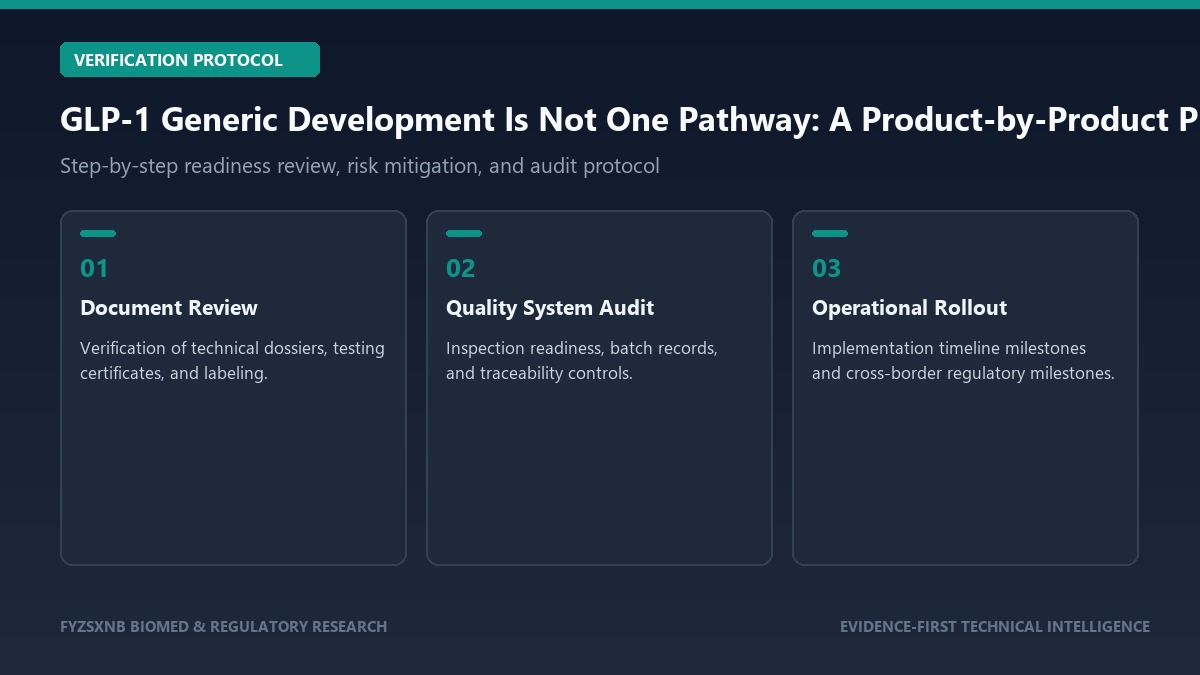
Background: What the September 2026 workshop covers
The FDA and CRCG co-host a two-day hybrid (virtual and in-person) workshop on September 23-24, 2026, at The Universities at Shady Grove in Rockville, Maryland. Virtual attendance is free (S01, S02).
Fact (C01): The workshop is scheduled for September 23-24, 2026 and covers generic GLP-1 agonist development (S01).
The stated goal is to provide clarity and foster discussions on evidence-based approaches to establish acceptable critical quality attributes of recombinant and synthetic generic peptide products, address manufacturing quality considerations, and tackle the unique challenges associated with drug-device combination products, where applicable (S01).
Workshop topic areas (from S01 and S02)
- Regulatory pathways and clinical contexts for GLP-1 products.
- API characterization, analytical characterization strategies, and impurity profiling.
- Recombinant peptide production and host cell impurities.
- Oral peptide formulation development and bioequivalence study design.
- Device user interface, human factors, and device quality and integration.
The FDA event page lists the regulated products as “Drugs” and “Generic Drugs,” with content current as of July 23, 2026 (S01).
What this article does not predict
This checklist is a pre-workshop organizing tool, not a forecast. It does not predict or assert any of the following:
- Generic launch dates. Timing depends on patent and exclusivity status, application review, and approval, none of which are assessed here.
- Freedom to operate. Patent landscape is mentioned as a workshop topic (S02), but this article makes no freedom-to-operate assessment for any product.
- Substitutability or interchangeability. These are distinct regulatory determinations. This article does not claim that any GLP-1 product is substitutable or interchangeable.
- Equivalence. This article does not assert therapeutic equivalence, bioequivalence, or biosimilarity for any product.
- Workshop conclusions. The workshop has not yet occurred. This article does not predict what FDA will decide, what guidance will issue, or what consensus will emerge from the sessions.
- Final FDA policy. A workshop is a forum for discussion, not a policy announcement. Do not treat any topic listed here as established FDA policy.
Medical and regulatory scope disclaimer
This article is provided for informational and educational purposes only. It is not legal, regulatory, medical, or pharmaceutical advice. It does not constitute a regulatory submission, a freedom-to-operate opinion, or a determination of bioequivalence, biosimilarity, interchangeability, or substitutability for any product.
All regulatory determinations must be made by qualified regulatory affairs professionals and legal counsel based on current, product-specific information retrieved directly from FDA databases, including the Orange Book (S03) and the Purple Book (S04), and in consultation with FDA where appropriate. Patent and exclusivity status changes over time and must be verified at the time of any decision.
The FDA/CRCG workshop referenced in this article is a scientific discussion forum. Its content does not, by itself, establish binding FDA policy, guidance, or legal requirements. Any outcomes from the workshop should be evaluated against subsequently published FDA guidance and regulations.
Update trigger: September 25, 2026
Scheduled review date: September 25, 2026 (the day after the workshop concludes on September 24).
On or after this date, this article should be reviewed and updated to incorporate:
- Any publicly announced outcomes, clarifications, or new guidance discussed during the workshop.
- Any updates to the list of GLP-1 reference products identified as available for generic development.
- Any changes to FDA Product-Specific Guidance documents referenced or released in connection with the workshop.
- Any clarification of the Orange Book vs. Purple Book classification for specific GLP-1 products.
Until that review is completed, this article reflects only the information available as of July 30, 2026 and should be treated as a pre-workshop reference, not a post-workshop summary.
Sources
The following four sources are the only evidence used in this article. No other URLs, citations, or external data have been introduced.
-
S01 (regulator primary):
FDA/Center for Research on Complex Generics (CRCG) Workshop on Navigating the GLP-1 Generic Drug Pathway – 09/23/2026
— U.S. Food and Drug Administration. Content current as of 2026-07-23. Fetched 2026-07-30. -
S02 (co-organizer primary):
Navigating the GLP-1 Generic Drug Pathway
— Center for Research on Complex Generics (CRCG). Fetched 2026-07-30. -
S03 (regulator database):
Orange Book: Approved Drug Products with Therapeutic Equivalence Evaluations
— U.S. Food and Drug Administration. Interactive database; search per product for reference drug, patent, and exclusivity information. -
S04 (regulator database):
Purple Book: Database of Licensed Biological Products
— U.S. Food and Drug Administration. Interactive database; search per product for biologic reference-product and biosimilar status.