A practical, seven-item readiness checklist ahead of FDA’s August 27, 2026 virtual workshop on statistical considerations for digitally derived endpoints — separating what current guidance already expects from what the workshop will only begin to discuss.
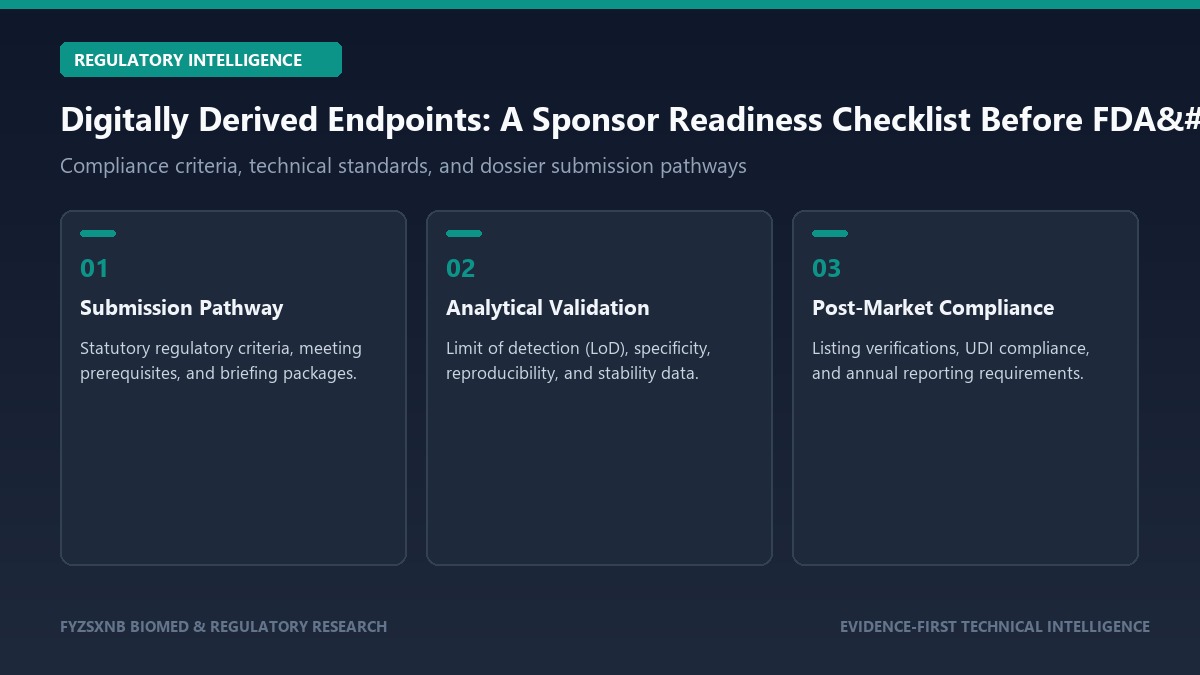
The Readiness Checklist at a Glance
Before FDA’s August 27, 2026 workshop on statistical considerations for digitally derived endpoints in drug and biological product trials, sponsors should be able to answer seven questions. These reflect expectations already embedded in current guidance — FDA’s digital health technologies (DHT) guidance and ICH E9(R1) — plus the topics the workshop will discuss. None of them imply that FDA has accepted any specific sensor, algorithm, endpoint, or analytical method.
- Clinical question: What treatment effect does the digital endpoint measure, and what clinical question does it answer?
- Estimand: Is the estimand framed per ICH E9(R1) — population, treatment, variable, intercurrent events, and population-level summary?
- Fit-for-purpose validation: Is the DHT, sensor, or algorithm documented as fit-for-purpose for the specific context of use?
- Measurement error: Have measurement error, bias, and sources of variability been characterized?
- Data standards: Do the data conform to expected standards and align with the workshop’s data-standards scope?
- Missing data: Is the missing-data strategy pre-specified, including the mechanisms and reasons for missingness?
- Sensitivity analysis: Are sensitivity analyses pre-specified to test the robustness of the primary estimand?
This seven-item structure is an editorial organizing framework. It is grounded in concepts present in current guidance but is not a verbatim list from any single FDA or ICH document.
Current Final Guidance: What Is Already in Effect
Two documents are the active preparation inputs today. The August 27, 2026 workshop itself is a discussion forum and is not binding guidance. Until the workshop produces any follow-up, sponsors should anchor readiness to the guidance already in force.
1. FDA DHT Guidance for Remote Data Acquisition (December 2023, final)
FDA’s December 2023 final guidance on digital health technologies for remote data acquisition in clinical investigations addresses how sponsors can use DHTs to capture data remotely. It introduces the fit-for-purpose concept: a DHT and the data it produces should be appropriate for the specific context of use in a given clinical investigation. This is the operative expectation sponsors must meet today for DHT-acquired data.
Read the FDA DHT guidance (S02)
2. ICH E9(R1): Estimands and Sensitivity Analysis
The ICH E9(R1) addendum provides the framework for defining the estimand — the precise treatment effect a trial is designed to estimate — and for pre-specifying sensitivity analyses that test the robustness of the primary estimand to assumptions about intercurrent events and missing data. For digitally derived endpoints, sponsors should articulate what is being measured and how deviations from the intended data collection are handled in a manner consistent with the ICH E9(R1) framework.
Workshop Questions: What Remains Open
According to the FDA event page, the August 27, 2026 virtual workshop — convened by Duke-Margolis under an FDA cooperative agreement, running 09:30–15:45 ET — will cover statistical considerations for digitally derived endpoints. The stated discussion topics are:
- Data standards for digitally derived endpoint data.
- Analytical methods appropriate for these endpoints.
- Continuous glucose monitoring (CGM) submission specifications.
These topics are open for discussion, not resolved. The workshop may surface questions, perspectives, and possible directions, but it does not by itself establish accepted methods or specifications. Sponsors should treat anything discussed at the workshop as signal to monitor, not as adoptable requirements, until FDA issues follow-up guidance.
Detailed Checklist: Seven Questions to Answer Before the Workshop
Use the following checkpoints as a self-assessment. Each item lists what to confirm against current guidance and what to listen for during the workshop. None of these imply endorsement of any particular approach.
1. Clinical Question
Define the treatment effect you intend to measure and the clinical question the digital endpoint is meant to answer. A digitally derived endpoint is only useful if it maps to a clinically meaningful question.
- Can you state, in one sentence, the clinical question the endpoint addresses?
- Is the endpoint derived from a measurement that is clinically relevant to the target population?
- Have you distinguished the endpoint concept from the sensor or algorithm that produces it?
- Workshop watch: Listen for any discussion of how clinical relevance is established for digitally derived measures.
2. Estimand
Frame the estimand explicitly per the ICH E9(R1) framework. The estimand should specify the five attributes: population, treatment, variable (endpoint), intercurrent events, and population-level summary.
- Is the treatment effect precisely defined, including how intercurrent events (for example, treatment discontinuation or use of rescue therapy) are handled?
- Is the endpoint variable clearly tied to the digital measurement, including the time window and derivation rule?
- Is the population-level summary (for example, mean difference, responder proportion) specified?
- Workshop watch: Listen for discussion of estimand attributes specific to continuous, high-frequency digital data.
3. Fit-for-Purpose Validation
Confirm that the DHT, sensor, or algorithm is documented as fit-for-purpose for the specific context of use, consistent with FDA’s December 2023 DHT guidance.
- Have you defined the context of use (population, setting, measurement purpose)?
- Is there evidence that the technology measures what it is intended to measure in that context?
- Have you documented the data flow from sensor to derived endpoint, including any algorithmic processing?
- Workshop watch: Listen for any alignment between fit-for-purpose expectations and the analytical methods under discussion.
4. Measurement Error
Characterize measurement error, bias, and sources of variability. Digitally derived endpoints can introduce variability from the device, the algorithm, the wearer, and the environment.
- Have you identified and quantified the principal sources of measurement error?
- Have you assessed both systematic bias and random variability?
- Do you understand how device drift, calibration, or algorithm updates could affect the measurement over time?
- Workshop watch: Listen for how measurement error is expected to be reported or bounded in submissions.
5. Data Standards
Ensure the data conform to expected standards and align with the workshop’s data-standards scope. Data standards support reviewability and interoperability across submissions.
- Do your datasets follow a recognized standard appropriate to the submission type?
- Are metadata, provenance, and derivation rules documented for the digitally derived variables?
- Can a reviewer trace a derived value back to its raw sensor input?
- Workshop watch: Data standards are an explicit workshop topic; capture any specifications or expectations signaled.
6. Missing Data
Pre-specify the missing-data strategy, including the assumed mechanisms and the reasons data may be missing. Digital data collection can produce intermittent gaps, device non-wear, or dropout that differ from traditional trials.
- Have you anticipated the patterns of missingness specific to continuous digital data (for example, non-wear intervals, sensor failures)?
- Is the primary analysis’s handling of missing data pre-specified and justified?
- Have you distinguished missingness due to intercurrent events from missingness due to device or data-collection issues?
- Workshop watch: Listen for discussion of missing-data methods applicable to high-frequency digital streams.
7. Sensitivity Analysis
Pre-specify sensitivity analyses that test the robustness of the primary estimand to key assumptions, consistent with the ICH E9(R1) framework.
- Do sensitivity analyses address the principal departures from the primary estimand’s assumptions (for example, handling of intercurrent events and missing data)?
- Are the analyses pre-specified in the protocol or statistical analysis plan, not added post hoc?
- Do they test sensitivity to measurement-error assumptions where relevant?
- Workshop watch: Listen for any expectations on the scope or number of sensitivity analyses for digitally derived endpoints.
Distinguishing Fact From Inference
To keep the evidence boundary clear:
- Fact: The workshop is scheduled for August 27, 2026 (09:30–15:45 ET), convened by Duke-Margolis under an FDA cooperative agreement, and will discuss data standards, analytical methods, and CGM submission specifications.
- Fact: FDA’s December 2023 DHT guidance and ICH E9(R1) are currently in effect and are the operative preparation inputs.
- Fact: The workshop is not binding guidance.
- Editorial inference (labeled as such): The seven-item checklist is a useful way for sponsors to self-assess readiness. It is the article’s organizing structure, not an FDA-endorsed framework.
- Not asserted: Any prediction of what the workshop will conclude, or that FDA has accepted a specific sensor, algorithm, endpoint, or missing-data method.
Sources
Only the following whitelisted sources are cited in this article. All links open in a new tab.
- S01 (regulator_primary): FDA Virtual Workshop: Digital Health Technologies and Statistical Considerations for Digitally Derived Endpoints. U.S. FDA. Scheduled 2026-08-27. https://www.fda.gov/drugs/news-events-human-drugs/fda-virtual-workshop-digital-health-technologies-and-statistical-considerations-digitally-derived
- S02 (regulator_guidance): Digital Health Technologies for Remote Data Acquisition in Clinical Investigations. U.S. FDA, December 2023 (final). https://www.fda.gov/regulatory-information/search-fda-guidance-documents/digital-health-technologies-remote-data-acquisition-clinical-investigations
- S03 (regulator_guidance): E9(R1) Statistical Principles for Clinical Trials: Addendum on Estimands and Sensitivity Analysis. ICH / U.S. FDA. https://www.fda.gov/regulatory-information/search-fda-guidance-documents/e9r1-statistical-principles-clinical-trials-addendum-estimands-and-sensitivity-analysis-clinical
Update Trigger
Next scheduled review: 2026-08-28 — the day after the FDA workshop. On that date, this article should be revisited to incorporate any publicly posted workshop materials, slides, transcripts, or FDA statements, and to re-evaluate which topics have moved from “open” to “clarified.” Until that update, this article remains a pre-workshop checklist and must not be presented as reflecting workshop outcomes.
If the workshop is postponed, rescheduled, or if FDA publishes related guidance before the event, an earlier update may be warranted.