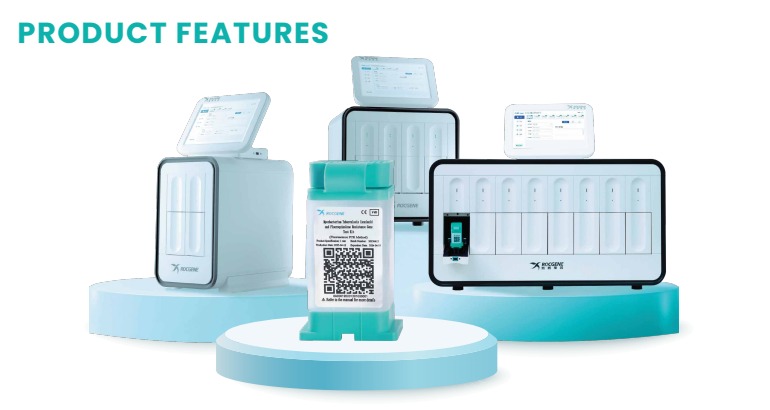
The iFIND INH/FQs (IFQ) Assay is a molecular cartridge for simultaneous detection of isoniazid (INH) and fluoroquinolone (FQ) resistance. A peer-reviewed study by Ou et al., published in Microbiology Spectrum in March 2026, evaluated the assay with frozen sputum specimens and phenotypic drug-susceptibility testing (pDST). It reported 97.59% sensitivity and 98.10% specificity for INH resistance, and sensitivity of 92.16% for levofloxacin and 92.00% for moxifloxacin resistance. The supplied brochure adds broader claims – including non-sputum matrices, storage at 2 to 28 degrees Celsius and CE-IVD status – that still require SKU-level regulatory and matrix-specific evidence.
2. Why Simultaneous INH/FQ Resistance Information Matters
Isoniazid and fluoroquinolone resistance are central concerns in tuberculosis management. According to the WHO 2025 drug-resistant TB burden page, an estimated 1.5 million incident isoniazid-resistant TB cases occurred in 2024, and approximately 18 percent of multidrug-resistant or rifampicin-resistant (MDR/RR-TB) cases had pre-XDR-TB, defined there as resistance to any fluoroquinolone tested. These figures underscore the operational value of tools that can flag both INH and FQ resistance quickly, particularly in settings where treatment decisions must be made before line-probe assay or phenotypic DST results are available.
The WHO 2023 mutation catalogue explains that INH resistance is largely mediated by mutations in katG and the inhA promoter region, while fluoroquinolone resistance is predominantly associated with mutations in gyrA. These mechanisms are considered sufficiently understood for molecular detection. However, understanding the biological basis for resistance is distinct from validating a specific commercial product. The WHO 2025 Module 3, which combines guidance on TB diagnosis and drug-resistance detection, does not endorse or recommend the iFIND IFQ cartridge. Procurement teams seeking broader context on China-origin molecular diagnostics can explore our China Global Biomed category for related analyses.
3. What the Brochure Claims
The manufacturer brochure, referenced internally as iFIND IFQ-EN-20260626, makes the following claims. None of these have been independently verified:
- Turnaround: Results in 120 minutes or less.
- Target genes: katG and inhA for INH resistance; gyrA for fluoroquinolone resistance.
- Method: Nested PCR with multiplex molecular-beacon probe melting-curve analysis.
- Limit of detection: 100 CFU/mL.
- Specimen types: Sputum, bronchoalveolar lavage fluid (BALF), pleural fluid, ascites, pus, cerebrospinal fluid (CSF), gastric aspirate, urine, stool, tissue, and bacterial isolates.
- Storage: Lyophilized reagent beads at 2 to 28 degrees Celsius.
- Catalogue numbers: 10210102A (10 tests per box) and 10210102B (50 tests per box).
- CE-IVD claim: The brochure states CE-IVD status on page 4, but no certificate has been supplied for verification.
For related iFIND platform procurement context, see our fully automated molecular POCT system iFIND procurement guide and our iFIND TBR MTB/RIF cartridge procurement guide for parallel analyses of other cartridges in the same product family.
4. Peer-Reviewed Performance and Study Limits
The table below summarizes the locatable peer-reviewed study. It used frozen sputum specimens; pDST and sequencing served as reference methods. The study does not establish performance for the brochure’s claimed non-sputum matrices.
| Measure | Result | 95% CI or denominator |
|---|---|---|
| INH resistance sensitivity | 97.59% | 91.63-99.34% |
| INH resistance specificity | 98.10% | 94.57-99.35% |
| Levofloxacin resistance sensitivity | 92.16% | 81.50-96.91% |
| Levofloxacin resistance specificity | 97.33% | 93.89-98.85% |
| Moxifloxacin resistance sensitivity | 92.00% | 81.16-96.85% |
| Moxifloxacin resistance specificity | 96.81% | 93.21-98.53% |
| Calculated LoD | 20.79 CFU/mL for INH; 9.34 CFU/mL for FQ | 15.13-39.91; 7.54-13.10 |
| Indeterminate results | 2.8% for INH; 4.0% for FQ | 7/248; 10/248 |
The brochure’s separate aggregate tables show totals of 813 comparison records and include confidence intervals, but the brochure does not clearly define the unit of analysis or reconcile those totals with the 248 frozen sputum specimens in the published study. Treating 813 as 813 unique patients or samples would therefore be unsafe.
5. Why Agreement Against Conventional DST Is Not Enough
Reporting strong accuracy estimates is a starting point, not a complete procurement case. The journal paper resolves several gaps that the brochure leaves open, but important questions remain:
- Matrix scope: The publication evaluated frozen sputum. Its results cannot be extrapolated to CSF, pleural fluid, stool, tissue, urine or the other matrices listed in the brochure.
- Indeterminate results: The paper reports 7/248 indeterminate INH results and 10/248 indeterminate FQ results. Buyers need site-specific repeat-testing and reportable-result cost assumptions.
- Mutation coverage: The assay detected the targeted mutations except one ahpC c.-6 mutation that is outside the stated panel. A wild-type molecular result does not exclude resistance mechanisms outside assay coverage.
- Discordant results: Sequencing agreed with iFIND in all five INH-discordant cases, but only five of nine FQ-discordant cases. This distinction matters when designing a reflex-testing algorithm.
- Brochure aggregation: The brochure’s total of 813 comparison records is not clearly explained as patients, specimens or drug-result observations.
- Generalizability: Procurement teams still need prospective, multi-site and local-population evidence, especially for low-bacillary-load and non-sputum specimens.
6. The March 2026 Study Is Locatable
The brochure’s incomplete citation can be resolved. The article is Xichao Ou et al., “iFIND INH/FQ: a LC-aNAAT assay for rapid simultaneous detection of isoniazid and fluoroquinolone resistance in Mycobacterium tuberculosis,” published in Microbiology Spectrum, volume 14, issue 3, on 3 March 2026. Its DOI is 10.1128/spectrum.03743-25, PubMed ID 41649261. Buyers should still request the full study report, IFU and regulatory file because peer review does not verify CE status, every specimen matrix or local market eligibility.
7. Regulatory and Procurement Red Flags
- CE-IVD certificate absent: The brochure claims CE-IVD status, but no certificate has been supplied for verification. Under the EU IVDR (Regulation 2017/746), CE-IVD marking requires conformity assessment, technical documentation, and, for higher-risk devices, notified-body involvement. The absence of a verifiable certificate means regulatory eligibility in the EU cannot be confirmed from the supplied materials.
- Exact SKU and intended-use scope absent: While catalogue numbers 10210102A and 10210102B are listed, the precise intended-use statement, compatible instrument model numbers, software versions, and geographic labelling for each SKU are not fully specified.
- Brochure and paper totals need reconciliation: The peer-reviewed paper evaluates 248 frozen sputum specimens, while the brochure presents aggregate comparison totals of 813 without clearly defining the unit. Request a mapping between the publication dataset and brochure tables.
- Broad specimen claim requires matrix-specific validation: The claim of 11 specimen types is unusually broad. Each matrix, particularly low-bacillary-load specimens such as CSF and pleural fluid, requires independent validation to establish sensitivity, specificity, and reproducibility.
- No verified WHO product recommendation: The WHO 2025 Module 3 does not list or recommend the iFIND IFQ cartridge. No WHO prequalification or expert review has been identified.
- No verified public price: No public pricing, tender history, or cost-per-test figure has been confirmed. Procurement teams should request a formal quotation and compare against alternatives.
8. Twelve-Point Evidence Request Checklist
Before issuing a purchase order or tender, request the following from the manufacturer or distributor:
- Full study report and supplementary files for DOI 10.1128/spectrum.03743-25.
- Reconciliation of the 248 published specimens with the brochure’s aggregate total of 813 comparison records.
- Prospective multi-site validation with predefined acceptance criteria.
- Specimen matrix breakdown showing sample counts and performance for each of the 11 claimed specimen types.
- Invalid, indeterminate and repeat-test rates by bacterial load and specimen type.
- Discordant-resolution methodology, including sequencing results for discrepant specimens.
- Site information: number of sites, countries, laboratory types, and biosafety levels.
- CE-IVD certificate with notified-body number, conformity assessment route, and expiry date.
- Intended-use statement specifying approved specimen types, compatible instruments, and software versions for each SKU.
- WHO prequalification status or evidence of WHO expert review, if any.
- Stability data supporting the 2 to 28 degree Celsius storage claim, including real-time and accelerated studies.
- Formal quotation with unit price, minimum order quantity, lead time, and warranty terms for both 10-test and 50-test configurations.
9. Frequently Asked Questions
Does WHO recommend the iFIND IFQ cartridge?
No. The WHO 2025 Module 3 on TB diagnosis and drug-resistance detection does not list, recommend, or endorse the iFIND IFQ cartridge. WHO publications cited in this article provide general context on TB drug-resistance burden and mutation mechanisms, not product-specific endorsement.
Is the CE-IVD mark verified?
No. The brochure states CE-IVD status on page 4, but no certificate has been supplied for verification. CE-IVD status cannot be confirmed from the materials provided. Under EU IVDR, manufacturers must maintain technical documentation and, for most IVDs in this category, obtain notified-body assessment.
What genes does the cartridge target?
The manufacturer claims the cartridge targets katG and inhA for isoniazid resistance and gyrA for fluoroquinolone resistance using nested PCR with multiplex molecular-beacon probe melting-curve analysis. These gene targets align with known resistance mechanisms described in the WHO mutation catalogue, but target alignment does not validate product performance.
What is the claimed turnaround time and limit of detection?
The brochure claims results in 120 minutes or less and a 100 CFU/mL limit of detection. The peer-reviewed study reports about 90 minutes sample-to-result and calculated LoDs of 20.79 CFU/mL for INH and 9.34 CFU/mL for FQ in its analytical design. These values are not interchangeable because they reflect different definitions and study conditions.
Can the cartridge be used on non-sputum specimens?
The brochure lists 11 specimen types, including CSF, pleural fluid, stool, and tissue. The peer-reviewed study evaluated frozen sputum only, so matrix-specific validation is essential before relying on performance claims for any non-sputum specimen type.
What is the storage requirement?
The brochure states that lyophilized reagent beads can be stored at 2 to 28 degrees Celsius. This storage range is convenient for cold-chain-limited settings, but stability data have not been independently reviewed.
10. Sources
- Manufacturer brochure: iFIND IFQ-EN-20260626.pdf (supplied to editorial team). Brochure specifications are manufacturer claims, not independently audited. Public use of brochure images authorized by user on 2026-07-27; certificate status: pending.
- Ou et al., iFIND INH/FQ, Microbiology Spectrum 14(3), 2026, DOI 10.1128/spectrum.03743-25
- WHO 2025 Module 3: TB Diagnosis and Drug-Resistance Detection
- WHO 2025 Global TB Report: Drug-Resistant TB Burden
- WHO 2023 Mutation Catalogue for TB
- EU IVDR Regulation 2017/746
- FYZSXNB: Fully Automated Molecular POCT System iFIND Procurement Guide
- FYZSXNB: China Global Biomed Category
- FYZSXNB: iFIND TBR MTB/RIF Cartridge Procurement Guide