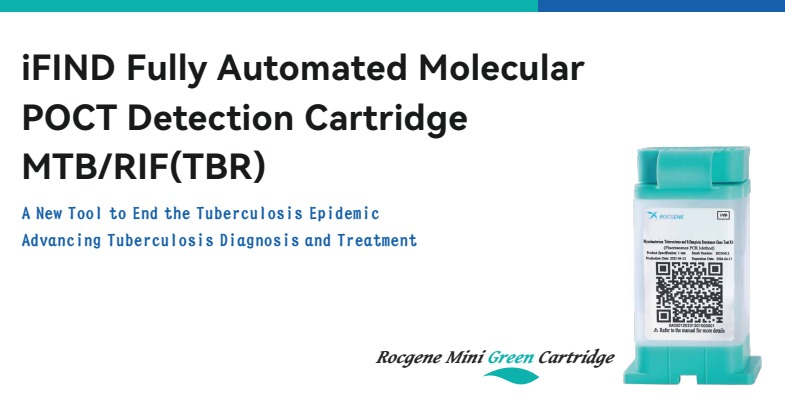
The iFIND TBR (MTB/RIF) Assay is a molecular diagnostic cartridge that detects Mycobacterium tuberculosis complex and rifampicin resistance using nested PCR combined with molecular-beacon melt analysis. One peer-reviewed preliminary study (Ou et al., 2024) assessed analytical material and frozen sputum samples, reporting a calculated limit of detection of 13.34 CFU/mL for MTB and 109.79 CFU/mL for rifampicin susceptibility, with sample-to-result within 90 minutes. Still unverified are the brochure’s broader specimen-matrix claims, its large-n agreement tables, a claimed CE-IVD marking, and the unnamed protocols behind its statement that validation data came from more than 100 medical institutions.
What the Brochure Claims
The supplied brochure identifies the product as the iFIND MTB/RIF (TBR) Assay. It claims detection of Mycobacterium tuberculosis complex and rifampicin resistance with a turnaround time of ≤120 minutes; page 3 specifies “report ready” in 85 minutes. The brochure states the assay uses nested PCR and molecular-beacon melt analysis on lyophilized reagents stored at 2–28 °C.
Claimed analytical sensitivity is 10 CFU/mL for TB identification and 100 CFU/mL for rifampicin resistance detection. Page 2 lists the molecular targets as IS6110, IS1081, and rpoB.
The brochure claims compatibility with sputum and numerous non-sputum matrices: lavage fluid, pleural fluid, pus, cerebrospinal fluid, gastric fluid, urine, stool, tissue, and strains. For a broader view of the platform, see our iFIND fully automated molecular POCT system procurement guide.
Target Discrepancy: IS1081 vs IS1087
A material discrepancy exists within the brochure itself. Page 2 states the detection targets are IS6110 + IS1081 + rpoB. However, the ordering table on page 4 lists the targets as IS6110 + IS1087 — omitting rpoB and substituting IS1087 for IS1081.
The peer-reviewed paper supports the page-2 formulation: it describes IS6110, IS1081, and rpoB as the assay targets. The “IS1087” reference on page 4 should be treated as an unresolved brochure and document-control issue. Procurement officers should require a corrected instructions-for-use (IFU) document that reconciles this inconsistency before any purchase order is issued.
Peer-Reviewed Evidence
The following table reproduces only values reported in Ou et al. (2024). This was a preliminary study using analytical material and frozen sputum samples.
| Parameter | Value | 95% CI |
|---|---|---|
| MTB LoD | 13.34 CFU/mL | 11.71–16.47 |
| RIF susceptibility LoD | 109.79 CFU/mL | 95–138.19 |
| Sensitivity vs culture (n=157) | 100% | 95.94–100 |
| Specificity vs culture (n=157) | 85.29% | 74.61–92.72 |
| Sensitivity vs phenotypic DST (n=82) | 98.15% | 90.11–99.95 |
| Specificity vs phenotypic DST (n=82) | 85.71% | 67.33–95.97 |
| Sample-to-result time | Within 90 minutes | — |
The paper explicitly states that its clinical validation is limited and discusses discordance, heteroresistance, and mutations outside the RRDR as potential causes.
Brochure Clinical-Data Tables (Manufacturer Claims, Not Independently Audited)
The following values appear on page 4 of the supplied brochure. They are manufacturer claims and have not been independently audited. They should not be treated as equivalent to the peer-reviewed study results above.
| Comparison | n | Agreement Type | Value |
|---|---|---|---|
| MTB vs WHO-recommended reagents | 926 | Positive agreement | 98.55% |
| MTB vs WHO-recommended reagents | 926 | Negative agreement | 92.76% |
| MTB vs WHO-recommended reagents | 926 | Overall agreement | 96.65% |
| Rifampicin resistance | 493 | Resistance agreement | 95.58% |
| Rifampicin resistance | 493 | Sensitivity agreement | 97.37% |
| Rifampicin resistance | 493 | Overall agreement | 96.96% |
| Culture comparison | 157 | Overall agreement | 93.63% |
| Phenotypic DST | 82 | Overall agreement | 93.90% |
Why Brochure Agreement Tables Are Not Interchangeable with the Paper
Although the brochure and the paper both cite n=157 for culture comparison and n=82 for phenotypic DST, the contexts differ in important ways:
- Sample type. The paper used frozen sputum samples. The brochure does not specify whether the same samples, fresh samples, or multiple specimen types were used for its larger n=926 and n=493 tables.
- Study scope. The paper explicitly calls its validation preliminary and limited. The brochure presents agreement figures without naming study sites, protocols, or whether independent auditors verified the data.
- Comparators. The paper used culture and phenotypic DST as reference standards. The brochure references “WHO-recommended reagents” without specifying which products, lot numbers, or testing algorithms were used.
- Sample size mismatch. The brochure’s n=926 and n=493 tables have no counterpart in the peer-reviewed literature. They cannot be independently assessed without a published protocol.
- Discordance transparency. The paper discusses discordant results, heteroresistance, and RRDR-outside mutations. The brochure does not provide equivalent discordance analysis.
Procurement decisions should therefore not rely on the brochure’s large-n agreement tables as a substitute for peer-reviewed evidence.
Regulatory and Procurement Red Flags
- CE-IVD certificate absent. Page 4 claims CE-IVD status, but no certificate has been supplied. Under EU IVDR, placing an IVD on the EU market requires a valid declaration of conformity and, for most class C/D devices, notified-body involvement. CE-IVD status is not verified.
- Exact SKU and intended-use scope absent. The brochure lists catalogue numbers 10210001A (10T/box) and 10210001B (50T/box) but does not specify the regulatory-intended-use statement tied to each SKU.
- Broad specimen claim requires matrix-specific evidence. The brochure claims nine specimen types beyond sputum, but the peer-reviewed paper assessed sputum only. Each matrix requires separate analytical and clinical validation.
- Over-100-institution validation statement lacks named sites or protocol. The brochure says its data come from validation studies across more than 100 medical institutions, but it provides no site list or protocol for the larger tables.
- Product-naming inconsistency. Page 4 references “iFIND MDR Assay,” while a companion brochure for a related product calls it “iFIND IFQ Assay” — see our iFIND IFQ INH/fluoroquinolone resistance cartridge guide. Naming inconsistency complicates regulatory traceability.
- No verified public price. No public pricing information has been confirmed for either SKU.
- Target discrepancy unresolved. As noted above, IS1081 (page 2) versus IS1087 (page 4) requires a corrected IFU.
For more context on Chinese manufacturers in global biomed markets, see our China Global Biomed category.
12-Point Evidence Request Checklist
Before issuing a purchase order, request the following from the manufacturer:
- CE-IVD certificate or EU IVDR declaration of conformity with notified-body number.
- Corrected IFU reconciling IS1081 vs IS1087 and confirming the full target panel (IS6110, IS1081, rpoB).
- SKU-specific intended-use statement for catalogue numbers 10210001A and 10210001B.
- Matrix-specific validation data for each claimed non-sputum specimen type (lavage fluid, pleural fluid, pus, CSF, gastric fluid, urine, stool, tissue, strains).
- Named study sites and protocols supporting the over-100-institution validation statement.
- Protocol and audit trail for the n=926 and n=493 agreement tables on page 4.
- Lot-to-lot reproducibility data for lyophilized reagents stored at 2–28 °C.
- Stability data supporting the claimed storage range, including real-time and accelerated studies.
- Cross-reactivity panel showing results for non-tuberculous mycobacteria (NTM) and common respiratory pathogens.
- Discordance analysis explaining false positives, false negatives, heteroresistance, and RRDR-outside mutations.
- WHO prequalification or EXPAND-TB status, if applicable — note that WHO 2025 Module 3 describes assessment pathways but does not endorse this product.
- Pricing quotation with Incoterm, lead time, and minimum order quantity for both SKUs.
Frequently Asked Questions
What does the iFIND TBR cartridge detect?
The brochure claims detection of M. tuberculosis complex and rifampicin resistance. The peer-reviewed paper supports this for sputum samples using IS6110, IS1081, and rpoB targets.
Is CE-IVD status verified?
No. The brochure claims CE-IVD, but no certificate has been supplied. CE-IVD status is not verified.
How fast is the test?
The brochure claims ≤120 minutes, with page 3 stating “report ready” in 85 minutes. The peer-reviewed paper reports sample-to-result within 90 minutes.
Can it test non-sputum specimens?
The brochure claims nine additional specimen types, but the peer-reviewed paper assessed sputum only. Matrix-specific evidence is required.
Does WHO recommend iFIND TBR?
No. WHO 2025 Module 3 describes product-assessment pathways for TB diagnostics but does not endorse or recommend this product.
What is the IS1081/IS1087 issue?
Page 2 of the brochure lists IS6110 + IS1081 + rpoB; the page 4 ordering table lists IS6110 + IS1087. This is an unresolved document-control discrepancy requiring a corrected IFU.
What is the verified limit of detection?
The peer-reviewed paper calculated 13.34 CFU/mL for MTB and 109.79 CFU/mL for rifampicin susceptibility. The brochure claims 10 CFU/mL and 100 CFU/mL respectively, but these have not been independently confirmed.
Sources
- iFIND TBR Cartridge manufacturer brochure (supplied PDF). Manufacturer claims; not independently audited. User authorized public use of brochure images on 2026-07-27; certificate pending.
- Ou et al., “Development and preliminary assessment of the iFIND TBR: all-in-one molecular diagnostic assay for rapid detection of Mycobacterium tuberculosis and rifampicin resistance,” Frontiers in Cellular and Infection Microbiology, 29 October 2024. DOI: 10.3389/fcimb.2024.1439099.
- WHO, WHO consolidated guidelines on tuberculosis, Module 3: Diagnosis – 2025. https://www.who.int/publications/i/item/9789240107984. Describes product-assessment pathways; does not endorse this product.
- WHO, Global Tuberculosis Report 2025 – TB disease burden: drug-resistant TB. https://www.who.int/teams/global-programme-on-tuberculosis-and-lung-health/tb-reports/global-tuberculosis-report-2025/tb-disease-burden/1-3-drug-resistant-tb.
- EU, Regulation (EU) 2017/746 on in vitro diagnostic medical devices (IVDR). https://eur-lex.europa.eu/eli/reg/2017/746/oj.