Chinese DCT & DHT Hybrid Transmissions in Russia: Wet Dual-Clutch Calibration, Valve Body Overhaul & Winter Fluid Guide
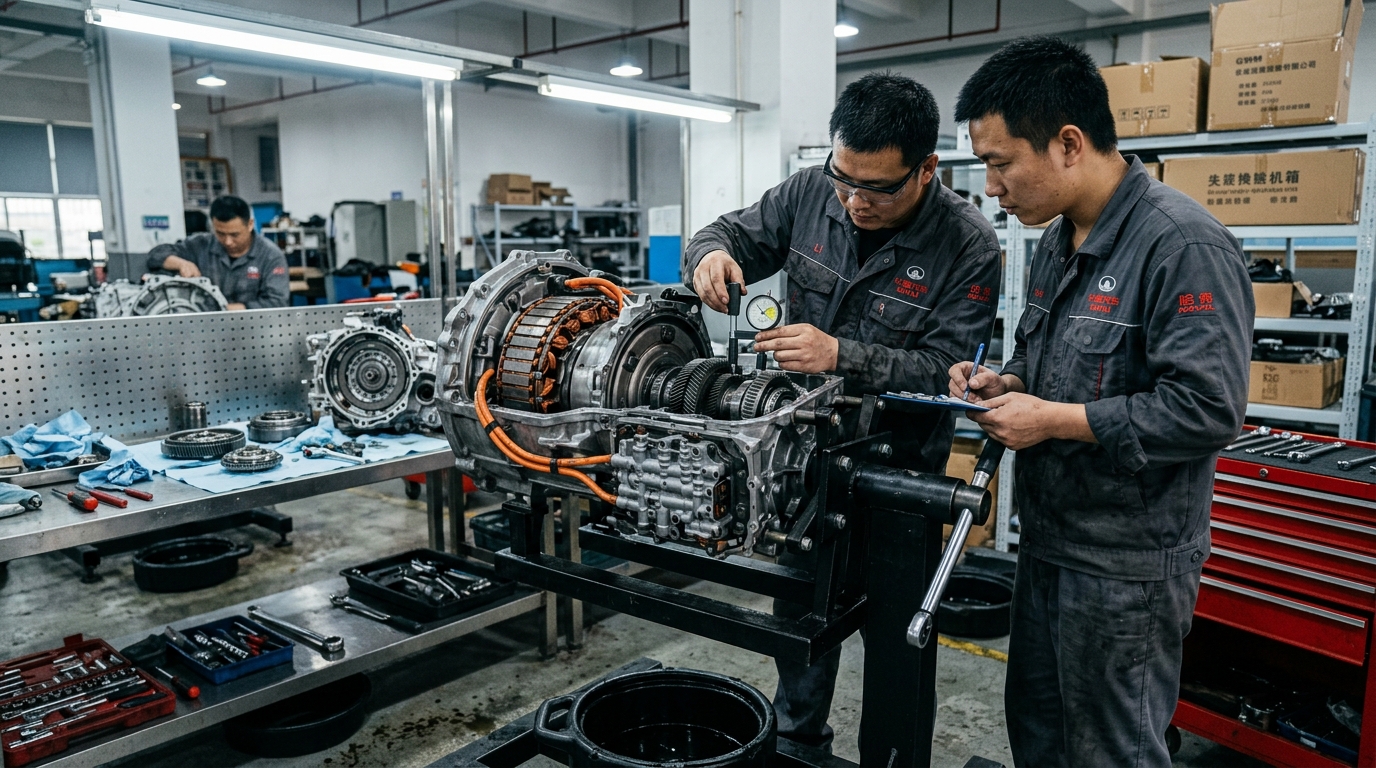
Transmission reconditioning specialists inspecting the integrated P1/P3 traction motor stator windings, dual-clutch input shaft, and compound planetary gearset on a heavy-duty rebuild stand.
Executive Summary: The Dual Transmission Architecture Dominance
Over 72% of modern Chinese passenger cars entering the Russian market utilize one of two advanced automatic transmission architectures: 7-speed wet Dual-Clutch Transmissions (7DCT) or multi-mode Dedicated Hybrid Transmissions (DHT). While traditional planetary automatic transmissions (AT) are reserved for premium body-on-frame SUVs like the Tank 300/500 and continuously variable transmissions (CVT) are limited to entry-level compacts, the volume crossover segments—represented by the Chery Tiggo 7/8 series, Haval Jolion/F7, Geely Atlas/Coolray, and Changan CS55 Plus—are universally powered by wet 7DCT or complex DHT units.
In the hybrid domain, Chinese manufacturers have pioneered multi-speed dedicated hybrid transmissions that depart fundamentally from Toyota’s power-split e-CVT architecture:
- Chery 3DHT125 (Kunpeng DHT): A 3-speed dual-motor hybrid transmission with 9 operating modes and 11 speed combinations, capable of delivering up to 510 Nm of system torque;
- Geely DHT Pro (3-Speed Hybrid Transmission): Integrating P1 and P2/P3 electric motors with a planetary gearbox, allowing full electric propulsion, series range extension, and direct engine mechanical drive across all three forward gears;
- Great Wall Motor L.E.M.O.N. 2DHT: A 2-speed parallel hybrid transmission utilizing an electro-hydraulic clutch pack to switch between city EV/series mode and high-speed highway direct gear drive.
For Russian independent workshops (СТО), these transmissions present a dual challenge: addressing low-temperature hydraulic hesitation during severe sub-zero winters (-30°C) and executing precise electro-hydraulic valve body recalibrations without access to OEM proprietary cloud servers.
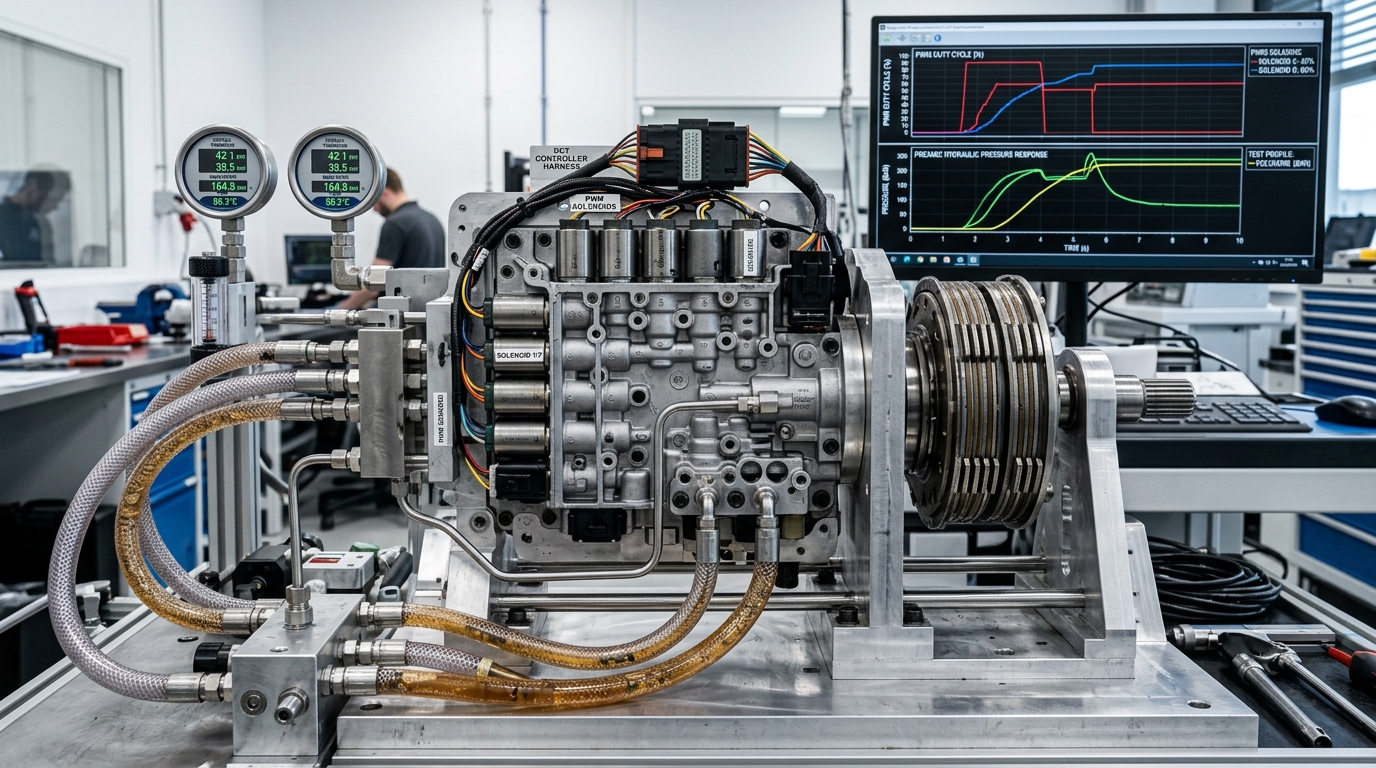
Automated flow bench verifying proportional PWM solenoid pressure curves, spool valve clearance, and clutch kiss-point hydraulic fill times under controlled fluid temperatures.
1. Common Sub-Zero Failure Modes in Russian Operations
Under severe Russian operating conditions, transmission fluid encounters extreme temperature gradients, cycling from -35°C upon cold start to over +110°C during heavy highway cruising or stop-and-go city traffic.
1.1 Cold-Start Clutch Judder & Touch-Point Adaptation Drift
In wet dual-clutch transmissions, the Transmission Control Module (TCM) continuously updates the clutch kiss-point (touch-point pressure)—the precise hydraulic pressure at which the odd (K1) and even (K2) friction plates begin transferring torque. When transmission fluid reaches -30°C, kinematic viscosity surges exponentially (from 6.5 cSt at 100°C to over 6,000 cSt at -30°C). This causes:
- Hydraulic Fill Delay: The electro-hydraulic proportional solenoids cannot displace thick fluid rapidly, leading to prolonged clutch engagement slip or sudden violent clamping;
- Adaptation Corruption: If the TCM attempts automated kiss-point relearn during extreme cold before the sump reaches +40°C, false calibration values are permanently stored in EEPROM, resulting in harsh 1-2 upshifts, severe hesitation when moving from standstill, and engine stalling upon coming to a stop.
1.2 Electro-Hydraulic Valve Body Bore Wear & Solenoid Sticking
In both 7DCT and DHT units, the mechatronic valve body manages line pressures between 18 and 32 bar. Microscopic wear particles from wet clutch friction linings, suspended in aged transmission fluid, act as lapping compound within the aluminum valve bores. As solenoid spools stick, workshops observe characteristic DTCs:
- P0730 / P0746: Incorrect gear ratio or pressure control solenoid performance error;
- P2714 / P2715: Pressure control solenoid valve performance stuck off/on;
- P0841: Transmission fluid pressure sensor/switch circuit range/performance fault.
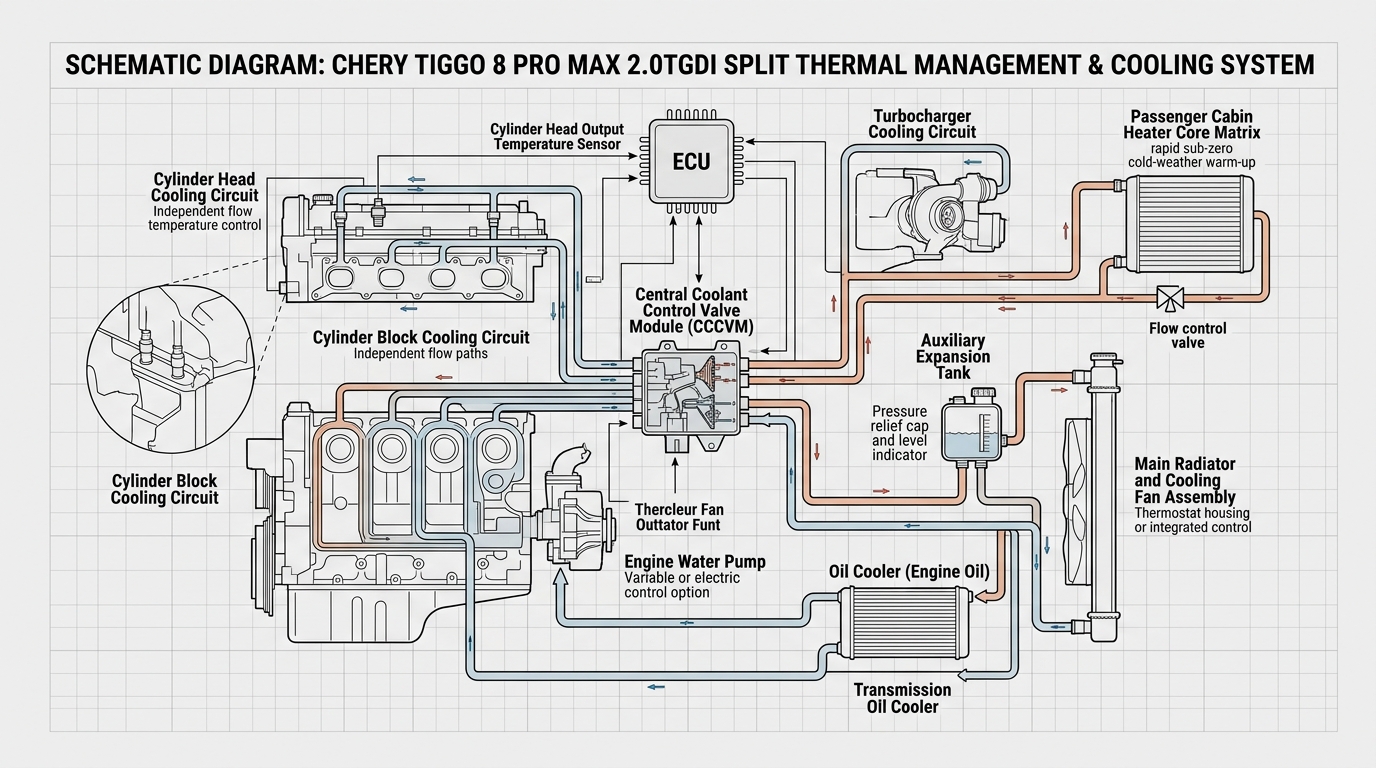
Schematic overview of the high-voltage electric oil pump (EOP), mechanical auxiliary pump, plate heat exchanger, and multi-channel cooling circuits maintaining optimum fluid viscosity in extreme temperatures.
2. Step-by-Step Diagnostic & Re-Calibration Protocol
When a Chinese 7DCT or DHT vehicle arrives at an independent workshop with shifting complaints, technicians must execute a standardized 4-phase diagnostic workflow before recommending total transmission replacement:
1. Verify transmission sump temperature between 35°C and 45°C using live scanner PID.
2. Inspect overflow level plug; evaluate fluid color, odor, and metal contamination index.
3. Hook manual pressure gauge to line pressure test port: verify baseline 18.5 ± 1.5 bar at idle.
PHASE 2: SOLENOID RESISTANCE & VOLTAGE DROP AUDIT
1. Disconnect TCM multi-pin harness; measure resistance across K1, K2, and line solenoids (normal range: 4.8 – 5.6 ohms @ 20°C).
2. Inspect ground straps for corrosion (resistance must remain below 0.2 ohms to prevent PWM signal drift).
PHASE 3: STATIC & DYNAMIC CLUTCH TOUCH-POINT RELEARN
1. Clear all historical clutch adaptation values in TCM memory.
2. Execute automated static kiss-point routine on vehicle lift (requires engine running in Park, brake depressed).
3. Execute dynamic road learn: 5 acceleration cycles from 0 to 60 km/h at 20% throttle, followed by coast-down deceleration.
PHASE 4: HYDRAULIC VALVE BODY BENCH TESTING (IF REPAIR REQUIRED)
1. Disassemble mechatronic module; test solenoid flow on automated test bench.
2. Inspect aluminum bores using vacuum decay tester (vacuum must hold > 18 in-Hg).
3. Ream worn bores and install hard-anodized oversize Sonnax-type repair spools if available.
3. Technical Comparison of Leading Chinese Transmissions
| Transmission Model | Architecture | Max Input Torque | Fluid Specification | Recommended Service Interval |
|---|---|---|---|---|
| Geely / Volvo 7DCT330 | 7-Speed Wet Dual-Clutch | 330 Nm | Shell DCTF-G / Castrol BOT 351 C4 | 50,000 km / 3 Years |
| Great Wall 7DCT450 | 7-Speed Wet Dual-Clutch | 450 Nm | GWM DCTF-2 / Fuchs Titan DCTF 52529 | 45,000 km / 3 Years |
| Chery 738DHA (Getrag 7DCT300) | 7-Speed Wet Dual-Clutch | 300 – 320 Nm | Pentosin FFL-7 / Castrol Transmax DUAL | 50,000 km / 3 Years |
| Chery 3DHT125 (Kunpeng) | 3-Speed Dual-Motor Hybrid | 510 Nm (System) | Ultra-Low-Viscosity Synthetic DHTF (Dielectric Compatible) | 40,000 km (Severe Duty) |
| Geely DHT Pro (Leishen) | 3-Speed Dual-Motor Hybrid | 4920 Nm (Wheel) | Dedicated Geely Hybrid Fluid (Low EC Conductivity) | 40,000 km / 2 Years |
4. B2B Commercial & Tooling Opportunities for Transmission Shops
Workshop Rebuilding Margin Analysis
Replacing a complete Chinese 7DCT or DHT assembly through official dealer channels typically costs between 350,000 and 700,000 RUB (3,800 to 7,500 USD), often with delivery wait times of 4 to 8 weeks. Independent transmission repair centers that invest in specialized diagnostic and rebuild capabilities achieve outstanding commercial returns:
- Valve Body Overhaul & Solenoid Replacement: Average job ticket of 65,000 – 110,000 RUB with gross margins exceeding 60%;
- Clutch Pack Replacement & Touch-Point Calibration: Turnaround in 48 hours utilizing certified Tier-1 clutch replacement discs from Chinese OEM suppliers;
- Dedicated Diagnostic Terminals: Deploying multi-brand Chinese scanners (Launch X-431 PAD VII, Autel MaxiSys MS909, Thinkcar Master) equipped with CAN-FD and DoIP protocols to execute official TCM relearns.
Conclusion
As Chinese vehicles dominate Russian roads, transmission repair is shifting decisively away from legacy Japanese and German units toward Chinese wet 7DCT and multi-mode DHT architectures. Russian independent workshops that master precise electro-hydraulic diagnostics, temperature-dependent touch-point calibration, and specialized low-viscosity fluid chemistry will secure a long-term competitive moat in the evolving automotive aftermarket.