Chinese EV & Hybrid Battery Remanufacturing in Russia: High-Voltage Safety Protocols, Cell Balancing & Sub-Zero Thermal Diagnostics
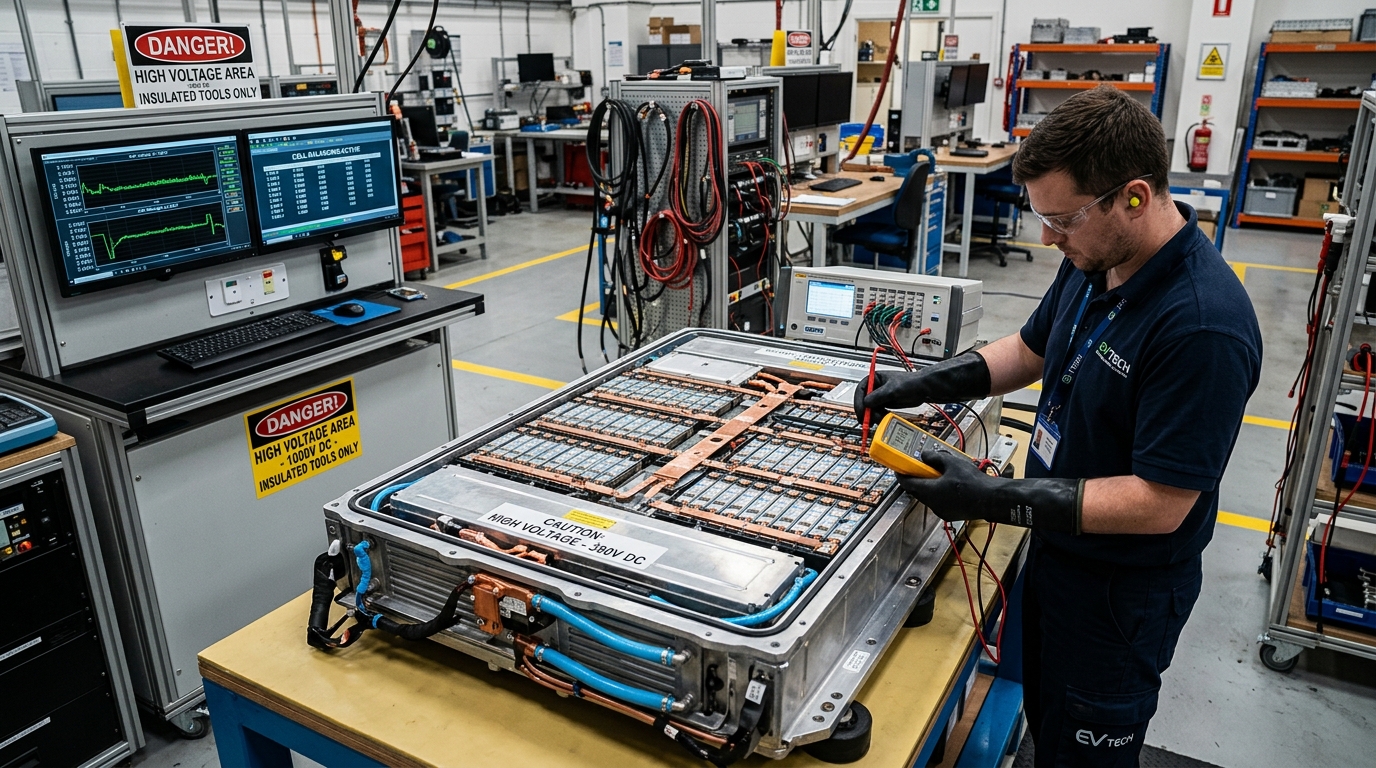
Automotive high-voltage technician in certified 1000V Class 0 insulating gloves verifying individual cell voltages, busbar resistance, and liquid cooling channel integrity on an opened 380V lithium-ion pack.
Executive Summary: High-Voltage Reality Meets Severe Russian Winter
The Russian automotive landscape has undergone an unprecedented surge in premium Chinese New Energy Vehicles (NEVs). Luxury battery electric vehicles (BEVs) and extended-range electric vehicles (EREVs)—led by the Zeekr 001 / 009, Li Auto L7 / L8 / L9, Voyah Free / Dreamer, and BYD Tang / Han—now represent over 42,000 active units in major metropolitan zones like Moscow, Saint Petersburg, Kazan, and Novosibirsk. Almost all of these vehicles arrived via parallel import channels, devoid of official OEM factory warranty or direct cloud telematics support.
Operating high-voltage (400V and 800V) lithium-ion traction batteries in regions where winter temperatures plunge to between -25°C and -40°C introduces severe electrochemical and electro-mechanical stress:
- Kinetic Resistance Surges: Internal cell resistance increases by up to 350% at -30°C, causing dramatic voltage sag under acceleration and steep drops in usable capacity (State of Charge – SOC);
- Lithium Plating Danger During Fast DC Charging: Attempting rapid DC charging when battery cell temperatures remain below 0°C forces metallic lithium deposition onto the graphite anode, inducing irreversible capacity loss and dangerous internal micro-short circuits;
- Thermal Management Loop Failures: High-voltage Positive Temperature Coefficient (PTC) coolant heaters (operating at 350V–750V DC) draw up to 8 kW of continuous power to heat the cabin and battery. Frequent electrical element breakdowns trigger catastrophic vehicle immobilizer lockouts.
Despite this massive influx, less than 4% of Russian independent workshops (СТО) possess certified high-voltage safety tooling, cell balancing equipment, or the technical diagnostic procedures required to service traction battery packs safely. This engineering report establishes the foundational protocols for workshop safety, module-level diagnostics, and battery remanufacturing.
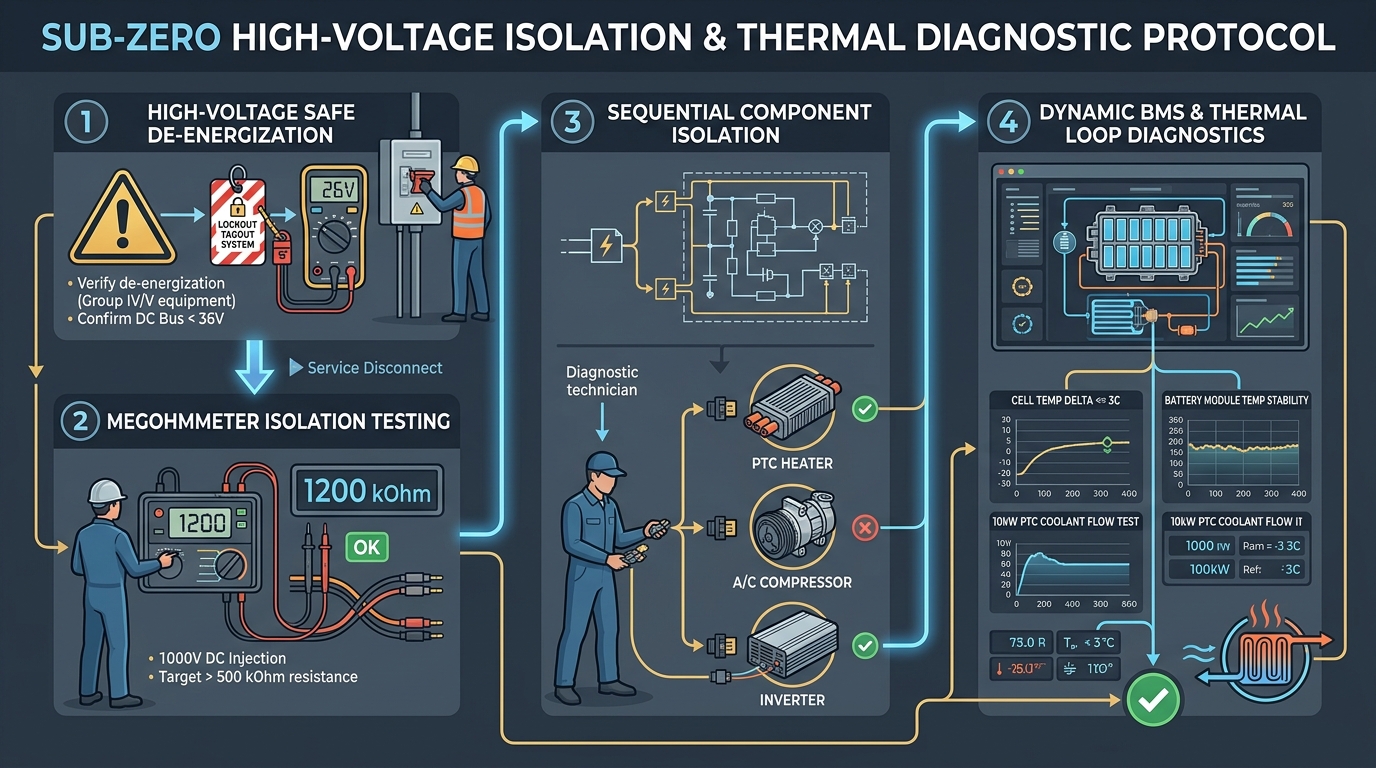
Technician verifying zero residual voltage across the inverter DC link capacitors using a calibrated CAT IV 1000V two-pole voltage detector following Manual Service Disconnect (MSD) removal and lockout/tagout (LOTO).
1. Standardized 5-Step High-Voltage De-Energization Protocol
Traction batteries on Chinese NEVs operate between 350V DC and 800V DC—levels that are immediately lethal upon direct contact. Every workshop handling an EV must enforce the following mandatory safety procedure before breaking any orange high-voltage connector:
STEP 1: SECURE WORKING PERIMETER & PPE DEPLOYMENT
– Establish a 2-meter barrier with high-voltage warning stanchions around the vehicle bay.
– Don Class 0 (1000V AC / 1500V DC rated) dielectric gloves with leather outer protectors, 40-cal arc flash face shield, and electrostatic discharge (ESD) safety boots.
STEP 2: LOW-VOLTAGE SLEEP & 12V AUXILIARY BATTERY DISCONNECT
– Switch ignition OFF; remove smart key fob to a RFID-shielded box beyond 10 meters.
– Wait 5 minutes for vehicle ECUs to enter complete sleep mode.
– Disconnect and insulate the 12V lead-acid or lithium-iron auxiliary ground cable.
STEP 3: EXTRACT MANUAL SERVICE DISCONNECT (MSD)
– Locate the MSD orange plug (typically under the rear seat cushion, center console, or pack belly).
– Release secondary lock, pull primary disconnect lever, and extract the service fuse plug.
– Apply a physical padlock (Lockout/Tagout – LOTO) to the MSD cavity; the technician keeps the sole key.
STEP 4: CAPACITIVE DISCHARGE BUFFER (10 MINUTES)
– Allow a strict 10-minute resting period for the inverter bleed resistors to discharge internal DC-link smoothing capacitors from 400V/800V down to safe potential (< 60V DC).
STEP 5: THREE-POINT ZERO VOLTAGE PROVING (MANDATORY VERIFICATION)
– Test CAT IV 1000V two-pole tester against a known live voltage source (prove tester works).
– Measure DC potential between HV+ and HV-, HV+ to chassis ground, and HV- to chassis ground.
– Zero-voltage confirmed ONLY when all readings remain strictly below 5.0V DC.
– Re-test CAT IV meter against live voltage source to ensure tester did not fail open during measurement.
2. Battery Cell Balancing & Module Remanufacturing
When an EV experiences sudden range loss, turtle mode (reduced propulsion power), or DTCs such as P0B29 / P0B24 (Battery Cell Voltage Imbalance), the root cause is rarely complete pack failure. Rather, it is typically an individual weak prismatic or blade cell module.
2.1 Cell Voltage Delta Diagnostics
The Battery Management System (BMS) continuously monitors every cell voltage via multi-channel slave measurement ICs (LTC6811 / ADBMS6830). In a healthy pack, cell-to-cell voltage variance ($\Delta V$) remains under 15 mV at 50% SOC.
- Mild Imbalance (25 mV < $\Delta V$ < 50 mV): Passive cell balancing resistors on the BMS board attempt bleeding high cells during overnight Level 2 AC charging. If AC charging is rarely used (DC-only fast charging), imbalance compounds rapidly;
- Critical Imbalance ($\Delta V$ > 80 mV): The BMS enters emergency limp-home mode. Under load, the weakest cell drops below the lower cut-off threshold (2.80V for NCM / 2.50V for LFP), triggering immediate drive power cutoff.
2.2 Automated Balancing & Module Replacement Protocol
Rather than condemning the entire 15,000 USD battery pack, specialized workshops utilize multi-channel battery cyclers and balancers:
- The battery pack cover is removed in an ISO-compliant clean room (temperature: 20±3°C, relative humidity < 50%);
- Technicians inspect flexible copper busbars for galvanic corrosion and micro-cracking caused by road vibration;
- An automated balancing unit connects to the cell module voltage sensing taps, discharging overcharged cells or topping up lagging cells at controlled 5A currents until cell delta drops below 5 mV across all 96 to 192 series connections;
- Defective cell groups exhibiting internal resistance ($R_i$) greater than 1.5x the pack average are unbolted or laser-desoldered and replaced with matched-capacity replacement modules.
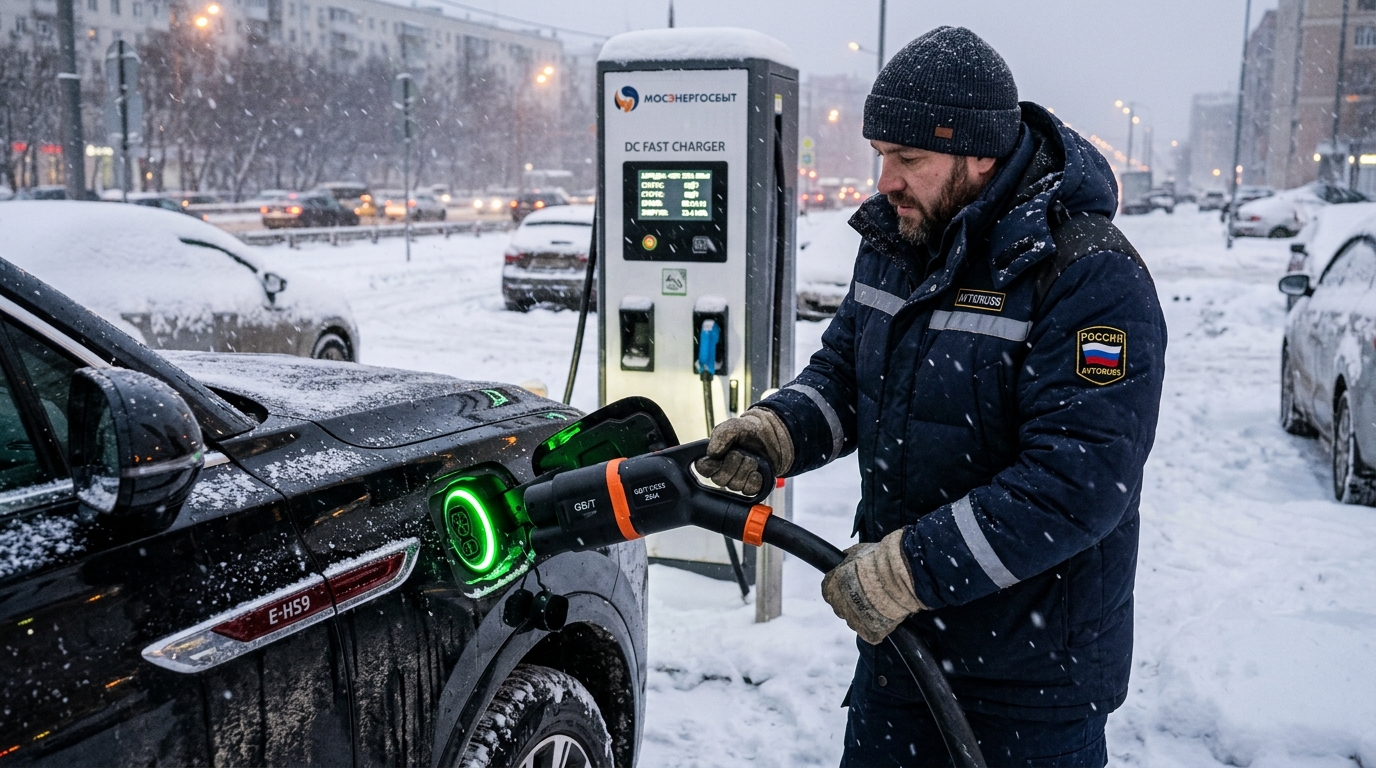
Chinese crossover EV undergoing high-current DC fast charging in a snowy Russian winter landscape. The thermal management system directs high-voltage PTC heater output to warm the battery pack above +15°C to avoid lithium plating.
3. Winter Thermal Loop Diagnostics: PTC Heaters & Isolation Faults
The thermal loop in modern Chinese NEVs is the most vulnerable subsystem during Russian winters. Two persistent failure modes dominate workshop service bays:
3.1 High-Voltage PTC Coolant Heater Breakdown
Unlike internal combustion engines that utilize waste engine heat, BEVs and EREVs (Li Auto, Voyah) rely on high-voltage PTC coolant heaters to circulate 65°C glycol to the cabin matrix and battery preconditioning plate. When electrical insulation degrades due to thermal cycling, ceramic PTC stones develop micro-arcs.
3.2 Road Slush Condensation & Pack Breathability Failures
Traction battery enclosures feature semi-permeable Gore-Tex style pressure relief and breathability vents. Under severe Russian winter cycling—driving over slush at -15°C followed by washing in a heated indoor garage—the rapid enclosure air contraction draws humid moisture past worn vent seals. Condensed water pooling at the bottom of the aluminum pack casing triggers intermittent high-voltage isolation faults that disappear when the vehicle dries out.
4. Commercial ROI & Essential Workshop Equipment
High-Voltage Workshop Profitability Matrix
A standard independent workshop can transition into an authorized regional EV battery repair center with an initial equipment investment of approximately 1.8M to 2.5M RUB (20,000 to 28,000 USD). Key tooling requirements and revenue potential:
- Certified 1000V Toolset & Safety Bay: Insulated socket sets, CAT IV meters, safety barrier gates, Class 0 PPE (Est. 250,000 RUB);
- Multi-Channel Battery Pack Cycler & Equalizer: Automated 24-channel module balancing unit (Est. 850,000 RUB);
- Smoke & Helium Pack Airtightness Tester: Verifying IP67 / IP68 seal integrity before reinstalling the battery under the vehicle (Est. 300,000 RUB);
- Average Service Ticket: Battery pack module rebalancing and resealing commands 85,000 to 180,000 RUB with a typical turnaround time of 3 business days, generating gross margins in excess of 68%.
Conclusion
The rapid expansion of Chinese New Energy Vehicles in the Russian Federation has created an unprecedented technological transition. As thousands of parallel-imported Zeekr, Li Auto, Voyah, and BYD vehicles enter their third winter without dealer coverage, the independent workshops that adopt stringent high-voltage safety standards, master module-level cell equalizing, and conquer sub-zero thermal management diagnostics will become the undisputed leaders of Russia’s next-generation automotive aftermarket.