Tank 300 in Russia: Heavy-Duty Drivetrain Maintenance, BorgWarner TOD Calibration & 4×4 Aftermarket Ecosystem Guide
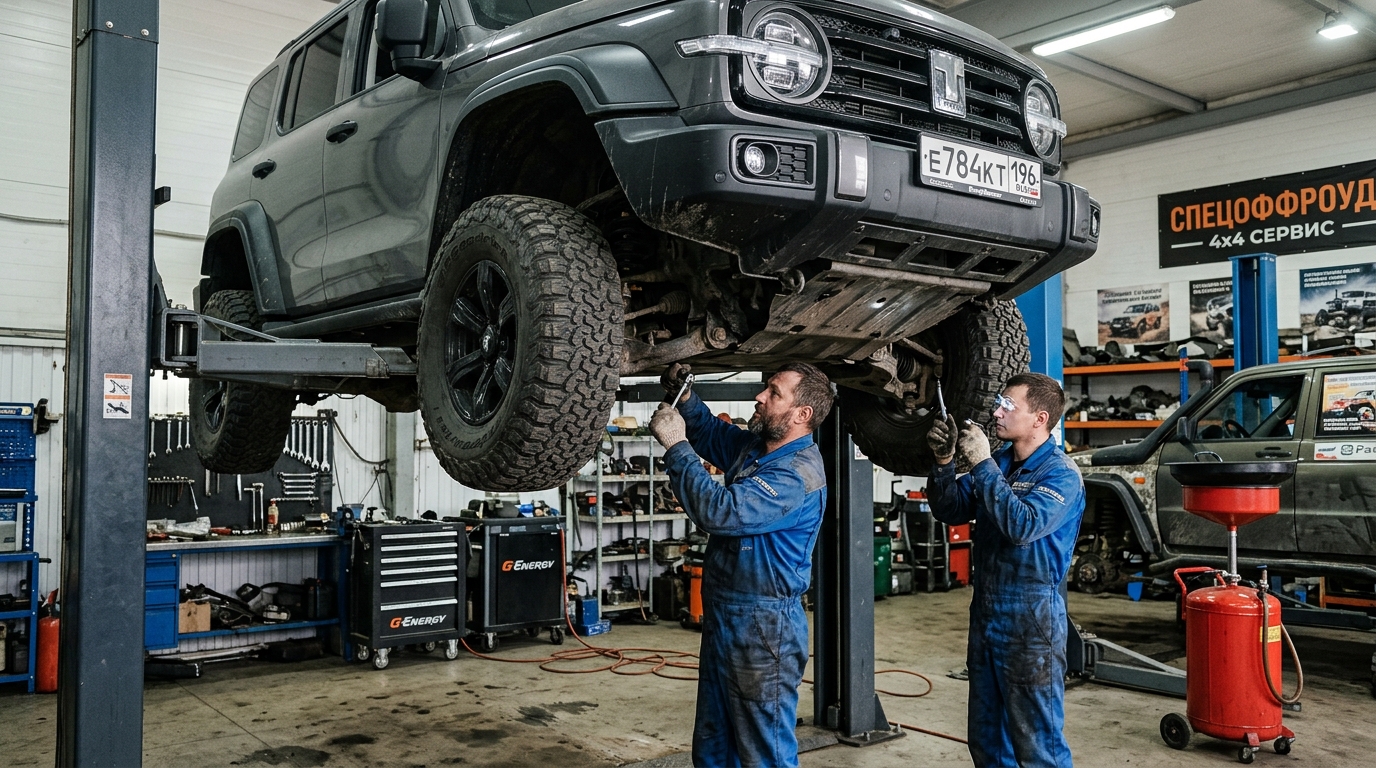
Automotive technicians examining the BorgWarner Torque-on-Demand (TOD) transfer case, front independent suspension control arms, and heavy-duty steel skid plate assembly on a hydraulic lift.
Executive Summary: The Tank 300 Phenomenon in the Russian Federation
Since its Russian commercial debut in early 2023, the Great Wall Motor (GWM) Tank 300 has transitioned from an exotic alternative to traditional Japanese and European off-roaders into the undisputed market leader in Russia’s premium 4×4 segment. By late 2026, active vehicle registrations across Russia exceeded 55,000 units. The vehicle’s popularity spans from daily metropolitan commuting in Moscow and Saint Petersburg to extreme overland expeditions across the Ural mountains, Lake Baikal ice tracks, and sub-Arctic routes in the Yamal Peninsula.
Engineered on GWM’s proprietary body-on-frame global off-road platform, the Tank 300 combines a longitudinally mounted 2.0-liter turbocharged E20CB gasoline engine (220 hp / 380 Nm), a licensed ZF 8HP50 8-speed automatic transmission, and an advanced four-wheel-drive architecture. The vehicle is supplied in two distinct drivetrain configurations:
- Part-Time 4WD (City / Adventure variants): Featuring a traditional mechanical transfer case with rigid 2H / 4H / 4L modes;
- Torque-on-Demand (TOD) AWD (Premium / City Edition variants): Utilizing an electronically controlled BorgWarner dual-mode transfer case with automated torque vectoring, multi-plate wet clutch engagement, and low-range reduction (2.64:1).
While the robust ladder frame and solid rear axle deliver exceptional structural durability, Russian operating realities—marked by sub-zero cold (-35°C), corrosive road brine, heavy towing, and extreme off-road mud and snow driving—present unique technical challenges to independent workshops (СТО). This engineering report provides an in-depth breakdown of drivetrain servicing, transfer case diagnostics, differential lock maintenance, and the rapidly growing B2B aftermarket tuning ecosystem.
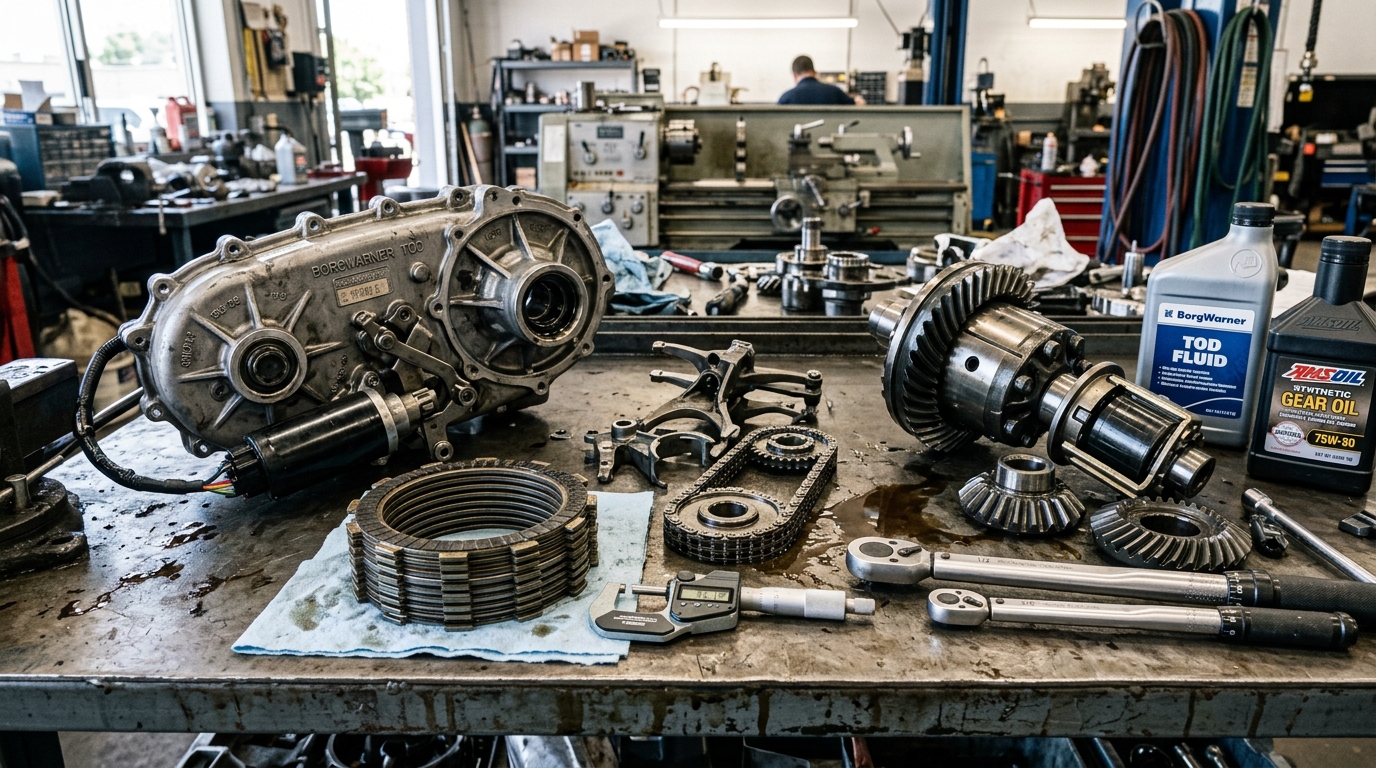
Disassembled transfer case housing revealing multi-plate wet friction disc stack, internal chain drive, shift fork mechanism, and Eaton electromagnetic differential locker solenoid assembly.
1. Drivetrain Architecture & Common Operational Stress Points
Understanding the exact failure modes of the Tank 300 drivetrain requires dissecting the interaction between mechanical torque limits, thermal loads, and electronic control algorithms.
1.1 BorgWarner TOD Transfer Case: Wet Clutch Wear & Chain Deflection
The BorgWarner Torque-on-Demand system relies on an electro-magnetic coil and ball-ramp mechanism to compress a multi-disc wet clutch pack, dynamically distributing torque between the rear axle (100:0 default) and the front axle (up to 50:50). In 4L (Low Range) mode, a mechanical dog clutch bypasses the friction pack to provide positive 50:50 mechanical locking with 2.64:1 torque multiplication.
Key symptoms of TOD distress encountered by Russian workshops include:
- Low-speed steering binding and judder on dry asphalt when returning from off-road trails (indicates clutch pack thermal warping or sticking solenoid);
- Rattling noise under hard acceleration in 4L (caused by internal Morse chain elongation slipping over transfer case drive sprockets);
- Diagnostic Trouble Code C1113 / C1114 stored in the All-Wheel Drive Control Unit (AWD-ECU), flagging actuator current anomalies or transfer case clutch thermal protection limits.
1.2 Eaton Electronic Differential Lockers (Front & Rear)
The Tank 300 features factory-installed Eaton electronic differential lockers on both the front independent differential and the heavy-duty rear solid axle. Engagement is initiated via dashboard rotary switches, which energize an electromagnetic stator coil (12V DC), forcing a ramped locking collar into mesh with the side gears.
Under Russian winter conditions, technicians frequently observe two primary failure mechanisms:
- Actuator Wiring Harness Damage: The external locking solenoid wiring harness at the front differential is exposed to flying gravel and ice build-up. Fractured insulation or connector water intrusion triggers open-circuit DTCs (U0102 / P1808) and flashing locker status icons on the instrument cluster;
- Engagement Delay in Extreme Cold: In temperatures below -25°C, high-viscosity mineral differential oils prevent the locking pins from sliding smoothly into their detents. Engaging lockers while wheels are actively spinning at differential speeds shears the locking dogs, resulting in metal shavings that contaminate the ring and pinion gear set.
2. ZF 8HP50 8-Speed Automatic Transmission Adaptation
The longitudinal 8-speed automatic transmission in the Tank 300 is manufactured under license from ZF Friedrichshafen (designated internally as 8HP50). While renowned for rapid gear shifts and high torque capacity (up to 500 Nm), its calibration in heavy off-road vehicles operating in severe cold requires dedicated maintenance protocols.
| Component | Factory Specification | Severe Russian Climate Protocol | Service Interval |
|---|---|---|---|
| ZF 8HP50 Automatic Transmission | ZF LifeguardFluid 8 / Shell M-L12108 | Fully Synthetic Low-Viscosity ATF (Viscosity @ -40°C < 8,500 mPa·s) | 40,000 km / 2 Years (Severe Off-Road) |
| BorgWarner TOD Transfer Case | GWM BOT 850 / Shell TF 0870 | Dedicated High-Shear TOD Transfer Case Fluid (GL-4 Synthetic) | 30,000 km / Annually before Winter |
| Front Independent Differential | SAE 75W-85 GL-5 Hypoid Oil | Synthetic 75W-90 GL-5 with Extreme Pressure (EP) Additives | 30,000 km |
| Rear Solid Axle Differential | SAE 75W-90 GL-5 Hypoid Oil | Synthetic 75W-90 / 75W-140 GL-5 with Limited-Slip Friction Modifier | 30,000 km (Check for water ingress after fording) |
During cold-start operation at -30°C, the Transmission Control Module (TCM) executes a warm-up software routine that delays upshifts and locks the torque converter damper clutch to accelerate catalytic converter and fluid warming. Workshops must instruct owners never to apply full throttle until transmission sump temperatures surpass +20°C.
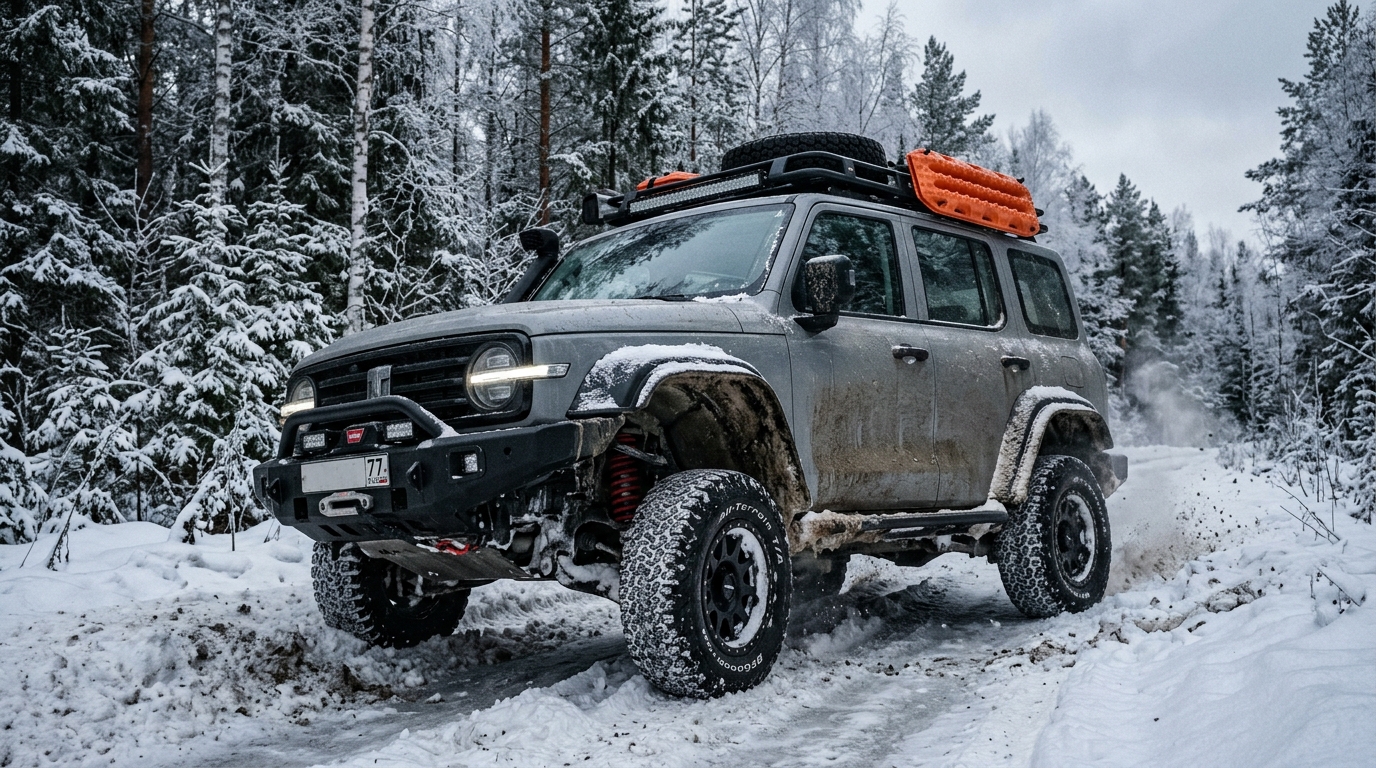
Field testing of reinforced remote-reservoir shock absorbers, heavy-duty coil springs, high-clearance all-terrain winter tires, and steel underbody protection navigating frozen Siberian taiga ruts.
3. Suspension Modifications & The 4×4 Aftermarket Ecosystem
The aftermarket modification sector for the Tank 300 in Russia represents an immense commercial opportunity for independent workshops. However, uncalculated suspension lift kits introduce critical mechanical and electronic hazards:
3.1 Suspension Lift Geometry Trade-offs (50mm / 2-inch Lifts)
Installing standard 50mm suspension lift kits increases ground clearance from 224mm to 275mm, accommodating 33-inch (285/70 R17) or 35-inch mud-terrain tires. However, lifting the chassis severely alters factory driveline angles:
- Front CV Axle Angle Exceedance: The independent front suspension driveshaft operating angles increase beyond 18 degrees, causing accelerated wear on the inner tripod joints and tearing rubber CV boots in extreme cold;
- Rear Prop-Shaft Driveline Vibration: The solid rear axle rotates, altering pinion flange angle relative to the transfer case output. Without an adjustable Panhard rod and trailing arm drop brackets, high-frequency driveline vibration manifests between 80 km/h and 100 km/h;
- Front Upper Control Arm Ball Joint Clearance: Factory stamped steel upper control arms contact the coil spring strut tower on full rebound. Professional workshops must replace them with forged or tubular aftermarket upper control arms with corrected ball joint angles.
3.2 Compulsory ADAS & Radar Recalibration After Lift Kits
Altering ride height and tire rolling radius directly disrupts the Tank 300’s Level 2 driver assistance perception suite. Raising the front bumper by 50mm tilts the forward-facing 77GHz millimeter-wave radar upwards by approximately 0.8 to 1.2 degrees. Consequently:
- The radar beam overshoots standard passenger car trunks at 50 meters, resulting in delayed Adaptive Cruise Control (ACC) deceleration;
- Overhead highway gantry signs and bridges are misinterpreted as stationary road obstacles, triggering violent phantom emergency braking (AEB) events at highway speeds.
Every professional workshop completing a lift kit installation must mandate a static target recalibration and dynamic radar learning drive before releasing the vehicle to the client.
4. Commercial & Workshop Tooling Opportunities
B2B Commercial Takeaway for Russian Independent Specialists
As the Tank 300 fleet ages into its second and third ownership cycles, dealership warranty attrition will surge beyond 65%. Independent 4×4 tuning centers and transmission workshops that establish dedicated Tank 300 service lanes can capture superior profit margins across three core service streams:
- Preventative Drivetrain Maintenance Packages: Pre-winter and post-expedition fluid flushes (Transmission + Transfer Case + Both Differentials) with premium low-pour-point synthetics;
- Transfer Case & Locker Remanufacturing: Component-level replacement of Morse drive chains, clutch packs, and Eaton electronic locker actuators without replacing the complete 4,000 USD transfer case assembly;
- Engineered Suspension & Protection Packages: Turnkey installation of heavy-duty control arms, calibrated remote-reservoir dampers, breathers elevated to firewall height, and certified ADAS re-zeroing.
Conclusion & Technical Recommendation
The GWM Tank 300 has redefined the Russian off-road landscape by combining genuine heavy-duty mechanical architecture with modern automotive intelligence. For Russian independent workshops, mastering its specific electro-mechanical interactions—from the BorgWarner TOD clutch parameters to ZF 8AT fluid dynamics and lift-induced ADAS geometry shifts—is the key to dominating the most lucrative segment in the modern Russian automotive aftermarket.