Software Localization for Chinese Connected Cars: Firmware Flashing, T-Box Telematics & SGW Security Bypass Guide
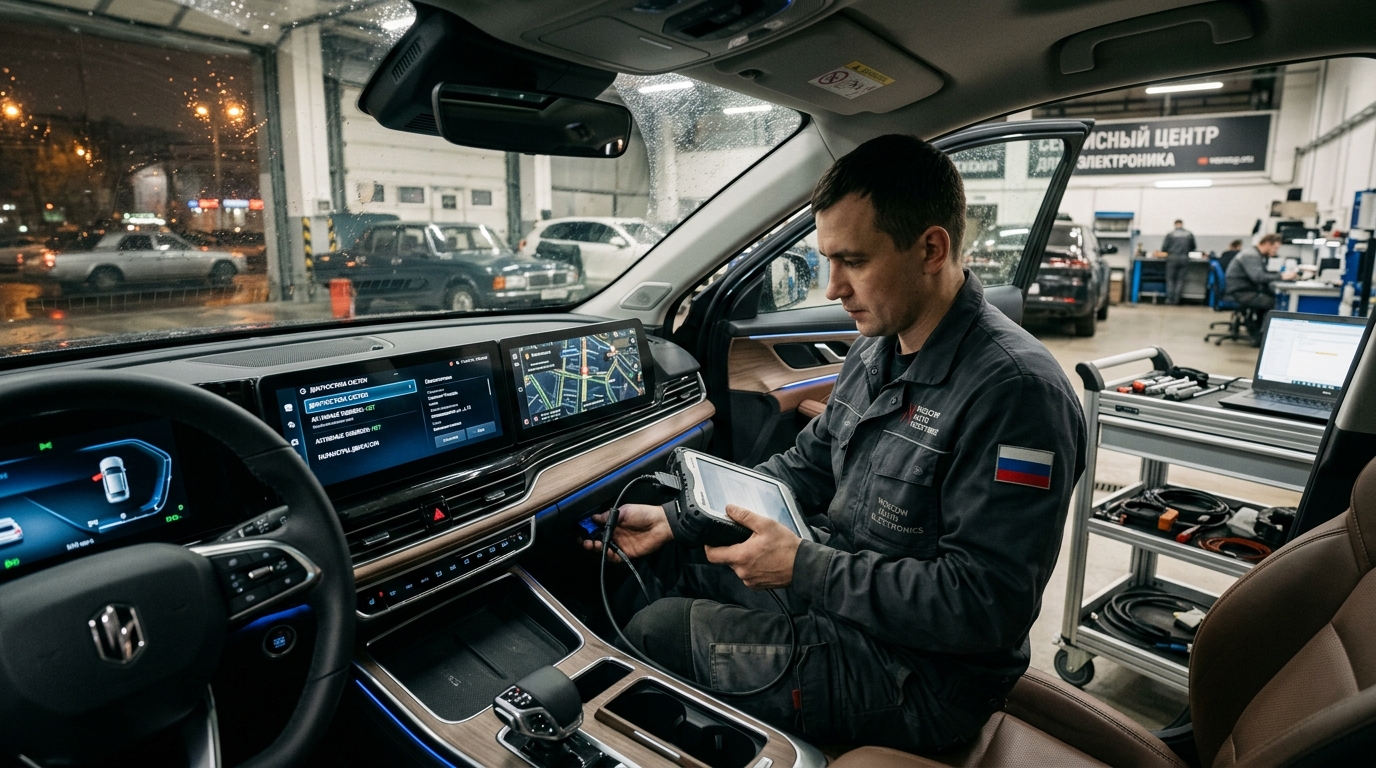
Automotive electronics specialist interfacing with the cockpit gateway during a native firmware flash, displaying Cyrillic typography and synchronized navigation telemetry across multi-screen digital displays.
Executive Summary: The Software-Defined Vehicle (SDV) Paradox
The rapid globalization of Chinese intelligent automobiles has transformed cross-border vehicle trade from a mechanical delivery pipeline into a complex software integration challenge. Contemporary Chinese crossovers and electric sedans (Geely Monjaro, Zeekr 001, Li Auto L7/L9, Chery Tiggo 8 Pro Max, Changan Uni-K) are fundamentally Software-Defined Vehicles (SDVs). Their cockpits are governed by automotive System-on-Chips (SoCs) such as the Qualcomm Snapdragon SA8155P or SA8295P running customized Android Automotive OS (AAOS).
When these vehicles cross international borders outside official OEM distributor channels, they encounter four critical operational bottlenecks:
- Language Isolation: Displays feature native Chinese interfaces, lacking Cyrillic character sets, regional input keyboards, and voice assistants.
- Navigation Blackout: Factory mapping suites (Amap Auto, Baidu Maps) rely on domestic Chinese cloud servers, rendering offline maps completely blank without regional POIs or speed camera warnings.
- Telematics Lockout: Embedded SIM chips (eSIMs) soldered to the Telematics Box (T-Box) reject foreign cellular roaming, permanently disabling remote pre-heating apps, live weather, and tracking.
- Cryptographic Security Barriers: Hardware-backed Secure Boot, Linux
dm-verity, and Security Gateways (SGW) mean amateur flashing attempts cause bootloops, black clusters, or Qualcomm 9008 EDL crashes.
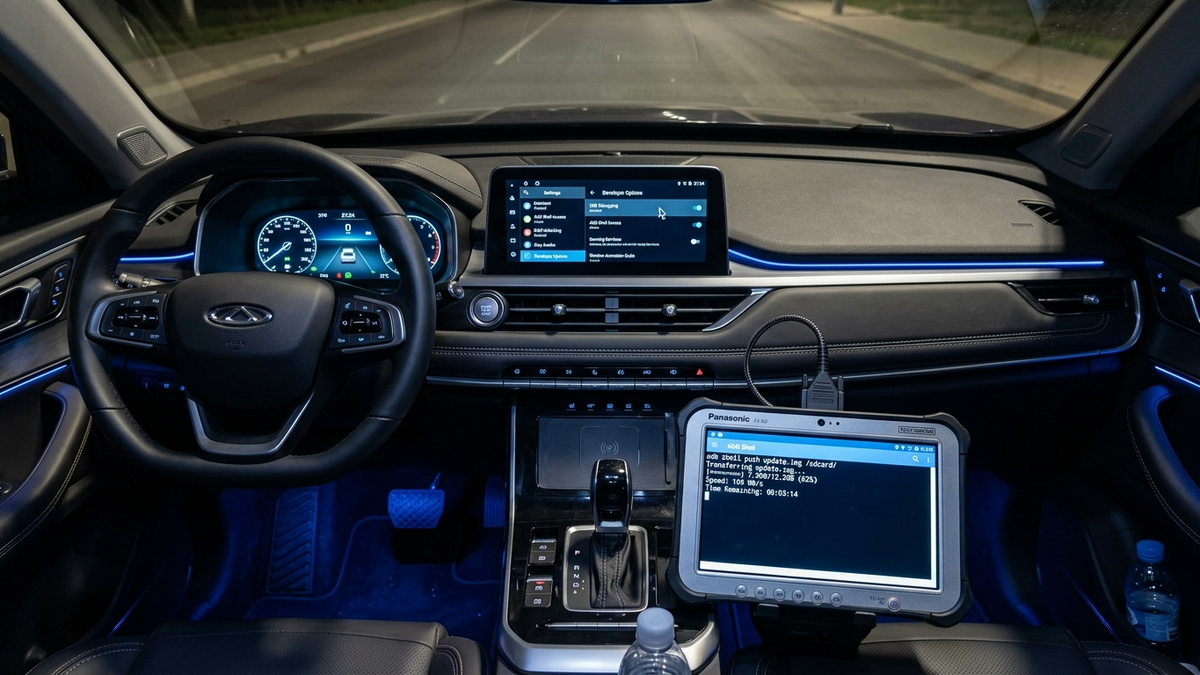
Central high-resolution touchscreen and virtual instrument cluster operating with verified Cyrillic typography, localized HVAC defrost controls, and integrated mapping telemetry.
1. Cockpit Electronic Architecture & Domain Topologies
To avoid brinking modern vehicles, technicians must understand the computational split inside contemporary smart cockpits:
│ INTELLIGENT COCKPIT ELECTRONIC TOPOLOGY │
├────────────────────────────────────────────────────────────────────────────────────────┤
│ ┌────────────────────────────────┐ ┌──────────────────────────────────┐ │
│ │ Cockpit Domain Controller │ │ Safety Microcontroller (MCU) │ │
│ │ (Qualcomm 8155 / 8295 SoC) │◄──SPI/UART─►│ (Infineon Aurix / Renesas) │ │
│ │ – Android Automotive OS │ Bridge │ – Real-Time Operating System │ │
│ │ – Cyrillic UI & Touch Panels │ │ – CAN-FD Vehicle Bus Handler │ │
│ │ – Yandex.Navigator Engine │ │ – Hardwired Gauge Logic │ │
│ └───────────────┬────────────────┘ └─────────────────┬────────────────┘ │
│ │ │ │
│ PCIe / USB 3.0 CAN-FD Bus │
│ │ │ │
│ ┌───────────────▼────────────────┐ ┌─────────────────▼────────────────┐ │
│ │ Telematics Box (T-Box 4G/5G) │ │ Central Gateway Module (CGW) │ │
│ │ – eSIM / Physical Nano-SIM │◄──CAN/Eth──►│ – Diagnostic Security Gateway │ │
│ │ – Dual-Mode GPS/GLONASS VCI │ │ – Body & Climate Controllers │ │
│ └────────────────────────────────┘ └──────────────────────────────────┘ │
└────────────────────────────────────────────────────────────────────────────────────────┘
Application Processor (AP): Qualcomm Snapdragon SA8155P/SA8295P executes the high-level Android OS, touch UI, graphics rendering pipelines, and multimedia playback.
Safety Microcontroller (MCU): Automotive-grade Infineon AURIX TC3xx or Renesas RH850 handles critical CAN-FD bus signals, physical warning lights (Check Engine, ABS, Airbags), and hardwired chimes. Even if a corrupted firmware update crashes the AP, the MCU maintains independent operation of dashboard safety indicators.
2. Human-Machine Interface (HMI) Localization & Typography
True automotive localization requires decompiling OEM framework packages (framework-res.apk, SystemUI.apk, Settings.apk), injecting Cyrillic string resources (values-ru/strings.xml), and substituting Chinese logogram fonts with Unicode typography optimized for high-DPI displays.
| Vehicle Function | Original Chinese | Russian Technical Term | Design Layout Consideration |
|---|---|---|---|
| Windshield Defrost | 前风挡除雾 (5 chars) | Обогрев лобового стекла (22 chars) | Requires font scaling or dynamic abbreviation to prevent clipping capacitive button edges. |
| Driver Seat Heating | 主驾座椅加热 (6 chars) | Подогрев сиденья водителя (25 chars) | Multi-line wrapping required in climate quick-access widgets. |
| Regenerative Braking | 能量回收强度 (6 chars) | Рекуперация энергии (20 chars) | Preserve driving mode state machines on digital cluster. |
| Tire Pressure TPMS | 胎压监测系统 (6 chars) | Давление в шинах (17 chars) | Ensure metric bar / kPa unit conversion consistency. |
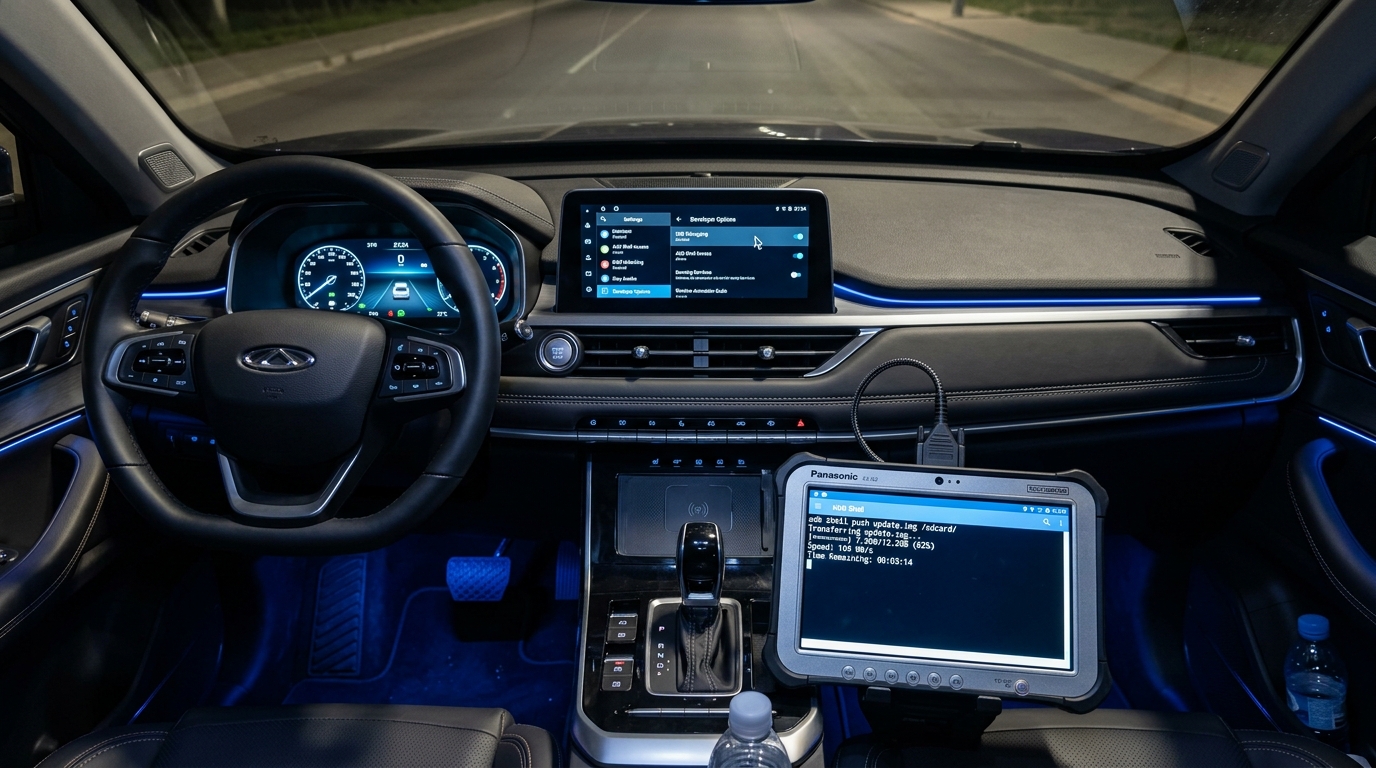
Automotive engineer running automated backup scripts and verifying partition hash integrity through a protected hardware diagnostic gateway before executing custom firmware injection.
3. Telematics & T-Box Hardware Retrofits: Winter Remote Pre-Heating
In Russian winter conditions where temperatures regularly reach -25°C to -35°C, remote pre-heating is an essential requirement. Because factory eSIM chips are locked to Chinese APNs (China Mobile/Unicom), international towers reject cellular registration.
To restore independent connectivity, workshops perform a 5-step hardware T-Box retrofit:
- Module Extraction: Disconnect the 12V battery ground and extract the T-Box module located behind the dashboard or center console.
- Micro-Soldering SMD eSIM: Use a temperature-controlled hot-air rework station (320°C) to de-solder the factory QFN-8 packaged eSIM chip without damaging adjacent traces.
- Nano-SIM Socket Jumpering: Solder high-durability micro-coaxial jumpers to the SIM bus pads (VCC, GND, RST, CLK, I/O) and install a physical Nano-SIM slot routed to the glove compartment.
- Modem Baseband Patching: Connect via Qualcomm Diagnostic interface (QDLoader 9008) to patch modem NVRAM parameters with regional LTE carrier APNs (MTS, MegaFon, Beeline).
- Active GLONASS Booster: Install an active inline satellite antenna amplifier to ensure fast GPS/GLONASS positioning in northern latitudes.
4. Cryptographic Security & Anti-Bricking Protocols
Modern automotive cockpits utilize dm-verity (Device Mapper Verity) in the Linux kernel to verify block hashes. Altering a single byte on the system partition without updating the cryptographic tree triggers a kernel panic, sending the Qualcomm chip into Emergency Download (EDL 9008) mode.
5. Commercial Service Tiers & Workshop Economics
| Attribute | Tier 1: Basic APK Sideloading | Tier 2: System Firmware Injection | Tier 3: Full Hardware + T-Box Retrofit |
|---|---|---|---|
| Method | ADB shell engineering menu | Custom system overlay + Cyrillic | Localized ROM + T-Box eSIM soldering |
| Language Coverage | Partial (English / Chinese apps) | 100% Cyrillic across all screens | 100% Cyrillic across all screens |
| Cluster & HUD Sync | No turn-by-turn sync | Full Yandex navigation arrows | Full Yandex navigation arrows |
| Mobile Remote Start | Inoperative | Inoperative | Fully functional via local 4G LTE |
| Factory Reset Safety | Lost upon vehicle factory reset | Fully persistent | Fully persistent |
| Workshop Price (RUB) | 5,000 – 10,000 RUB | 20,000 – 40,000 RUB | 45,000 – 75,000 RUB |
Conclusion
Software localization and telematics retrofitting represent the highest-margin service additions for modern independent workshops. By mastering Android Automotive architectures, secure overlay injection, and T-Box hardware micro-soldering, workshops eliminate the digital isolation of Chinese imported cars and secure a sustainable competitive advantage.