Chinese Automotive Spare Parts Supply Chain in Russia: VIN Decoding, EPC Catalogs & Logistics Guide
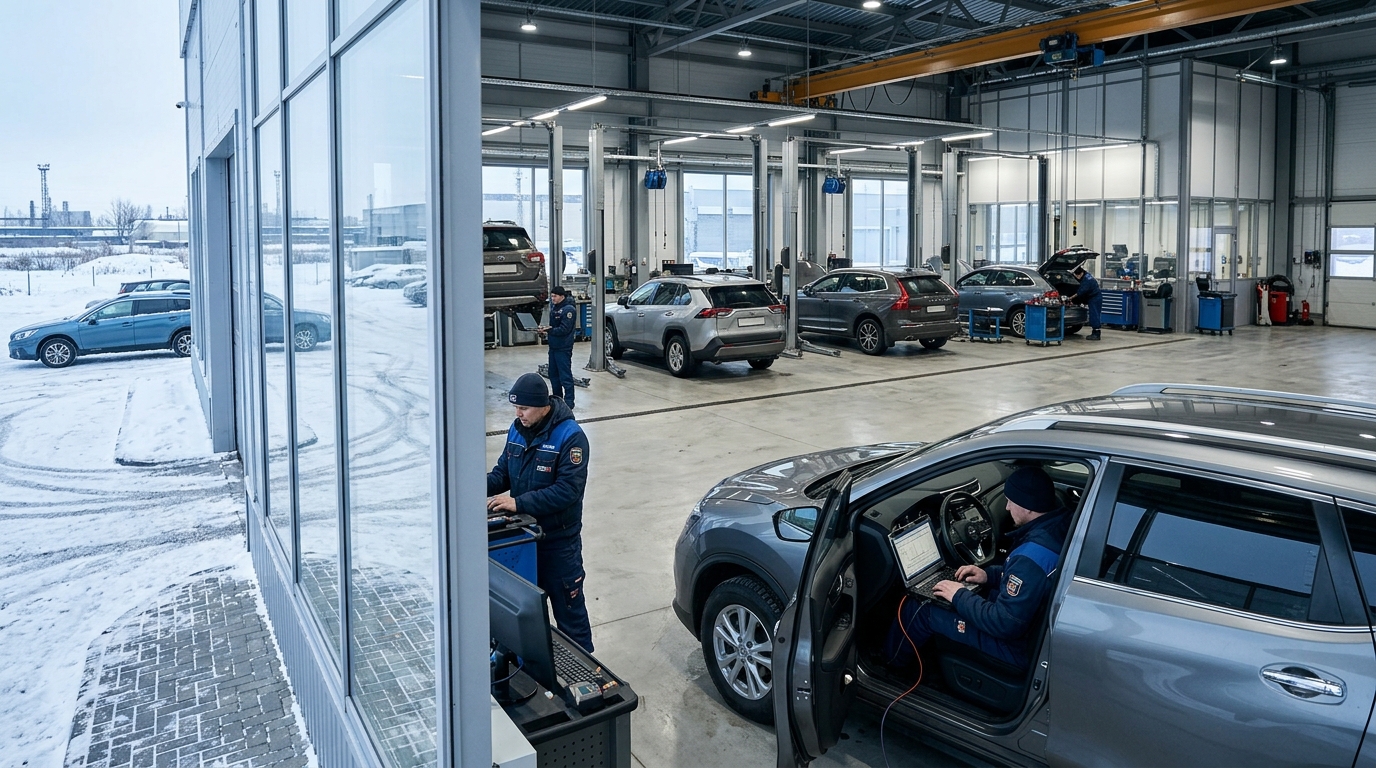
Independent workshop facility coordinating rapid component fulfillment, quality verification, and diagnostic installation for Chinese passenger vehicles.
Executive Summary: From Vehicle Export to Lifecycle Integration
An enduring rule governs international automotive commerce: the first vehicle is sold by showroom presentation and commercial pricing; subsequent vehicles are sold by downstream service capability and lifecycle support.
Following the massive expansion of Chinese automotive brands across the Russian Federation—where Geely, Haval, Chery, and Changan now represent over 60% of new vehicle sales—the market is entering a pivotal second operational phase. The initial imperative of distribution logistics has given way to an urgent challenge: resolving the severe downstream spare parts bottleneck.
Across major metropolitan centers and regional territories, Russian car owners and independent repair workshops (СТО) face recurring component delays: minor collision repairs frequently take 30 to 60 days due to missing body panels, while specialized electronic sensors and transmission mechatronics can take months to arrive. Overcoming this bottleneck requires moving beyond fragmented grey-market intermediaries toward structured, factory-direct B2B supply chains, cloud Electronic Parts Catalogs (EPC), and regional bonded buffer warehouses.
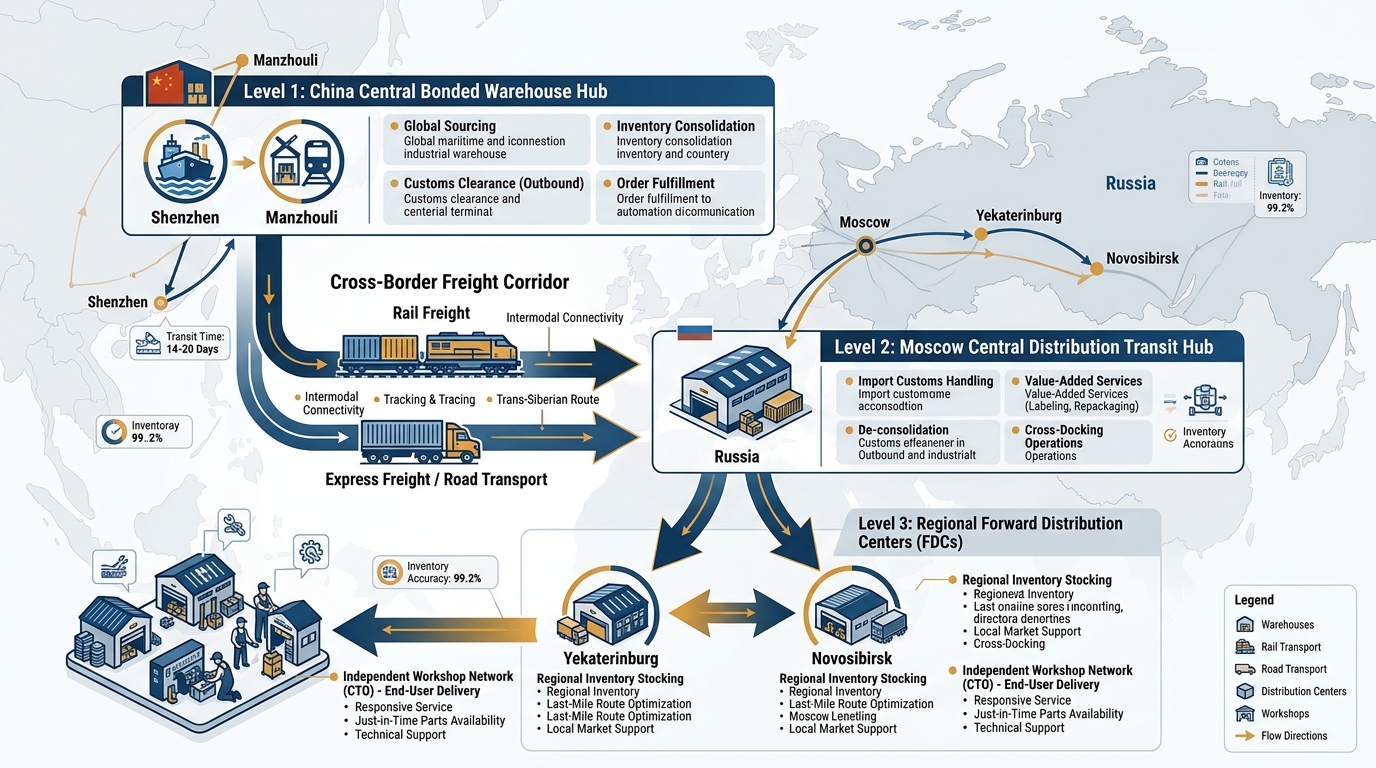
Multi-tiered logistics corridors connecting Chinese manufacturing hubs (Guangdong, Zhejiang, Jiangsu) through northern transit corridors to Russian regional consolidation hubs.
1. The VIN Decoding & Rapid Model Iteration Challenge
For three decades, European and Russian aftermarket supply chains were structured around stable parts cataloging. A Volkswagen Golf or Toyota Camry typically retained identical suspension arms and brake pads across a multi-year model lifecycle.
In contrast, the Chinese automotive industry operates on rapid, consumer-electronics-style iteration cycles:
- Annual Facelifts & Mid-Year Changes: Chinese OEMs regularly modify brake calipers, suspension bushing diameters, and electronic sensor pinouts during mid-cycle production updates without altering vehicle model nomenclature.
- OE Number Divergence: Two vehicles carrying the name “Chery Tiggo 8 Pro Max” manufactured just six months apart may utilize entirely different Front Lower Control Arms or ABS wheel-speed sensors.
- Engine Suffix Variations: Powertrains carry subtle regional engineering variants. For example, Volkswagen Tayron 330TSI models assembled by FAW-Volkswagen feature DKV, DPL, or DTH engine designations, requiring different Gasoline Particulate Filters (GPF), timing chains, and high-pressure fuel pumps.
Attempting to order replacement components based merely on model name or registration year results in a 22% to 35% parts return rate in Russian workshops. Precise 17-digit Chinese VIN decoding is mandatory.
2. The Electronic Parts Catalog (EPC) Deficit
Traditional multi-brand diagnostic and parts lookup software used in Europe (such as TecDoc, AutoData, and Mitchell1) suffer from severe data blindness regarding modern Chinese vehicles:
│ Catalog Dimension │ Legacy Western Catalogs (TecDoc) │ Dedicated Chinese Cloud EPC Portals │
├──────────────────────┼───────────────────────────────────┼──────────────────────────────────────┤
│ Chinese VIN Parsing │ Returns “Unknown Manufacturer” │ Full 17-digit breakdown to build date│
│ Sub-Assembly Diagrams│ Generic exploded line drawings │ OEM 3D CAD interactive exploded views│
│ Component Supersession│ Stale, disconnected OE numbers │ Real-time superseded part number maps│
│ Sourcing Traceability│ Local distributors only │ Tier-1 OEM vs Aftermarket cross-match│
│ Update Frequency │ Quarterly batch updates │ Weekly cloud synchronization │
└──────────────────────┴───────────────────────────────────┴──────────────────────────────────────┘
To eliminate ordering errors, progressive Russian parts importers and workshop networks are deploying specialized Chinese cloud EPC systems (such as dedicated micro-cat portals for GWM, Geely, and Chery), which link the vehicle’s unique VIN directly to the factory bill of materials (BOM).
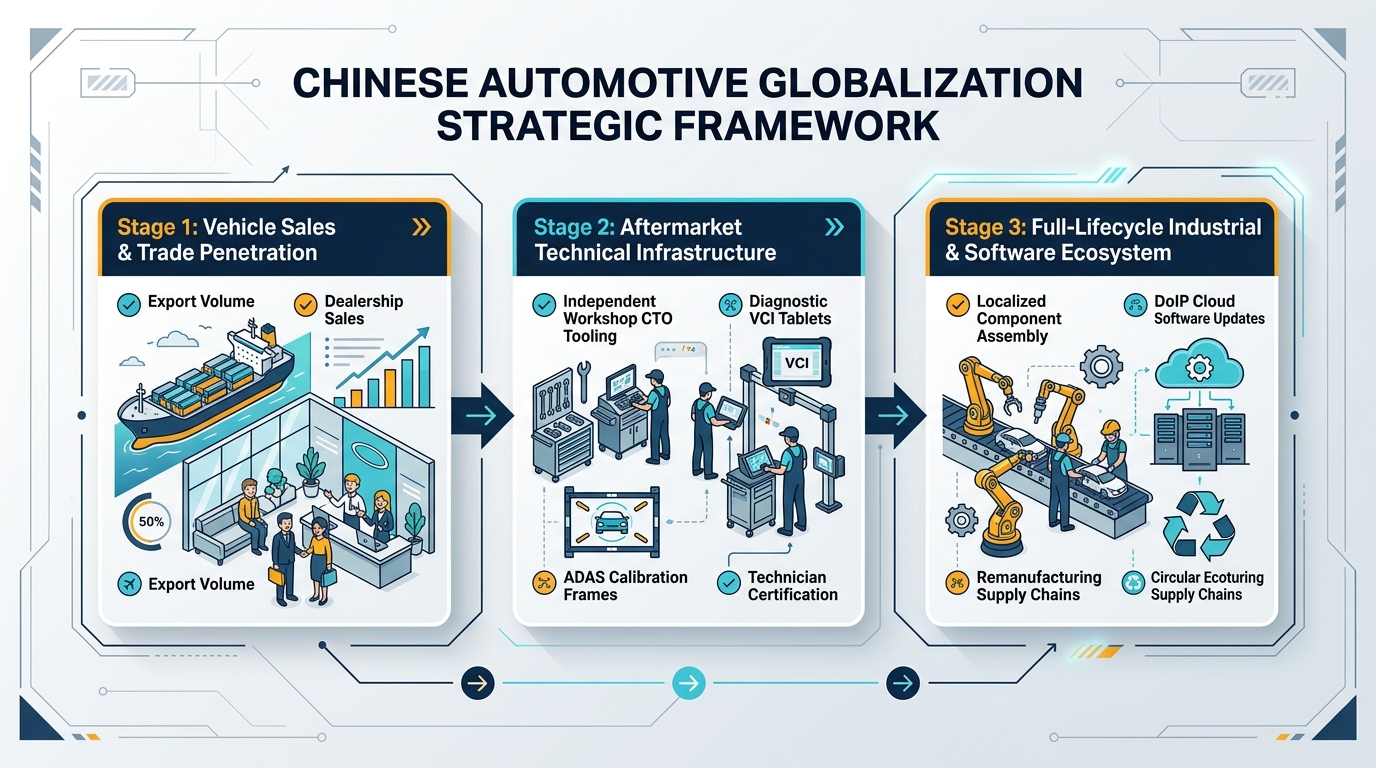
Developmental roadmap: Stage 1 (Vehicle Export Penetration) → Stage 2 (Aftermarket Infrastructure & Supply Chains) → Stage 3 (Residual Value & Brand Equity).
3. Cross-Border Supply Chain Topography & Freight Corridors
Securing predictable component availability requires understanding China’s specialized regional industrial clusters and matching them to optimal transport modes:
| Manufacturing Cluster | Component Specialization | Primary Transport Corridor | Lead Time to Moscow |
|---|---|---|---|
| Pearl River Delta (Guangzhou, Shenzhen, Foshan) | Cockpit electronics, LED headlights, T-Boxes, sensors, wiring harnesses | Air Freight via Urumqi or Rail Express via Manzhouli | Air: 5–8 Days Rail: 16–22 Days |
| Yangtze River Delta (Taizhou, Wenzhou, Ningbo) | Suspension arms, shock absorbers, brake discs, steering racks | Container Rail via Zabaykalsk | Rail: 18–25 Days |
| Jiangsu Cluster (Changzhou, Danyang) | Stamped body panels, plastic bumpers, grilles, fenders | Consolidated Truck Freight (LTL) via Horgos | Road: 14–18 Days |
| Chongqing / Sichuan | Engine internal components, manual/automatic gear sets, turbochargers | Chongqing-Xinjiang-Europe Railway | Rail: 16–20 Days |
4. Technical Regulation Compliance & EAC / TR CU 018 Certification
Importing automotive components into the Eurasian Economic Union (EAEU) requires strict conformity with Technical Regulation TR CU 018/2011 (“On the Safety of Wheeled Vehicles”):
Furthermore, professional importers must establish rigorous quality verification protocols at Chinese departure ports to filter out sub-grade counterfeits—particularly low-cost brake pads containing excessive metallic filler that accelerate rotor wear, and uncalibrated radar brackets that deform under road vibration.
5. Sourcing Optimization: Compressing Workshop Lead Times to 72 Hours
To eliminate the crippling 45-day repair backlog, progressive Russian repair networks and B2B automotive importers are adopting an Agile Sourcing Framework:
- Regional Bonded Buffer Warehouses: Establishing inventory hubs in Moscow, Yekaterinburg, and Novosibirsk stocked with high-frequency “Class A” maintenance items (filters, brake pads, spark plugs, suspension links) and “Class B” collision parts (bumpers, grilles, radiators).
- Automated B2B API Sourcing Portals: Independent workshops scan vehicle VINs, instantly displaying local warehouse availability with guaranteed same-day dispatch, alongside direct-from-factory air options for rare modules.
- Lead Time Compression: Routine maintenance components are fulfilled within 24 to 72 hours, while specialized domain controllers and body stampings arrive via expedited air corridors in 5 to 8 business days.
Conclusion
As defined in the Three-Stage Chinese Automotive Globalization Model, market share achieved through initial vehicle sales cannot be sustained without an agile, reliable aftermarket supply chain. Independent workshops and automotive distributors that invest in VIN-accurate cloud EPC catalogs, compliant customs corridors, and regional warehouse networks will establish themselves as the indispensable leaders of Russia’s modern automotive economy.