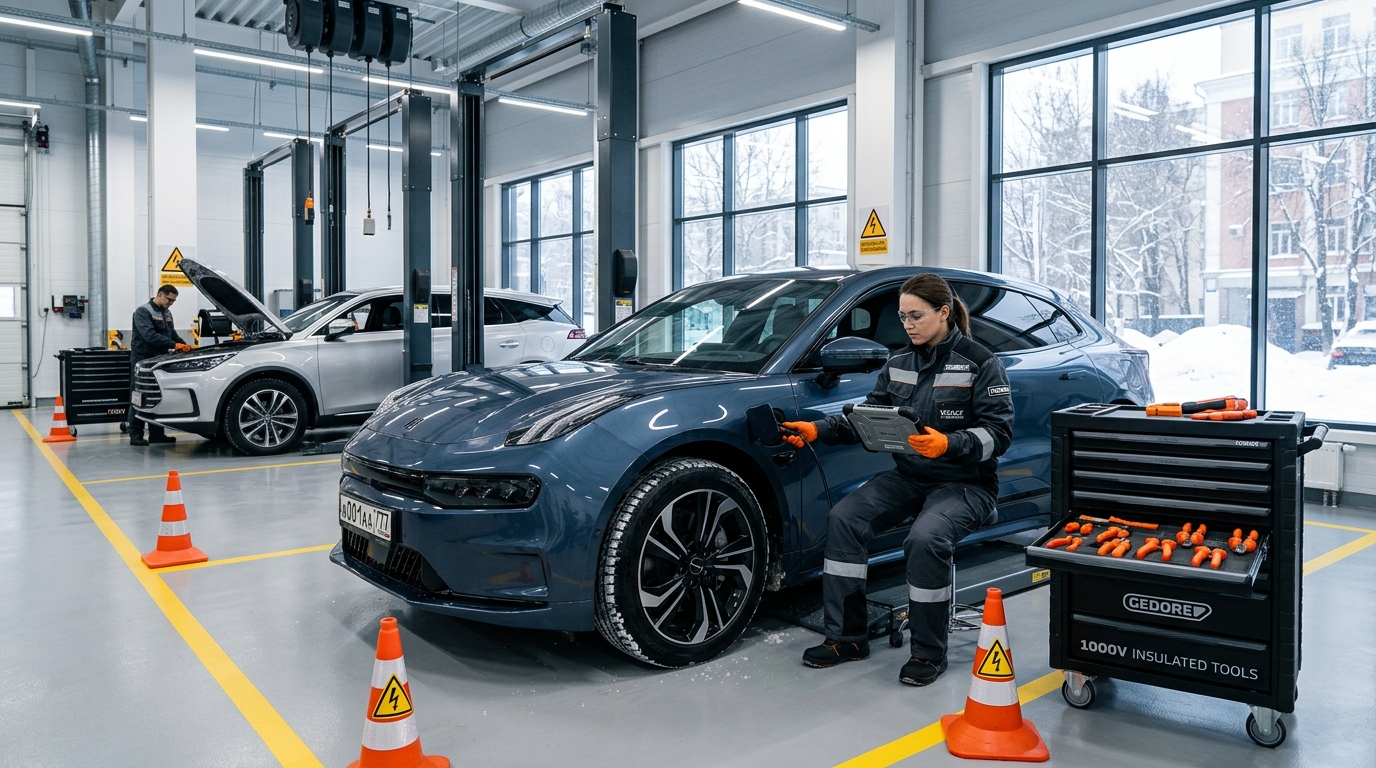
1. The Electronic Architecture Leap: Domain Controllers and Network Topologies
To understand why legacy diagnostic scan tools fail when connecting to modern Chinese electrified platforms, one must evaluate the structural evolution of their underlying electronic and electrical (E/E) architectures. Traditional internal combustion engine (ICE) platforms historically relied on decentralized, discrete Electronic Control Units (ECUs) communicating over low-speed CAN buses (250–500 kbps) with standardized SAE J1979 OBD-II diagnostic identifiers.
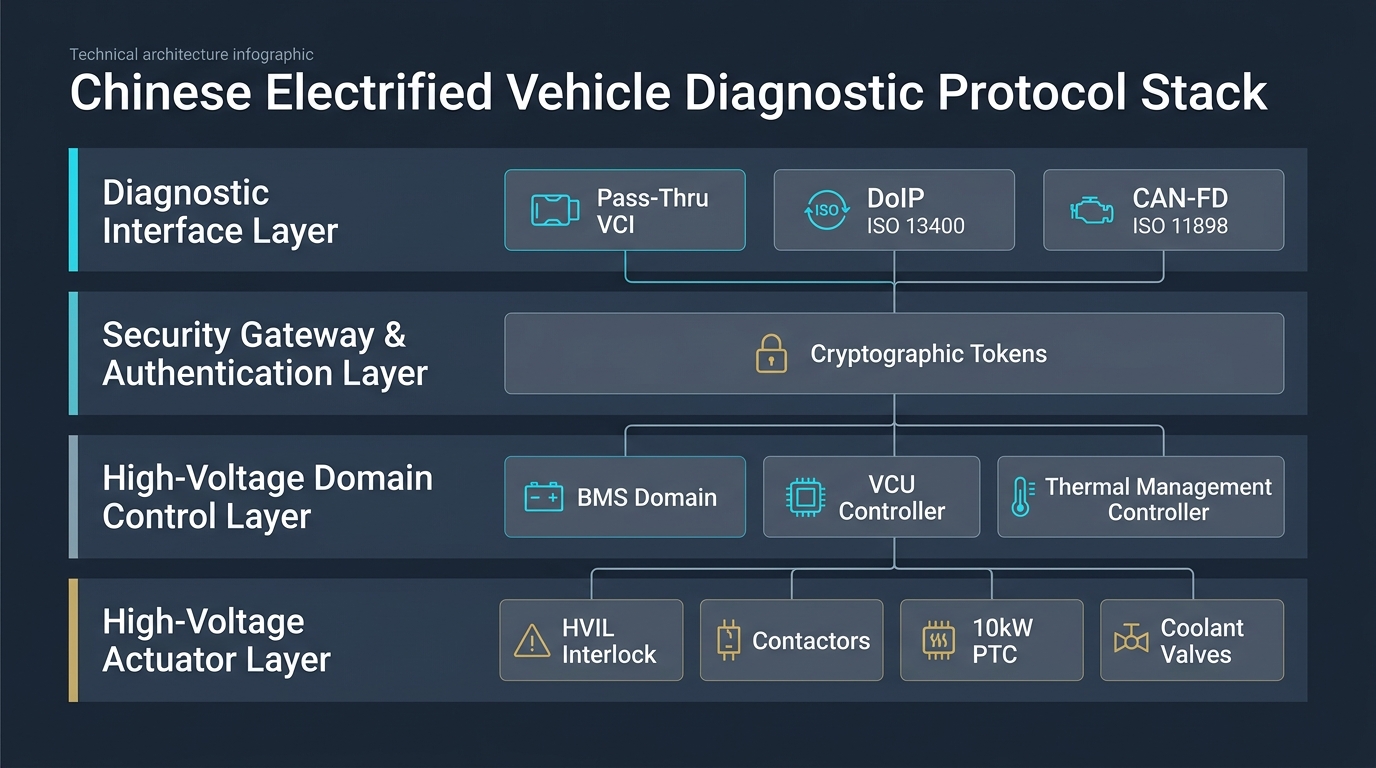
In contrast, modern Chinese electrified architectures integrate domain-centralized computing models. Functions governing propulsion torque arbitration, cell-level electrochemical monitoring, regenerative braking, and thermal regulation are consolidated into high-performance multi-core domain controllers:
- Vehicle Control Unit (VCU): Executes torque coordination, regenerative braking blending, and operational state-machine arbitration.
- Battery Management System (BMS): Continuously computes state-of-charge (SoC), state-of-health (SoH), cell internal resistance, and actuates high-voltage pyrofuses and contactors.
- Thermal Management Controller (TMC): Regulates multi-loop coolant circuits, proportional expansion valves, and high-voltage positive temperature coefficient (PTC) heaters.
These domain controllers exchange high-density telemetry across CAN Flexible Data-Rate (CAN-FD) buses operating up to 5 Mbps, and 100Base-T1 Automotive Ethernet backbones utilizing ISO 13400 (Diagnostics over IP / DoIP). Generic scanners lacking DoIP transceivers and CAN-FD controllers cannot establish physical link-layer handshakes, leaving independent workshops blind to critical high-voltage battery parameters and inverter diagnostic trouble codes (DTCs).
2. The Sub-Zero Operational Crucible: Battery Chemistry, Thermal Loops, and Cold Throttling
Eurasian winter conditions—where ambient temperatures frequently drop between -15°C and -40°C—impose severe physical and chemical constraints on high-voltage battery systems. The internal impedance of both Lithium Iron Phosphate (LFP) and Nickel-Cobalt-Manganese (NCM) battery chemistries rises exponentially as electrolyte viscosity increases.
Key Cold-Climate Operational Dynamics
- Lithium Iron Phosphate (LFP): Exhibits pronounced voltage sag below -10°C, requiring active thermal conditioning to prevent rapid discharge cutoffs.
- Nickel-Cobalt-Manganese (NCM): Retains higher cold-weather energy density but strictly enforces low-temperature charge limits to eliminate the hazard of metallic lithium dendrite plating.
- Propulsion Power De-rating (“Turtle Mode”): To protect cell chemistry from sub-zero over-discharge, the BMS automatically caps inverter current draw. Uninformed repair facilities frequently misdiagnose this protective software limit as an inverter or motor hardware fault.
To preheat battery packs and maintain passenger comfort, modern electrified platforms utilize high-voltage liquid PTC heaters operating at 350V–750V with power ratings between 5 kW and 10 kW. Field reports from Eurasian repair networks highlight two predominant winter failure modes:
- PTC Substrate Micro-Cracking: Rapid thermal shock between -30°C ambient temperatures and +85°C coolant outlet temperatures, combined with trace moisture ingress, degrades internal ceramic insulation, triggering high-voltage isolation faults.
- Electronic Coolant Valve Sticking: Freezing condensate or incorrect glycol concentrations can cause multi-way proportional coolant valves to stick, starving the battery loop and inducing thermal imbalance across cell modules.
3. High-Voltage Isolation Faults and Environmental Contamination
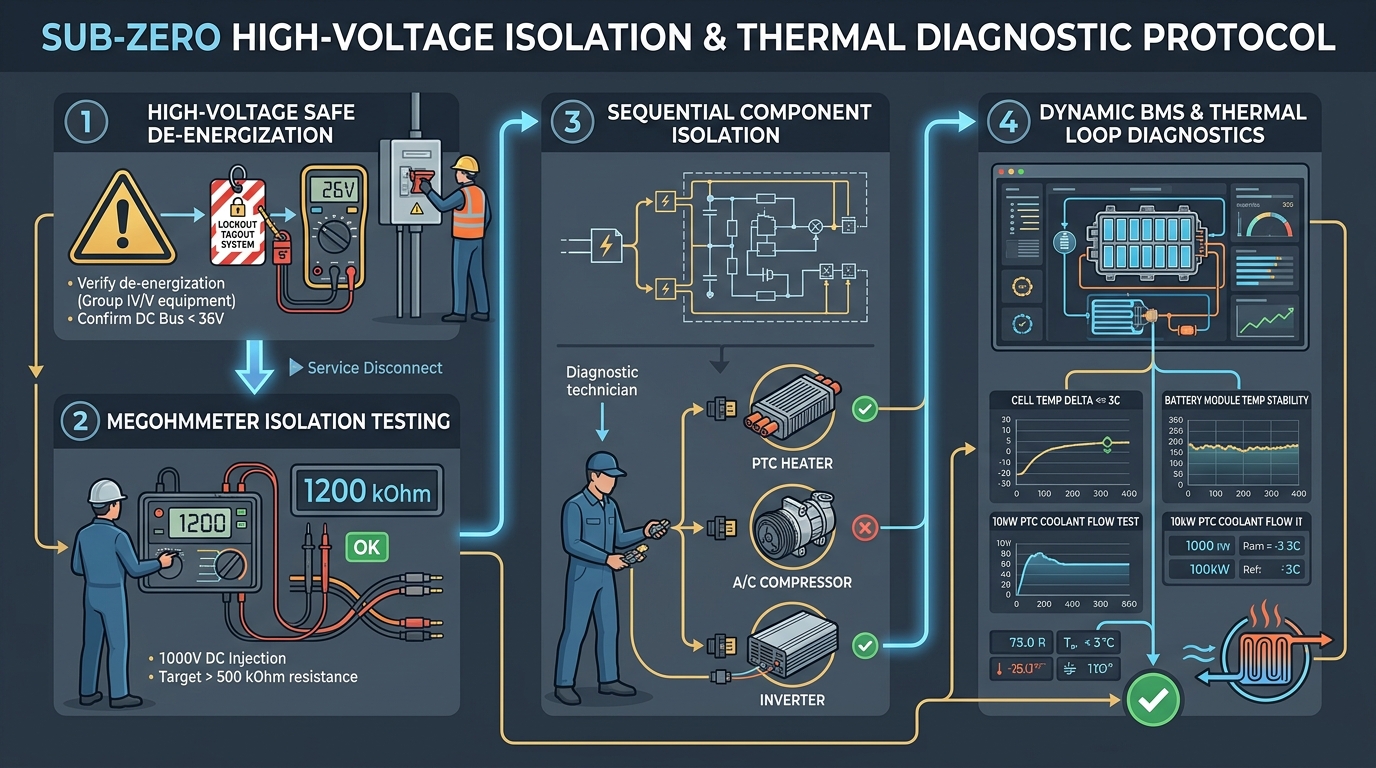
In accordance with international standards (ECE R100) and Chinese national standard GB/T 18384-2020, electrified platforms continuously monitor insulation resistance (R_iso) between the high-voltage DC bus (positive and negative rails) and the chassis electrical ground.
The regulatory safety threshold mandates at least 500 Ω/V for DC buses (and 100 Ω/V for AC circuits). On a standard 400V DC platform, any insulation drop below 200 kΩ triggers a Level-2 warning, while drops below 50 kΩ immediately actuate Level-3 emergency isolation, opening the main battery contactors and disabling propulsion.
Environmental Drivers: Road Slush and Chemical De-Icing Brines
In major metropolitan centers such as Moscow and Saint Petersburg, municipal winter road maintenance utilizes aggressive chemical de-icing brines (calcium chloride and technical salt solutions). These conductive mists penetrate low-mounted high-voltage harness connectors, charging port backplanes, and air-conditioning compressor seals whose silicone gaskets have hardened in extreme cold.
Workshops lacking dedicated 1000V Megohmmeters and structured step-by-step isolation procedures often waste days replacing major powertrain modules when the actual fault lies in a contaminated secondary charging harness or an external PTC heater connection.
4. Fast-Charging Interoperability: Navigating GB/T Protocols and Multi-Standard Adapters
Unlike the domestic Chinese market, where charging infrastructure and vehicle inlets natively adhere to the unified national standard GB/T 20234 and GB/T 27930, the charging ecosystem across Russia and the EAEU presents a fragmented mix of European Combined Charging System (CCS Combo 2), Japanese CHAdeMO, and newly installed domestic GB/T DC fast chargers.
| Standard | Physical Signaling Layer | Digital Protocol Model | Common Failure Mechanism in Field |
|---|---|---|---|
| GB/T 27930 | Dedicated Dual-Wire CAN (250/500 kbps) | Cyclic Broadcast (BMS Master) | Auxiliary 12V/24V wake-up timing delays |
| CCS Combo 2 | Power Line Communication (PLC / HomePlug) | Client-Server (ISO 15118 / DIN 70121) | Adapter signal translation latency & pre-charge mismatch |
To charge imported Chinese vehicles on CCS2 infrastructure, operators utilize active hardware adapters that translate between CCS2 PLC signals and GB/T CAN frames. In field operations, these adapters represent a significant source of diagnostic tickets:
- Auxiliary Power Wake-Up Timing: If an adapter fails to supply auxiliary low-voltage power (12V/24V) to the BMS within strict millisecond timing windows, the vehicle aborts the handshake.
- Pre-Charge Voltage Equalization: Before closing the main DC contactors, the charging station must ramp voltage to match battery potential within a ±10V window. Slower response times on legacy chargers trigger “Pre-Charge Overvoltage” locks in the on-board charger (OBC).
5. The Diagnostic Tooling Deficit and Security Gateway Authentication
Under modern automotive cybersecurity standards (UNECE WP.29 R155/R156 and national standard GB/T 40856-2021), vehicle domain controllers are shielded behind Central Security Gateways. While basic read-only status codes can occasionally be queried across the gateway, advanced service functions require authenticated digital certificates:
- High-Voltage Contactor Reset: Re-enabling contactors after collision interlock activation or isolation fault latching.
- Battery Pack Cell Balancing: Initiating active or passive cell re-balancing cycles following module replacement.
- BMS Firmware Calibration: Flashing updated temperature control curves and cold-weather charging algorithms.
- Electronic Brake Bleeding: Dynamic actuation of integrated electro-hydraulic braking systems (One-Box/e-Booster).
Independent repair facilities in the Eurasian market face a stark tooling divide between generic multi-brand scanners (which lack bidirectional actuation and DoIP capability) and OEM dealer software packages (which historically required domestic Chinese cloud server verification). The establishment of secure, cross-border diagnostic bridges is essential to bridging this capability gap.
6. High-Voltage Safety, Workshop Qualification, and Legal Liability
Mandatory Safety Compliance Protocol
High-voltage systems operate between 300V and 800V DC, presenting lethal electrical shock and arc-flash hazards. Under Russian industrial safety regulations (ПТЭЭП), physical service on high-voltage circuits must only be performed by certified engineers holding at least Group IV Electrical Safety Qualification for installations up to and above 1000V. Do-it-yourself (DIY) servicing or unqualified mechanical tampering is strictly prohibited.
Before any mechanical or electrical operation on high-voltage components, service technicians must execute a mandatory, recorded Five-Step De-Energization Protocol:
- Low-Voltage Power Isolation: Disconnect the 12V auxiliary battery to prevent automated contactor cycling.
- Manual Service Disconnect (MSD) Withdrawal: Physically remove the high-voltage safety plug and lock it within an authorized Lock-Out/Tag-Out (LOTO) security box.
- Capacitive Discharge Interval: Wait a mandatory 5 to 10 minutes to allow traction inverter smoothing capacitors to fully discharge.
- Zero-Voltage Verification: Using a calibrated CAT III (1000V) or CAT IV (600V) rated dual-pole voltage tester, verify zero potential between positive and negative bus terminals, and between each terminal and chassis ground.
- Safe Residual Threshold: Confirm that all measured potentials remain strictly below 36V DC prior to physical disassembly.
7. Building the Cross-Border High-Voltage Service and Equipment Supply Chain
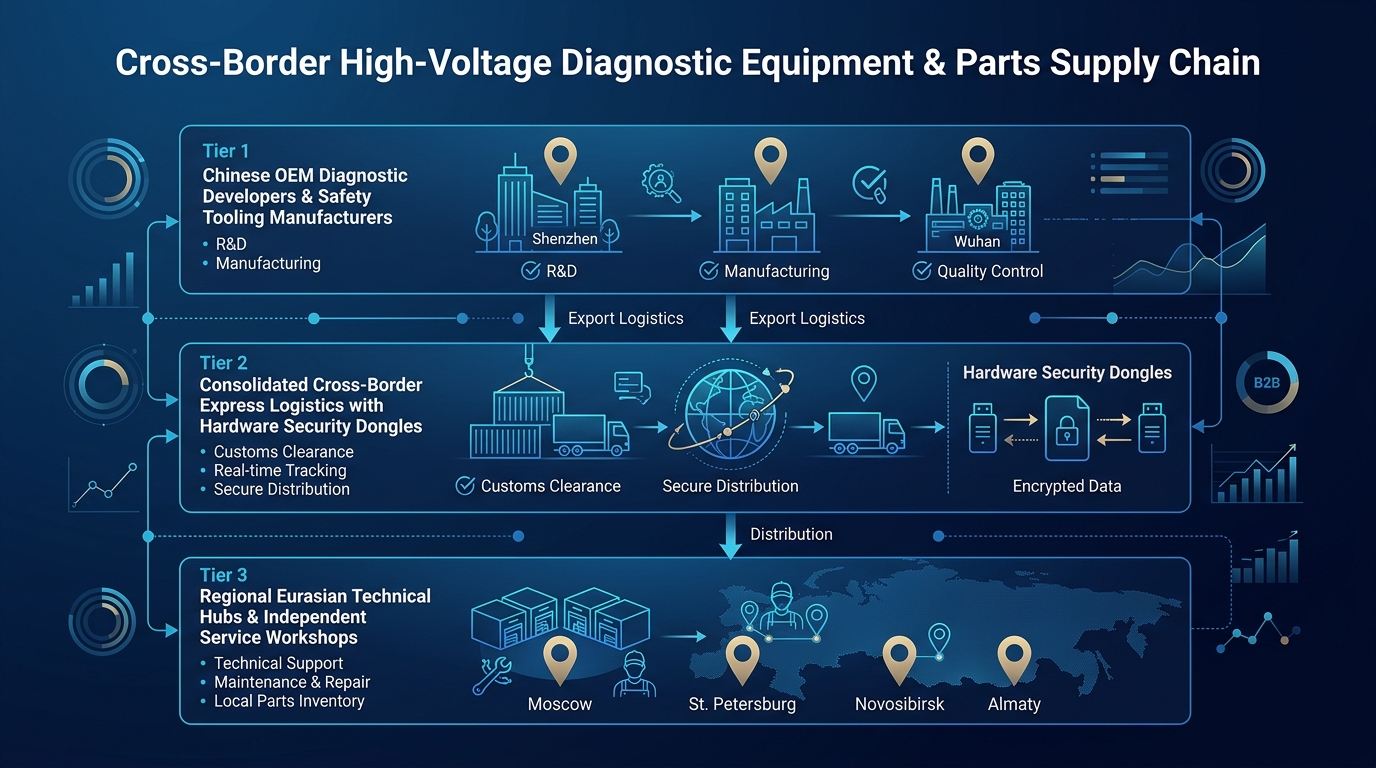
As vehicle sales volumes mature into long-term aftermarket operational demands (as defined in the Three-Stage Chinese Automotive Globalization Model), the supply chain must expand beyond mechanical body panels and filters to encompass high-voltage diagnostic and repair infrastructure:
- Diagnostic Instrumentation & Safety Tooling: Sourcing certified VDE 1000V insulated hand tool sets, calibrated high-voltage Megohmmeters, and multi-brand DoIP/CAN-FD scan tools directly from verified Chinese manufacturers.
- Cell-Level Battery Balancing Stations: Equipping regional specialist hubs with portable cell balancing systems, allowing workshops to repair drifted cell strings without cost-prohibitive complete pack replacements.
- Thermal Management Replacement Modules: Establishing regional buffer inventories of sub-zero optimized high-voltage PTC heaters, electronic expansion valves, and heavy-duty active GB/T-to-CCS2 charging adapters.
- Bilingual Technical Documentation: Providing accurate, translated high-voltage wiring schematics, guided diagnostic trees, and standardized repair manuals.
Conclusion & Strategic Takeaways
The electrification of the Eurasian automotive landscape is an ongoing structural reality. Chinese electrified platforms deliver advanced technology, impressive range, and compelling performance, but their long-term residual value and market sustainability depend entirely on downstream diagnostic capability.
Workshops, fleet managers, and parts distributors that invest proactively in certified high-voltage safety regimes, specialized DoIP diagnostic instrumentation, and direct cross-border engineering supply chains will establish a decisive competitive advantage in this new era of automotive intelligence.
Technical Standards & Reference Baselines
- GB/T 18384-2020: Electric vehicles safety requirements — High-voltage electrical safety and protection.
- GB/T 27930-2015: Communication protocols between off-board conductive charger and BMS for electric vehicles.
- GB/T 38661-2020: Technical specifications of battery management system for electric vehicles.
- China Automotive Technology & Research Center (CATARC): White Paper on Cold-Weather Electric Vehicle Thermal Management and Battery Reliability.
- China Automobile Maintenance and Repair Association (CAMRA): Standard T/CAMRA 018-2022: Technical Specifications for High-Voltage Battery Pack Maintenance.
- Ministry of Energy (Russian Federation): Rules for Technical Operation of Consumer Electrical Installations (ПТЭЭП) — High-Voltage Electrical Safety Standards.