The international expansion of Chinese passenger vehicles has achieved a remarkable transformation across the Russian automotive market over recent years. Following the departure of traditional European, Japanese, and Korean manufacturers, Chinese automotive brands moved swiftly to address the market vacuum through authorized franchise channels, regional distribution partnerships, and parallel importation mechanisms. Today, modern crossovers, sedans, and commercial transports from major Chinese manufacturers represent a dominant share of new vehicle deliveries.
However, an enduring reality governs the global automotive industry: the first vehicle is sold by showroom presentation and commercial pricing; subsequent vehicles are sold by downstream service capability and lifecycle support.
As the operating fleet of Chinese vehicles expands across vast geographic territories, enters demanding multi-season operational cycles, and steadily transitions out of initial factory warranty coverage, the market is entering a pivotal second phase of development. The initial imperative of distribution logistics is giving way to the longer-term demand for structured maintenance standards, independent workshop technical adaptation, localized software ecosystems, and resilient cross-border component supply chains.
This automotive intelligence whitepaper delivers a comprehensive macro-level analysis of the challenges and strategic opportunities defining the modern Russian aftermarket for Chinese vehicles, introducing the Three-Stage Chinese Automotive Globalization Model and outlining the technical infrastructure necessary to ensure long-term residual value and sustainable brand equity.
## 1. Executive Summary: The Structural Shift from Vehicle Export to Lifecycle Integration
For decades, international automotive expansion has followed a consistent historical trajectory. When Japanese manufacturers expanded into North America and Western Europe during the 1970s and 1980s, and when South Korean brands achieved global scale during the 2000s, initial commercial success was frequently followed by a critical test of endurance: whether downstream service networks could support vehicles throughout their multi-year operating lifecycles.
The Chinese automotive presence in Russia is currently navigating this exact historical threshold. The primary challenge is no longer vehicle availability or consumer acceptance. Modern Chinese vehicles offer competitive powertrain engineering, advanced electro-hydraulic transmissions, contemporary active safety systems, and digital cockpits that meet the demands of international consumers. Instead, the central industry challenge has shifted toward aftermarket infrastructure consolidation.
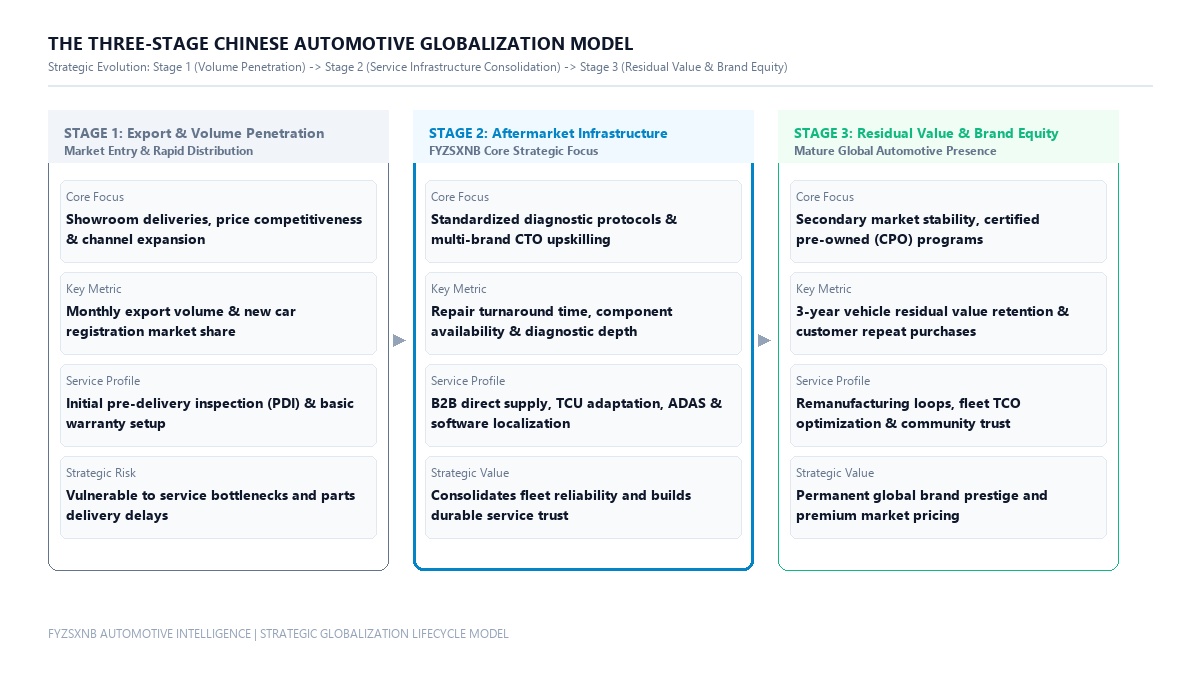
The Three-Stage Chinese Automotive Globalization Model defines this developmental evolution:
- Stage 1: Vehicle Export & Market Penetration (The Volume Phase): Characterized by rapid vehicle shipments, price-to-performance competitiveness, dealer network expansion, and capturing market share during structural supply disruptions.
- Stage 2: Aftermarket Infrastructure & Technical Support (The Ecosystem Phase): The core operational focus of modern market integration. Characterized by establishing standardized diagnostic protocols, upskilling independent multi-brand workshops, localizing digital cockpit software, and building agile cross-border B2B spare parts supply chains.
- Stage 3: Residual Value & Brand Equity (The Maturity Phase): Characterized by robust secondary market valuation, certified pre-owned (CPO) vehicle programs, established remanufacturing channels, and sustainable long-term consumer brand loyalty.
Without successful consolidation in Stage 2, high initial sales volumes risk translating into secondary market depreciation, consumer frustration over repair delays, and compromised brand equity. Consequently, building a mature aftermarket ecosystem represents the decisive strategic priority for cross-border automotive stakeholders.
## 2. The Post-Sales Reality: Fleet Expansion and Geographic Distribution Challenges
Analyzing the operational requirements of the Russian automotive aftermarket requires understanding the country’s unique geographic and demographic realities. Spanning eleven time zones with vast distances between major metropolitan centers, regional distribution dynamics differ significantly from compact domestic markets.
| Regional Zone | Market Characteristics | Primary Service Channel | Key Aftermarket Challenge |
|---|---|---|---|
| Tier-1 Metropolitan Hubs (Moscow, Saint Petersburg) | High vehicle density, newer model mix, strong fleet penetration | Authorized 4S Franchises & Premium Specialist Centers | High diagnostic complexity, digital telematics localization, fast turnaround demands |
| Central & Volga Regions (Nizhny Novgorod, Kazan, Samara) | Balanced commercial and private ownership, active intercity commuting | Regional Franchise Dealers & Independent Multi-Brand СТО | Preventative chassis maintenance, brake component wear, seasonal fluid exchange |
| Ural & Siberian Federal Districts (Yekaterinburg, Novosibirsk, Krasnoyarsk) | Severe continental sub-zero winters, extensive unpaved transport routes | Independent Specialist Workshops (СТО) & Regional Repair Hubs | Extreme cold-start lubrication, subframe corrosion protection, rubber bushing durability |
| Far Eastern Federal District (Vladivostok, Khabarovsk) | Parallel-import gateway, mixed powertrain platforms, extreme climate | Independent Import Repair Facilities & Specialized Rebuilders | Cross-border logistics speed, non-standard diagnostic protocol adaptation |
While authorized franchised dealership networks have expanded rapidly across major administrative centers, geographic coverage across secondary cities and remote territories remains constrained. Consequently, a substantial proportion of daily vehicle servicing naturally migrates toward the independent multi-brand repair sector (СТО).
Furthermore, because many Russian vehicle owners utilize their primary crossovers and sedans for high-mileage daily commuting and long-distance intercity family transit, operational wear accumulates rapidly. When routine maintenance or specialized repairs are required in regional areas, relying exclusively on multi-tiered traditional import chains can lead to extended lead times for specialized components. Developing regional warehousing and agile direct-sourcing mechanisms is therefore vital to maintaining fleet mobility.
## 3. The Evolution of Independent Multi-Brand Workshops (СТО)
For more than three decades, the technical competence of independent automotive repair facilities across Eastern Europe was structured around established European, Japanese, and Korean vehicle platforms. Workshop technicians developed deep familiarity with European diagnostic protocols, specialized service tools, and electronic control topologies.
The rapid transition toward Chinese vehicle platforms has created a significant technical transformation across the independent repair sector:
3.1 Diagnostic Protocol Adaptation and Electronic Architecture
Modern Chinese vehicles incorporate proprietary electronic control architectures utilizing advanced high-speed multiplexed communication networks. Diagnostic scan tools originally calibrated for European vehicle fleets often require software expansion to access specialized sub-routines, such as dual-clutch transmission clutch touch-point calibration, electronic parking brake service modes, or Advanced Driver Assistance System (ADAS) radar alignment.
To service these platforms effectively, independent workshops are steadily adopting specialized multi-brand diagnostic platforms that integrate verified manufacturer communication protocols and multi-language diagnostic trees, bridging the technical gap between factory service centers and the broader repair market.
3.2 EPC Parts Cataloging and Fast Model Iterations
A notable characteristic of the Chinese automotive manufacturing ecosystem is its rapid pace of product iteration. Vehicle models frequently receive annual electronic updates, chassis refinements, or supplier optimizations during their production lifecycle. Consequently, specific component part numbers (OE Numbers) for brake rotors, suspension control arms, and engine sensors can vary across model years.
Independent service centers increasingly require access to standardized, VIN-decoded Electronic Parts Catalogs (EPC) and digital cross-reference databases to ensure accurate component identification and eliminate costly procurement mismatches.
## 4. Cold-Climate Operational Demands and Preventative Maintenance Discipline
The climatic conditions of Northern Eurasia place extreme physical demands on all modern motor vehicles. Ambient winter temperatures regularly drop below -20°C in metropolitan centers and exceed -35°C in continental regions, while roads are treated with aggressive chemical de-icing agents. Maintaining high-output turbocharged direct-injection engines and multi-speed automated transmissions under these conditions requires disciplined preventative maintenance protocols.
4.1 Low-Viscosity Lubrication Standards
Contemporary internal combustion engines utilize variable-displacement oil pumps and tight internal bearing clearances designed for low parasitic drag. In severe winter environments, these engines require manufacturer-approved low-viscosity, low-SAPS fully synthetic engine oils (typically 0W-20 or approved 5W-30 formulations meeting API SP / ILSAC GF-6 standards).
Adhering to approved low-viscosity formulations ensures rapid oil circulation to turbocharger bearings during freezing cold starts, prevents low-speed pre-ignition (LSPI), and minimizes carbon deposit accumulation on intake valves during frequent short-distance urban driving.
4.2 Dual-Clutch and Multi-Speed Automatic Transmission Care
Modern transverse wet dual-clutch transmissions and hydraulic automatics operate within demanding thermal windows. In cold operating environments, dedicated low-viscosity transmission fluids must maintain stable shear properties to facilitate precise electro-hydraulic solenoid actuation.
Independent workshops servicing these drivetrains are transitioning toward automated dynamic fluid exchange procedures and subsequent electronic adaptation calibration, ensuring smooth shift quality and long-term clutch longevity.
4.3 Chassis Anti-Corrosion and Rubber Component Upkeep
Continuous exposure to road brines and chemical de-icers accelerates surface oxidation across underbody subframes, steering knuckles, and brake hardware. In professional workshop practice, preventative seasonal maintenance increasingly incorporates:
- Visual inspection of constant-velocity (CV) joint boots and steering rack bellows for cold-induced micro-cracking;
- Application of high-temperature synthetic grease to brake caliper slider pins during seasonal tire changes to prevent caliper binding;
- Preventative protective coatings on exposed structural subframe welds and electrical grounding points.
## 5. Smart Cockpit, Telematics, and Diagnostic Modernization
A defining hallmark of contemporary automotive engineering is the integration of advanced digital cabin technologies and intelligent driver assistance suites. Modern crossovers and sedans feature multi-screen panoramic interfaces powered by high-performance system-on-chip (SoC) architectures, integrated telematics connectivity, and active ADAS safety sensor arrays.
5.1 Infotainment and Telematics Localization
For vehicles sourced through non-domestic distribution channels, software adaptation represents a primary consumer consideration. The centralized infotainment system manages multimedia, vehicle dynamics settings, climate functions, and driver instrument cluster displays. Specialized automotive software providers collaborate with service centers to deliver verified, stable localization solutions:
- Complete Cyrillic Interface Translation: Translating all on-screen menus across media and instrument displays with native typography and graphical hierarchy;
- Regional Navigation Integration: Integrating widely utilized local mapping applications (such as Yandex.Navigator) to enable real-time traffic monitoring, lane guidance, and speed camera alerts;
- Telematics Module Adaptation: Configuring on-board telematics boxes (T-Box) with regional cellular SIM interfaces and dual-mode GPS/GLONASS satellite positioning, enabling remote engine pre-heating and cabin conditioning in severe winter weather.
5.2 ADAS Optical and Radar Sensor Calibration
The widespread adoption of Level 2 Advanced Driver Assistance Systems—including Adaptive Cruise Control (ACC), Automatic Emergency Braking (AEB), and Lane Keeping Assist (LKA)—has transformed routine body and glass repair. Common procedures such as replacing a damaged windshield or removing the front bumper assembly require recalibrating forward-facing optical cameras and 77GHz millimeter-wave radar units.
Independent collision centers and glass replacement facilities are actively equipping their workshops with specialized optical target boards, laser alignment rigs, and radar reflectors tailored to modern vehicle platform dimensions.
## 6. Building Agile B2B Supply Chains: The Role of Qualified Component Manufacturing
The foundational pillar of any sustainable automotive aftermarket is the availability and affordability of reliable spare parts. Historically, cross-border component procurement relied on fragmented trading intermediaries, resulting in inconsistent component quality, unpredictable freight transit times, and limited warranty recourse for independent repair facilities.
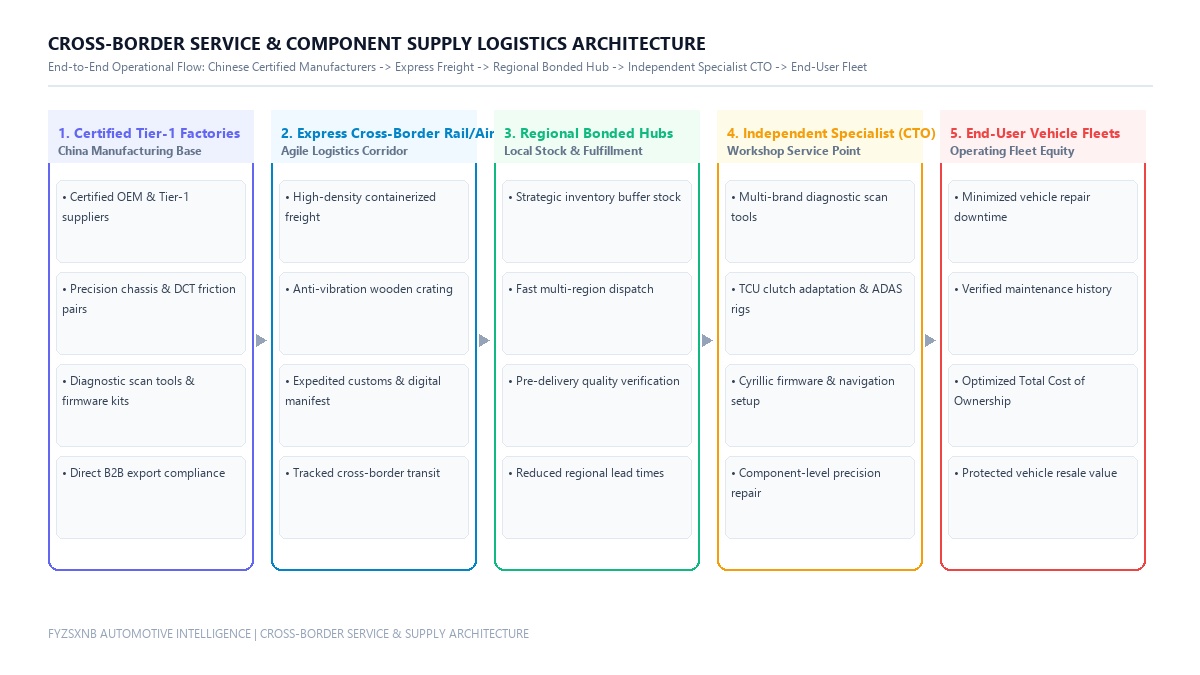
The modern cross-border aftermarket is evolving toward a structured, verified B2B supply ecosystem anchored by three strategic enablement pillars:
| Strategic Enablement Pillar | Core Technical Focus | Downstream Aftermarket Impact |
|---|---|---|
| 1. Certified High-Value Maintenance Parts | Chassis control arms, cold-resistant suspension bushings, precision wheel bearings, and high-carbon brake friction pairs from verified OEM and qualified Tier-1 manufacturers. | Ensures independent workshops receive durable, precision-engineered replacement parts that withstand severe road conditions without requiring expensive full-assembly replacements. |
| 2. Diagnostic Software & Workshop Equipment | Dedicated OBD-II diagnostic protocol hardware, TCU clutch adaptation reset modules, ADAS laser calibration rigs, and bilingual technical wiring schematics. | Empowers multi-brand service centers with the electronic depth and technical documentation needed to service complex powertrain and safety electronics accurately. |
| 3. Software Localization & Telematics Hardware | Pre-configured multimedia hardware kits, external dual-mode GPS/GLONASS antenna sets, and plug-and-play wiring harnesses. | Provides reliable, non-invasive software adaptation and remote connectivity without compromising factory electrical architecture or vehicle network stability. |
By establishing direct procurement partnerships with qualified manufacturers and reputable component rebuilders in China, regional distributors and workshop networks can optimize inventory turnover, lower repair costs for vehicle owners, and maintain rigorous quality control standards.
## 7. Why Aftermarket Maturity Decides Long-Term Residual Value and Brand Equity
In mature automotive markets, consumer purchasing decisions are heavily influenced by the Total Cost of Ownership (TCO) and expected secondary market depreciation. When a vehicle platform possesses an accessible, cost-effective aftermarket repair ecosystem, its secondary market residual value stabilizes, reinforcing consumer trust and supporting new vehicle sales.
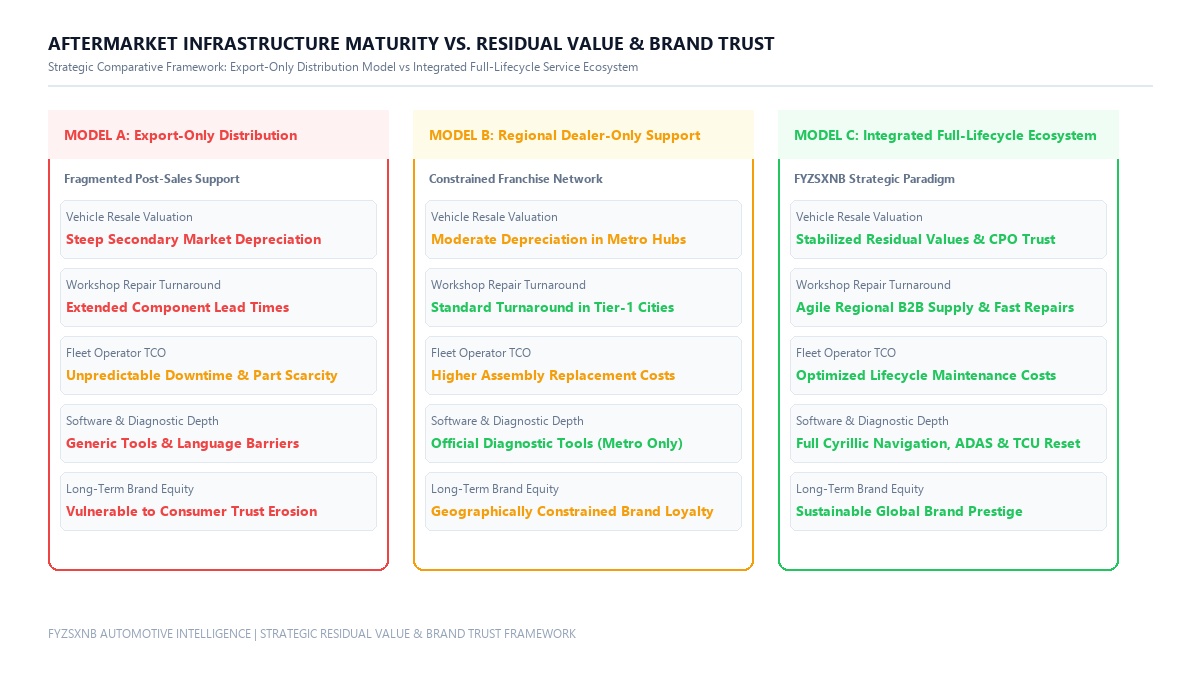
Conversely, if replacement components are difficult to source or independent workshops lack diagnostic capabilities, secondary market buyers apply steep valuation discounts to account for perceived maintenance risks. Therefore, investment in aftermarket infrastructure—encompassing technical training, parts availability, diagnostic tooling, and digital software support—is not merely an operational cost; it is the fundamental driver of long-term brand equity.
As the fleet of Chinese vehicles in Russia continues to mature, manufacturers, component suppliers, and independent service networks that collaborate to build transparent, accessible maintenance ecosystems will secure a permanent, respected position in the international automotive landscape.
## 8. Conclusion: The Roadmap for a Sustainable Cross-Border Automotive Ecosystem
The widespread adoption of Chinese motor vehicles across the Russian market marks the beginning of an enduring industrial era. Having successfully completed the initial phase of market penetration, the cross-border automotive sector now faces the vital task of building a mature, full-lifecycle service infrastructure.
Achieving long-term sustainability requires concerted action across the automotive value chain:
- Empowering Independent Workshops: Providing multi-brand service centers with verified diagnostic scan tools, bilingual technical repair documentation, and standardized training;
- Streamlining Component Logistics: Establishing regional bonded warehousing hubs and direct B2B channels with certified component manufacturers;
- Supporting Digital Localization: Delivering stable, non-invasive software adaptation for infotainment systems, regional navigation services, and cold-climate telematics;
- Fostering Lifecycle Transparency: Developing standardized parts cataloging and certified maintenance histories to protect secondary market residual values.
By uniting robust mechanical engineering with disciplined preventative maintenance and agile cross-border supply chains, the industry can ensure that large-scale vehicle export evolves into a resilient, globally respected automotive ecosystem.
This intelligence whitepaper is published by FYZSXNB Intelligence, delivering comprehensive cross-border automotive technical research, diagnostic frameworks, and supply chain analysis. For inquiries regarding technical research, diagnostic protocols, or specialized component sourcing, please contact the FYZSXNB team.