
Li Auto L7/L9 & Zeekr in Russia: Closed Air Suspension Overhaul, 1.5T EREV Oil Dilution & 2026 Customs Power Guide

A chassis technician connecting a dry-nitrogen manifold gauge and factory diagnostic tablet to the underbody solenoid valve block and aluminum double-wishbone air strut assembly.
Executive Summary: The EREV & Premium EV Surge Meets Russian Winter Realities
By late 2026, Extended-Range Electric Vehicles (EREVs) led by the Li Auto (Lixiang) L6, L7, and L9 alongside pure-electric architecture flagships such as the Zeekr 001 (FR / Facelift 800V) and Zeekr 7X have established an extraordinary footprint across the Russian Federation, surpassing 85,000 combined active units on Russian roads. These vehicles dominate the premium SUV segment formerly occupied by German luxury marques, offering dual-motor all-wheel drive, CDC (Continuous Damping Control) dual-chamber air suspension, and silicon-carbide (SiC) power electronics.
However, operating these software-defined luxury vehicles across two to three Russian winters—combined with major late-2025/2026 regulatory shifts in Russia’s progressive Utilization Fee (Утильсбор) and customs power calculation methodology—has exposed three acute technical and commercial bottlenecks:
- Closed-Loop Air Suspension (“Magic Carpet” / Vibracoustic / Continental) Seizure at -25°C to -38°C: Moisture intrusion into nominally sealed nitrogen circuits causes valve block solenoid icing, compressor piston ring scoring, and front strut sleeve delamination under aggressive road-brine exposure;
- 1.5T Range-Extender (L2E15M) Fuel-in-Oil Dilution & Emulsification: Automated generator start-stop cycles during short sub-zero urban trips prevent crankcase oil from reaching 95°C vaporization thresholds, leading to unburned gasoline accumulation exceeding 6.5% by volume;
- 2026 EREV & BEV Customs Power Valuation: Navigating the mandatory laboratory determination of 30-minute continuous electric motor output (Мощность 30-минутной отдачи) versus peak inverter power and internal combustion generator coupling under EAEU SBKTS/EPTS protocols.
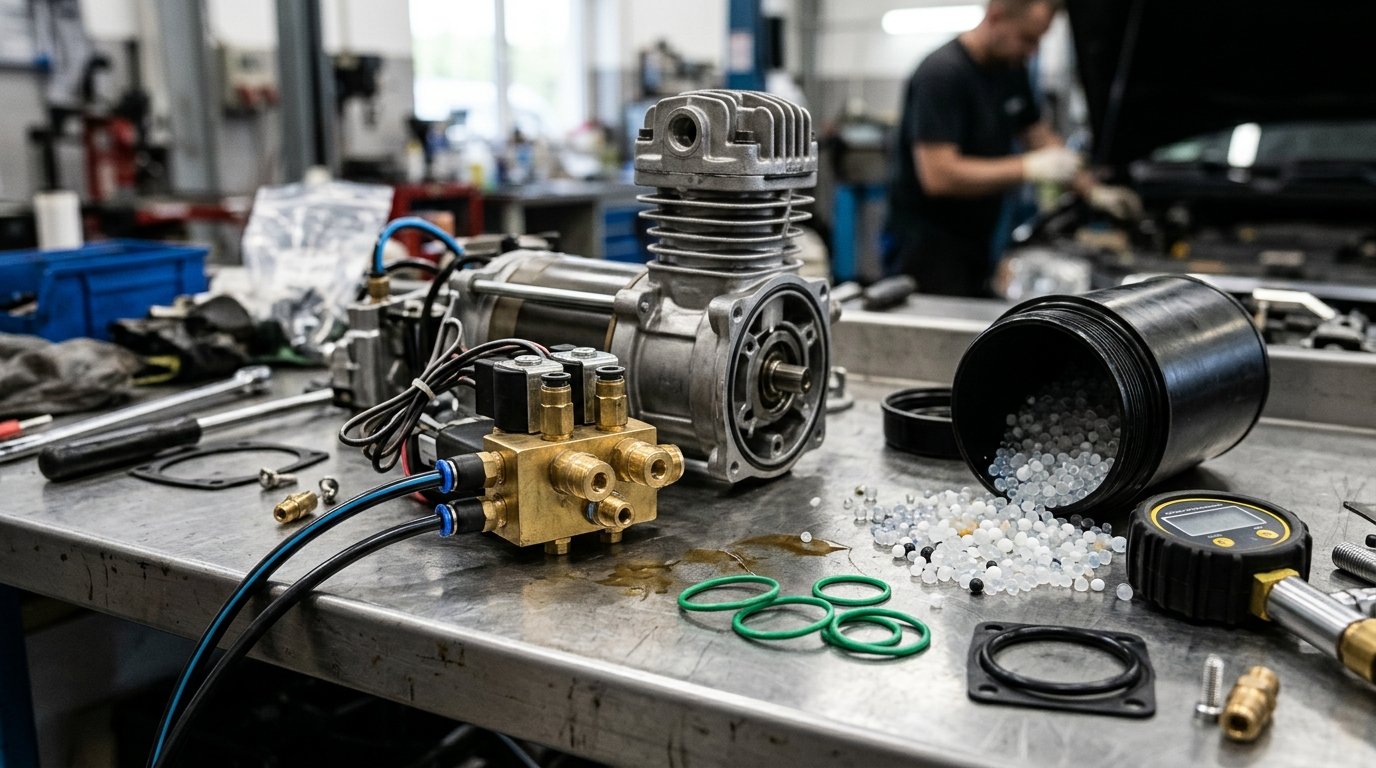
Bench inspection revealing the piston PTFE guide ring, brass multi-channel pressure distribution block, saturated molecular-sieve silica gel desiccant beads, and low-temperature FKM elastomer O-ring seals.
1. Closed-Loop Dual-Chamber Air Suspension: Engineering Failure Modes at -35°C
Both Li Auto’s “Magic Carpet” (supplied across various production batches by Vibracoustic, Continental, and domestic tier-1 partners Bost/KPSNC) and Zeekr’s dual-chamber air suspension operate on a closed-loop pressurized gas architecture. Unlike older open-atmosphere pneumatic systems, a closed-loop system shuttles pre-charged dry nitrogen (typically 12 to 17 bar static reservoir pressure) between an aluminum pressure accumulator tank and the four corner air struts.
1.1 Why “Sealed” Systems Freeze in Russian Winters
In theory, a closed nitrogen loop never inhales ambient moisture. In practice, Russian workshops encounter widespread winter suspension collapse (“Air Suspension Fault — Vehicle Speed Limited to 40 km/h”) due to a cascading thermodynamic chain:
- Micro-Permeation & Make-Up Air Ingestion: Standard EPDM/chloroprene rubber air sleeves and push-to-connect Voss fittings experience micro-contraction below -28°C. When reservoir pressure drops below the 10.5 bar threshold, the compressor automatically opens its atmospheric intake valve to replenish lost volume, drawing in humid winter slush air;
- Silica Gel Desiccant Saturation: The integrated dryer canister contains only 90–120 grams of molecular-sieve desiccant beads. Once saturated, moisture passes directly into the brass 6-way solenoid valve block;
- Directional Valve Ice Locking: When the vehicle parks overnight at -30°C, microscopic water droplets freeze across the 1.2 mm orifice seats of the corner leveling solenoids. Upon morning wakeup, the compressor runs continuously against a blocked manifold, tripping thermal overload protection (exceeding 135°C cylinder head temperature) and blowing the 40A midi-fuse.
Working Gas Medium: 99.9% Dry Nitrogen (N2) — Dew Point < -55°C
Accumulator Tank Pressure: 14.5 – 16.5 bar (at Standard Ride Height, +20°C)
Front Strut Operating Range: 7.2 – 9.8 bar (Dual-Chamber Valve Open/Closed)
Rear Strut Operating Range: 6.4 – 8.9 bar
Compressor Thermal Cutout: 140°C Cylinder Head / 115°C Brushless Motor Winding
Desiccant Replacement Cycle: Every 30,000 km or Annually Before November
Anti-Freeze Additive Policy: STRICTLY PROHIBITED (Alcohols swell FKM/EPDM valve seats)
1.2 Standardized 5-Step Winter Prevention & Rebuild Protocol
Independent Russian workshops achieving zero winter comebacks follow a strict nitrogen service protocol every autumn:
- Depressurization via Factory Diagnostic Mode: Engage “Jack Mode / Air Spring Deflation” using the diagnostic interface before lifting the chassis to prevent negative-pressure inversion of the rubber rolling lobe;
- Vacuum Evacuation & Desiccant Regeneration: Remove the compressor dryer cartridge, replace the saturated silica gel with fresh 3A/4A molecular sieve beads baked at 180°C, and pull a -0.95 bar vacuum across the accumulator and manifold lines for 20 minutes;
- Voss Fitting & FKM Seal Upgrade: Replace factory nitrile O-rings on the front strut top hats and valve block ports with low-temperature fluorocarbon (FKM / Viton GLT) or fluorosilicone (FVMQ) rings rated to -50°C;
- Protective Dust Boot Installation: Install corrugated neoprene protective bellows (“пыльники пневмобаллонов”) over exposed rear air sleeves to prevent abrasive sand and de-icing reagent crust from scoring the rubber fold;
- Dry Nitrogen Recharge & Ride-Height Calibration: Recharge the accumulator exclusively from a certified Grade 4.8 dry nitrogen cylinder to 15.5 bar, followed by four-corner inclinometer ride-height calibration on a leveled alignment rack.
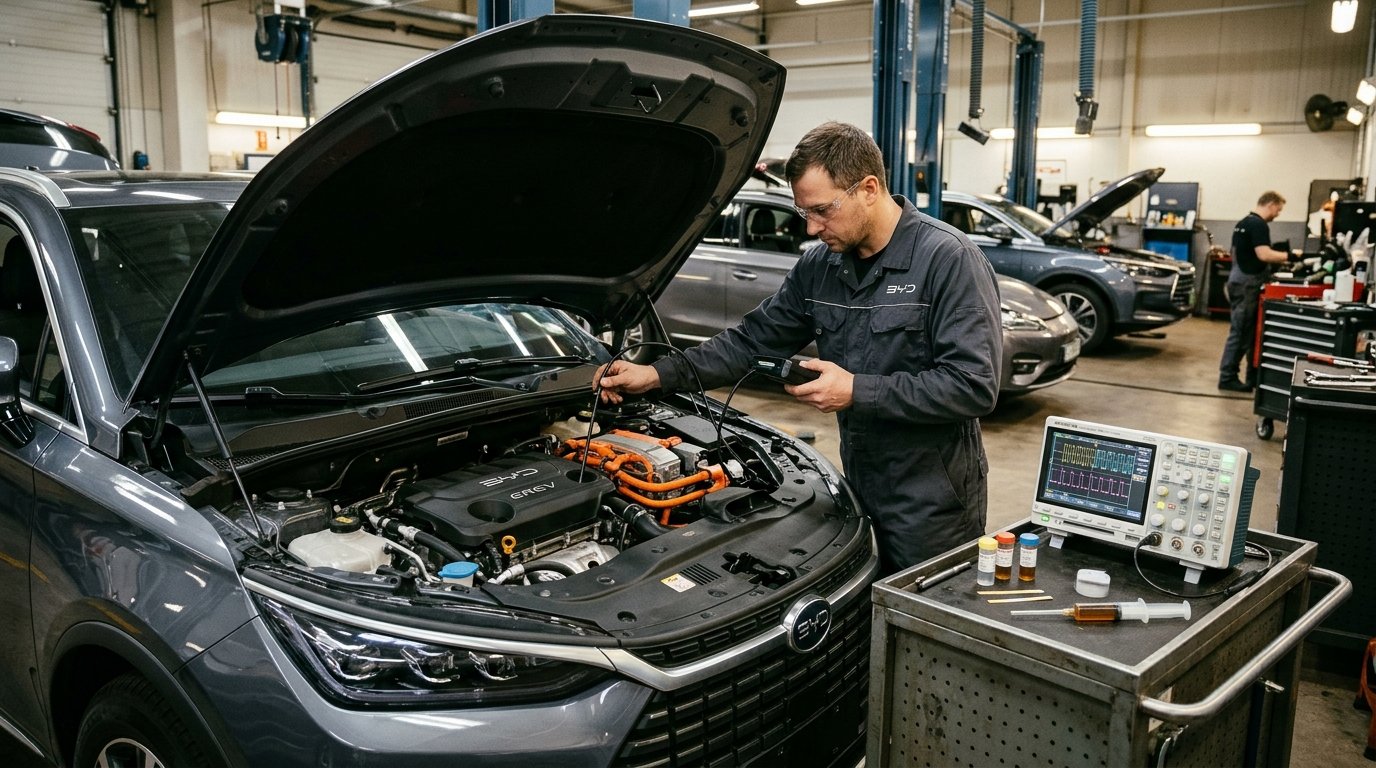
Evaluating piston crown carbon deposits, cylinder liner cross-hatch integrity, and fuel-in-oil viscosity degradation on a series-hybrid range extender operating in sub-zero urban duty cycles.
2. 1.5T Range-Extender (L2E15M) Fuel Dilution & Emulsification in EREVs
In the Li Auto L6, L7, L8, and L9, the four wheels are driven exclusively by front (130 kW) and rear (200 kW) permanent-magnet synchronous electric motors. The front-mounted 1.5-liter turbocharged four-cylinder Miller-cycle engine (code CE15 / L2E15M, 113 kW / 154 hp) has no mechanical clutch connection to the wheels; it drives a dedicated generator to recharge the 42.8 kWh or 52.3 kWh traction battery and supply cabin heat.
2.1 The Physics of Short-Cycle Winter Fuel Dilution
When a Russian owner operates a Li Auto in “Hybrid / Winter Priority” mode across short 15-minute urban commutes at -20°C, the range extender starts automatically into an aggressive cold-enrichment map (350 bar direct injection pressure) to rapidly warm the coolant loop. Because the engine operates at fixed generator RPM bands (typically 1,800 to 2,500 RPM) under high manifold pressure before cylinder walls reach thermal equilibrium, liquid gasoline condenses on the cold cylinder liners and scrapes past the low-tension piston rings into the crankcase sump.
| Operating Profile | Oil Sump Peak Temp | Fuel Dilution (% Vol at 5,000 km) | Kinematic Viscosity @ 100°C (cSt) | Required Workshop Action |
|---|---|---|---|---|
| Highway Long-Distance (+15°C) | 96°C – 104°C | < 1.8% (Normal evaporation) | 8.4 cSt (Within SAE 0W-20 spec) | Standard 10,000 km / 1-year interval |
| Mixed Suburban Winter (-10°C) | 74°C – 82°C | 3.5% – 5.2% (Moderate dilution) | 6.7 cSt (Borderline film strength) | Shorten oil change to 6,500 km |
| Short Urban Winter Trips (-25°C) | 52°C – 65°C | 6.8% – 10.5% (Critical rise in dipstick level) | < 5.1 cSt (Severe bearing/chain wear risk) | Immediate drain + PCV check + 5,000 km winter schedule |
Workshops servicing Lixiang vehicles in Russia must enforce three preventative measures:
- Strict 5,000 km / 150 Engine-Hour Winter Oil Interval: Ignore the onboard 10,000 km ICE maintenance counter during winter months. Use PAO/ester-based fully synthetic SAE 0W-20 or 0W-30 API SP / ILSAC GF-6A oil to withstand fuel wash and prevent Low-Speed Pre-Ignition (LSPI);
- PCV Breather Tube Insulation: Moisture emulsification (“yellow mayonnaise” sludge) collects in the positive crankcase ventilation (PCV) hose routing between the valve cover and turbocharger inlet. Wrapping the breather line in closed-cell thermal sleeve prevents ice plug formation that would otherwise blow out the rear main crankshaft seal;
- Monthly Thermal Boil-Off Cycle: Advise owners to run “Fuel Priority / Hold SOC 70%” on a highway run for 40 continuous minutes twice a month so oil sump temperatures exceed 95°C, boiling off accumulated light fuel fractions and condensation.
3. 2026 EREV & EV Customs Valuation: 30-Minute Continuous Power vs. Peak Power
For B2B importers and automotive dealers bringing Chinese EREVs and EVs into the Eurasian Economic Union (EAEU) and Russian Federation in 2026, customs classification and progressive Utilization Fee (Утильсбор) calculation hinge on accurate powertrain rating documentation.
3.1 Series Hybrid (EREV) vs. Parallel Hybrid Power Aggregation
A persistent point of friction at customs laboratories issuing SBKTS (СБКТС — Vehicle Safety Construction Certificate) and electronic passports (EPTS / ЭПТС) is distinguishing between:
- Peak 10-Second Electric Power (Пиковая мощность): For a Li Auto L7/L9, combined front + rear inverter peak output reaches 330 kW (449 hp), while a Zeekr 001 Dual-Motor reaches 580 kW (789 hp);
- 30-Minute Maximum Continuous Power (Максимальная 30-минутная мощность): Under UNECE Regulation No. 85 and EAEU Technical Regulation TR CU 018/2011, the legally binding taxable power of an electric traction drive is its thermally sustainable 30-minute continuous output. For the Li Auto L7/L9 dual-motor system, certified 30-minute continuous output is 145 kW (65 kW front + 80 kW rear, or ~197 hp);
- ICE Generator Exclusion in True Series Hybrids: Because the L2E15M 1.5T engine (113 kW / 154 hp) has zero mechanical transmission path to the axles, its shaft output cannot be arithmetically added to wheel traction motor output unless a regulatory re-classification treats generator + traction motors under combined excise brackets. Importers must verify the exact accredited test laboratory protocol (GOST 33997 / UNECE R85) before filing the customs declaration (GTD) to prevent retroactive post-clearance customs audits (ФТС России камеральная проверка).
B2B Workshop & Parts Supply Chain Opportunity (2026–2027)
Independent service centers in Russia that invest in closed-loop nitrogen charging stations and Lixiang/Zeekr diagnostic capability achieve rapid capital recovery:
- Dry Nitrogen Air Suspension Service Station Capex: ~185,000 RUB (Nitrogen cylinder + 25-bar regulator manifold + vacuum pump + Voss connector kit + silica gel regenerator);
- Average Revenue per Pre-Winter Air Suspension Service: 18,000 – 26,000 RUB (2.5 labor hours, 82% gross margin);
- High-Velocity Spare Parts Stocking List: Front air strut rebuild sleeves, WABCO/Continental-compatible piston rings, 6-way brass solenoid valve blocks, ride-height Hall sensors (OE 2914100-X01), and L2E15M oil filters with cold-climate PCV breather valves.
Conclusion
The Li Auto L-series and Zeekr platforms represent the pinnacle of contemporary Chinese automotive engineering, but their longevity in Russia depends entirely on proactive winterization. By eliminating moisture from closed-loop air suspensions with dry nitrogen, managing EREV crankcase fuel dilution through shortened PAO oil intervals, and adhering strictly to UNECE R85 30-minute continuous power documentation, Russian workshops and importers can protect both vehicle reliability and commercial margins.