
Evidence status: facts checked against the ISO catalogue pages for both standards on 4 November 2026; EN 10204 is a subscription standard whose full text was not read this round, and points attributed to it are labelled as secondary-source consensus. This is an editorial documentation note, not legal advice and not a statement about any supplier’s actual practice.
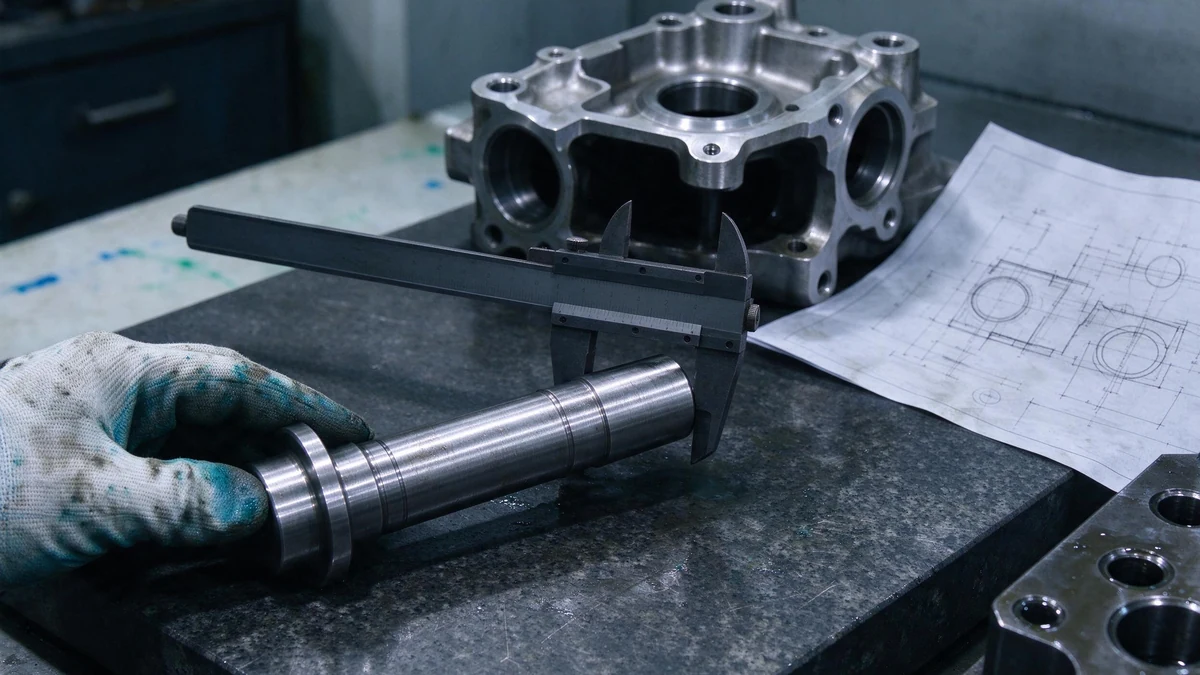
Fields that belong in the RFQ, not in the follow-up email
Most spare-part rework begins with what was never asked at quotation stage. The language for asking precisely exists: ISO 1101:2017, edition 4, confirmed current in 2022, defines the geometric specification symbols used on drawings, and per the ISO 16792 practice the same callouts can be carried onto 3D CAD models instead of a flat drawing. For fits, ISO 286-2:2010, edition 2, confirmed current in 2026 tabulates the common tolerance grades and limit deviations for holes and shafts. So a complete RFQ for a machined spare part names: the controlled drawing with GD&T applied; the material designation and the standard it is drawn from; the fit and tolerance code where a mating dimension exists — codes such as H7/g6 serve as examples of the notation, not as a recommendation for your part; the service temperature and medium; surface roughness; and the expected duty cycle or replacement interval.
The certificate that cannot be issued afterwards
Among inspection documents, EN 10204:2004 distinguishes type 2.1, 2.2 and 3.1 — and, in secondary-source consensus, the type 3.1 certificate, which reports specific test results for the delivered consignment and is signed by an authorised representative independent of the manufacturing department, is expected to be requested in the order itself; a 3.1 demanded after delivery typically cannot be produced because the sampling and testing had to happen at production time. The fuller 3.2 form, countersigned by both manufacturer and purchaser representatives, is the secondary-source description of the standard’s third-party variant. Two cautions: the certificate type must be specified contractually, and EN 10204 belongs to a different system from GOST and EAEU conformity documents — a Russian buyer should not assume one substitutes for the other.
At goods-in: four matches to make
- Certificate type matches what the PO ordered — 2.2 is not a 3.1 with fewer pages.
- Heat or batch number on the certificate matches the marking on the parts.
- The signer’s declared independence from the production department is stated in the document.
- Part identification — drawing number and revision — matches the controlled drawing you released.
Editorial checklist — not an official obligation
Our suggestion is to make this field list a template inside your RFQ form, and to reject a certificate type that was never ordered rather than negotiate it at receiving. This is an editorial procurement practice, not a requirement of ISO or EN 10204.
Limits
No tolerance values are reproduced; the H7/g6 pair is notation illustration only. We did not read the EN 10204 text — points attributed to it follow secondary sources and need first-hand confirmation before contractual use. No claims are made that Chinese suppliers routinely refuse 3.1 certificates, nor any statistics on rework rates. External links were checked on 4 November 2026.
For related sourcing notes, see the FYZSXNB intelligence desk.