
Official sources checked on 28 October 2026. Supplier checks below are editorial recommendations, not statutory requirements.
A 21 October opinion issued by the general offices of the CPC Central Committee and the State Council, published on China’s Ministry of Science and Technology (MOST) website, calls for closer integration between scientific and technological innovation and industrial innovation. It points to industry-oriented research, enterprise-led commercialization where industrial goals are clear, application scenarios, proof-of-concept centres, and pilot-validation platforms. The accompanying explanation emphasizes starting from application demand rather than treating commercialization as an afterthought.
For a buyer, that policy direction is useful context, but it is not a supplier credential. A company cannot establish that a product is production-ready, export-qualified, or suitable for a customer’s use simply by citing a national policy, a pilot centre, or a “commercialization” label. Those claims need evidence tied to the specific product, configuration, process, and delivery commitment.
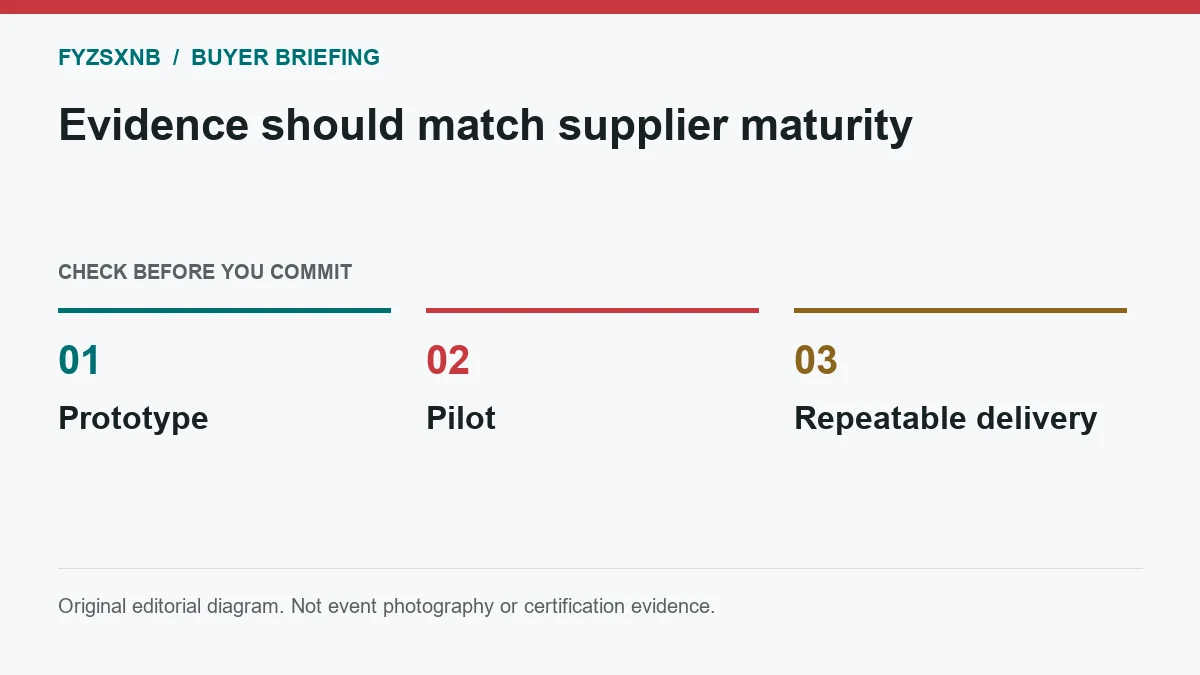
Ask for evidence at the right maturity level
Keep the discussion concrete. A prototype, a pilot build, and repeatable delivery answer different questions. The following RFQ prompts are practical buyer recommendations; they are not official policy tests or prescribed documentation:
- Sample configuration: What exact hardware, software, materials, firmware, and options are included? Ask the supplier to identify the version used for any sample or demonstration, and list differences from the quoted configuration.
- Repeat-run record: For a production claim, ask for dated evidence showing multiple runs of the same defined configuration, with output quantities, observed defects or rework, and how exceptions were handled. Agree what can be shared under confidentiality.
- Change control: Who must be notified before components, process steps, subcontractors, software, or manufacturing locations change? Ask how the delivered unit will be traceable to an approved specification.
- Support and dependencies: Identify installation, spare parts, service response, updates, training, and any third-party inputs. Put an owner and a response commitment beside each item.
- Acceptance milestones: Define what will be inspected at sample, pilot, and first delivery; who records the result; and what happens after a failed check. Do not let a broad “successful pilot” phrase substitute for agreed criteria.
Evidence should match the claim. A prototype can demonstrate a concept without proving repeatability. A pilot may reveal process or service gaps without proving stable volume delivery. A few successful units do not by themselves establish future capacity. Conversely, a policy statement about pilot-validation platforms does not tell a buyer whether a particular supplier used one, what it validated, or whether its results apply to the item being quoted.
Keep the resulting file modest and auditable: dated supplier responses, the exact specification, document versions, sample observations, open risks, and the next decision gate. Where a test or certification is material to the purchase, identify the actual test scope and responsible issuer instead of accepting a generic badge. This is procurement discipline, not a guarantee of product performance.
Related coverage is available in the China Tech & Products archive, which contains mixed-language posts, and at the FYZSXNB intelligence desk.
Source record: The 21 October 2026 opinion, published on MOST’s website (clauses 2, 3, 4 and 13), and its official Q&A. These sources state policy direction; the supplier evidence framework in this article is original editorial advice. Checked 28 October 2026; issuing authority rechecked 29 October.