The transformation of the Russian automotive landscape over recent years is characterized by a defining structural shift: the widespread adoption of modern Chinese passenger vehicles across mainstream consumer segments. While niche imports and premium platforms capture substantial industry attention, the true foundation of market volume rests with practical, high-capacity family crossovers. Foremost among these high-volume platforms is the Chery Tiggo 8 Pro Max (alongside the broader Tiggo 8 family), a seven-seat mid-size crossover developed on Chery’s modular T1X platform.
As tens of thousands of Tiggo 8 units—supplied through authorized dealer networks, regional distributor agreements, and parallel importation channels—accumulate extensive operational mileage across diverse geographic territories and severe winter operating conditions, the market is entering a pivotal lifecycle transition. The initial challenge of vehicle distribution is giving way to the longer-term demand for structured maintenance, precision diagnostics, electronic localization, and resilient spare parts supply chains.
This automotive intelligence report examines the engineering architecture of the Chery Tiggo 8 Pro Max, explores the operational realities imposed by severe sub-zero climates, evaluates the specialized software and diagnostic requirements of modern digital cabins, and outlines how agile, high-value Chinese supply chains are establishing the foundation for a sustainable, full-lifecycle aftermarket ecosystem.
## 1. Introduction: From Vehicle Export to Lifecycle Support
Following the withdrawal of traditional European, Japanese, and Korean automotive manufacturers, the Russian family vehicle segment experienced an immediate supply contraction. Historically, middle-class households and commercial fleets requiring three-row seating, generous cargo volume, and all-wheel-drive capability relied on established models such as the Škoda Kodiaq, Hyundai Santa Fe, Kia Sorento, and Mitsubishi Outlander. In this evolving market, Chery became one of the major Chinese automotive manufacturers responding to this changing market environment.
The Chery Tiggo 8 Pro Max achieved immediate commercial traction by delivering a compelling combination of functional interior space, high-output turbocharged performance, intelligent all-wheel drive, and contemporary digital convenience features. However, commercial expansion at scale introduces an enduring industrial reality: high sales volume does not conclude an automotive export strategy—it initiates the second, more demanding phase of global market integration.
For high-volume family crossovers, long-term brand equity and vehicle residual values are not determined by initial showroom delivery numbers. Instead, they are decided in the workshops, diagnostic bays, and logistics networks of the downstream aftermarket. When hundreds of thousands of family vehicles are in daily service, the availability of technical documentation, qualified independent repair facilities, and accessible replacement components becomes the true benchmark of international competitiveness.
## 2. Why Mainstream Chinese SUVs Create New Service Demand
Understanding the service profile of the Chery Tiggo 8 Pro Max requires analyzing the operational profile of its user base. Unlike specialized commercial transports or second-vehicle luxury crossovers, mainstream family SUVs operate under continuous, demanding usage patterns:
- Intensive Mileage Accumulation: Because many Russian SUV owners utilize their vehicles for daily metropolitan commuting, school transport, and long-distance intercity family travel, these vehicles accumulate substantial annual mileage under widely fluctuating load conditions.
- Multi-Passenger and Heavy Cargo Demands: Operating with full seven-passenger capacity and heavy cargo loads places sustained mechanical stress on suspension bushings, subframe mounts, brake friction materials, and rear driveline components.
- The Post-Warranty Service Migration: As initial warranty periods conclude, or as vehicles imported outside authorized franchise networks require routine care, service demand steadily migrates from franchised dealerships toward independent multi-brand service centers (СТО). This transition requires the independent repair sector to rapidly build diagnostic competence and secure reliable component supply lines.
## 3. Technology Complexity Behind Modern Family SUVs
The contemporary Chery Tiggo 8 Pro Max is built upon modern electro-mechanical engineering principles. Rather than relying on simple, low-output naturally aspirated engines, the platform integrates sophisticated powertrain, transmission, and chassis control technologies designed to deliver balanced performance and low emissions.
| Sub-system / Module | Engineering Architecture & Key Characteristics |
|---|---|
| Vehicle Platform | T1X Modular Crossover Platform with High-Strength Steel Construction |
| Internal Combustion Engine | Kunpeng Power 2.0TGDI Direct-Injection Turbocharged Four-Cylinder Engine |
| Fuel Injection System | Central High-Pressure Direct Injection with Dual Variable Valve Timing |
| Transmission System | Transverse 7-Speed Wet Dual-Clutch Transmission (Wet DCT) |
| All-Wheel Drive (AWD) | BorgWarner Electro-Hydraulic Intelligent Torque Distribution Coupling |
| Suspension & Chassis | Front MacPherson Struts / Rear Independent Multi-Link Architecture |
| Cockpit & ADAS Architecture | Dual 12.3-Inch Integrated Panoramic Displays with Advanced Driver Assistance Suite |
The foundation of the vehicle is the T1X modular architecture, an internationally collaborative chassis platform engineered to provide structural rigidity, balanced handling, and optimized passenger space across three seating rows. Structurally, the chassis incorporates multi-link independent rear suspension geometry configured to maintain stability under varying payload distributions.
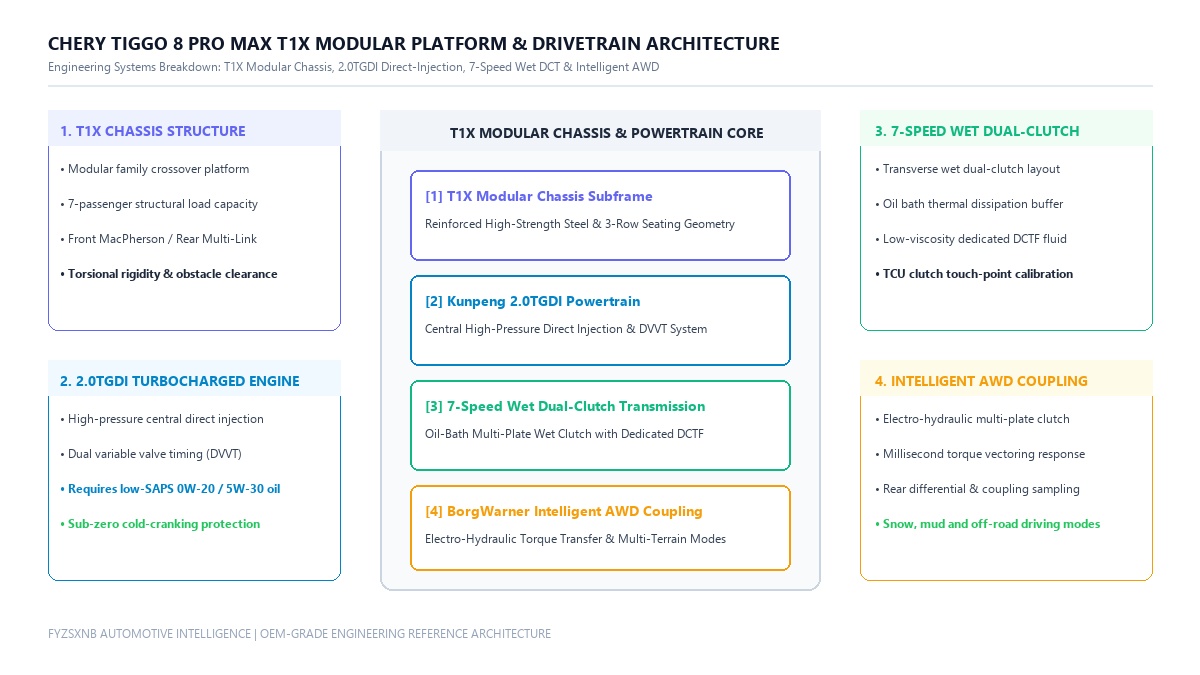
Powertrain duties are handled by the 2.0TGDI turbocharged direct-injection engine, paired with a 7-speed transverse wet dual-clutch transmission and an intelligent all-wheel-drive system. Unlike dry dual-clutch configurations, the wet clutch assembly operates within an oil bath, significantly improving thermal dissipation during extended low-speed urban crawling or snow driving. Realizing the full longevity potential of this powertrain requires establishing rigorous lubrication standards and structured service capabilities across regional repair networks.
## 4. Russian Operating Environment and Preventative Maintenance Realities
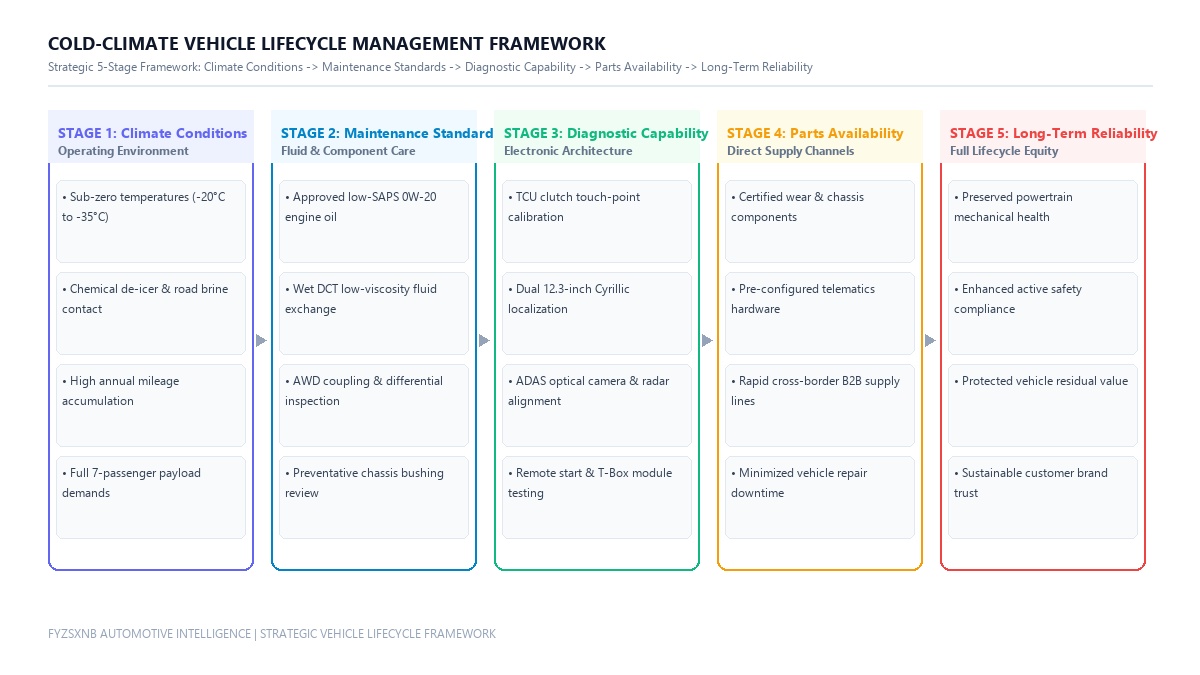
Operating an advanced turbocharged crossover in Northern and Eastern European climatic environments presents substantial physical demands. In regions where ambient winter temperatures regularly fall below -20°C and reach -35°C in continental zones, vehicle systems undergo extreme thermal cycling and exposure to aggressive road chemicals.
4.1 Engine Lubrication and Direct-Injection Care
Modern direct-injection turbocharged engines utilize narrow mechanical clearances, variable-displacement oil pumps, and high-pressure fuel delivery systems. Sub-zero cold cranking increases friction across internal components until nominal operating temperatures are reached. To ensure rapid fluid circulation and minimize Low-Speed Pre-Ignition (LSPI) risks, the powertrain relies on manufacturer-approved low-viscosity, low-SAPS fully synthetic engine oils (specifically high-performance 0W-20 or approved 5W-30 formulations).
In independent workshop practice, substituting approved low-viscosity formulations with generic, high-viscosity lubricants can delay oil delivery to the turbocharger core during cold morning starts. Furthermore, because winter operating routines frequently involve short urban trips that prevent engine oil from reaching sustained operating temperatures, regular preventative oil sampling and disciplined service routines are critical for maintaining fuel injector performance and preventing combustion deposit accumulation.
4.2 7-Speed Wet DCT and AWD System Maintenance
The 7-speed wet dual-clutch transmission relies on specialized Dual-Clutch Transmission Fluid (DCTF) that simultaneously lubricates internal gears, cools multi-plate clutch packs, and actuates electro-hydraulic control solenoids. Preventative servicing considerations include:
- Fluid Specification Compliance: The transmission requires dedicated low-viscosity DCTF formulated with specific friction modifiers. Using non-compliant universal transmission fluids alters clutch coefficient curves, potentially causing shift hesitation during cold-weather operation.
- Dynamic Fluid Exchange Standards: Automated dynamic fluid exchange equipment ensures complete fluid evacuation from the internal cooler and clutch cavity, achieving comprehensive renewal compared with basic gravity draining.
- Electronic TCU Adaptation Capability: Independent workshops require compatible diagnostic capabilities to complete electronic adaptation procedures (Clutch Touch Point Calibration) after major transmission fluid replacement or valve body servicing to ensure smooth, factory-grade gear engagement.
- AWD Differential & Coupling Inspection: The electro-hydraulic rear coupling and differential assembly benefit from periodic fluid sampling and seal inspection, particularly following intensive winter driving in deep snow or mud.
4.3 Winter Road De-Icers and Chassis Protection
Extensive seasonal application of chemical de-icing agents (such as calcium chloride and sodium chloride brines) on major transport routes exposes underbody assemblies to sustained chemical contact. Independent service centers operating in severe winter regions increasingly implement preventative maintenance checks focused on:
- Rubber Elastomer Inspection: Regular visual inspection of constant-velocity (CV) joint boots, steering rack bellows, and stabilizer bar bushings to detect premature cold-induced micro-cracking before road grime penetrates mechanical joints.
- Brake Mechanism Servicing: Cleaning and re-lubricating brake caliper slide pins with high-temperature synthetic grease during seasonal tire changes to prevent caliper binding caused by salt and road grime accumulation.
## 5. Infotainment, Telematics, and Diagnostic Ecosystem
A primary differentiator of modern Chinese vehicles is their advanced electronic architecture. The Chery Tiggo 8 Pro Max incorporates an integrated panoramic dual-screen cockpit, multi-zone automated climate controls, telematics connectivity, and an Advanced Driver Assistance System (ADAS) suite. In the international market, adapting these digital systems to local operating conditions has fostered a specialized technical service ecosystem.
5.1 Multi-Screen Interface and Navigation Localization
Vehicles sourced through non-domestic distribution channels frequently require software adaptation to meet regional consumer expectations. The vehicle’s centralized infotainment platform controls primary media, vehicle safety parameters, instrument cluster layouts, and ambient comfort settings.
Some vehicle owners, fleet operators, and independent workshops collaborate with specialized automotive software providers to implement verified localization packages. These software solutions deliver:
- Full Cyrillic System Translation: Comprehensive localization of menu structures across the digital instrument cluster and central media display, maintaining original typography and interface hierarchy.
- Regional Navigation Integration: Native integration of widely used local mapping applications (such as Yandex.Navigator), enabling real-time traffic monitoring, camera alerts, and lane guidance directly on the main display.
- Instrument Cluster Synchronization: Ensuring route guidance and media metadata project seamlessly onto the driver’s display without introducing interface latency or graphic rendering errors.
5.2 Remote Engine Start and Cold-Weather Telematics
In sub-zero climates, the ability to initiate engine pre-heating, seat warming, and windshield defrosting via smartphone applications or long-range key fobs is a highly valued operational feature. For imported vehicles whose factory telematics modules are linked to Chinese domestic networks, independent service centers offer hardware-adapted telematics interfaces that integrate with local cellular networks and dual-mode GPS/GLONASS satellite positioning systems.
5.3 ADAS Sensor Calibration Standards
The Tiggo 8 Pro Max integrates front-facing optical cameras and millimeter-wave radar sensors to support Adaptive Cruise Control (ACC), Automatic Emergency Braking (AEB), and Lane Keeping Assist (LKA). In standard workshop operations, common procedures such as replacing a damaged windshield or removing the front bumper assembly for radiator maintenance require recalibrating these sensors. Independent service facilities are steadily adopting standardized optical calibration targets and radar alignment fixtures to verify that active safety systems operate within factory tolerances.
## 6. High-Value Chinese Supply Chain Opportunities
As the operating fleet of Chery Tiggo 8 vehicles expands and matures, cross-border component logistics is transitioning from basic commodity replacement into a structured, high-value B2B supply chain ecosystem. For independent repair workshops and regional parts distributors, direct collaboration with specialized Tier-1 manufacturers and certified component rebuilders in China offers substantial commercial and operational advantages.
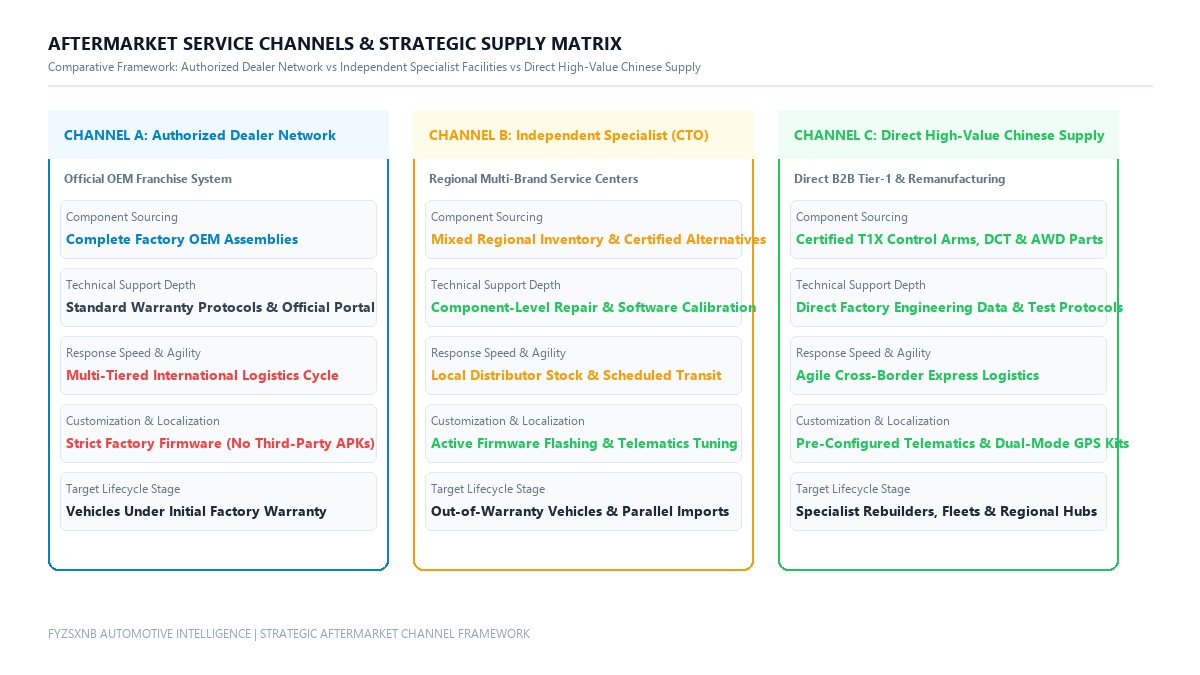
This evolving supply chain opportunity is structured around three strategic pillars:
| Strategic Pillar | Core Technical Focus | Downstream Aftermarket Value |
|---|---|---|
| 1. High-Value Maintenance Components | Reinforced chassis control arms, cold-resistant suspension bushings, precision wheel bearings, and high-carbon brake rotors | Provides independent workshops with certified, wear-resistant parts that withstand severe winter road conditions without requiring expensive full-assembly replacements. |
| 2. Diagnostic & Technical Support Equipment | Dedicated OBD-II diagnostic protocol interfaces, TCU clutch adaptation software, and ADAS optical calibration fixtures | Equips multi-brand service centers with the electronic diagnostic depth necessary to service modern electronic control modules and transmission hydraulics accurately. |
| 3. Software & Localization Hardware Kits | Pre-configured telematics modules, external dual-mode GLONASS antenna kits, and stable plug-and-play infotainment hardware | Enables non-invasive electronic localization and reliable remote telematics connectivity without compromising factory wiring harnesses or CAN-bus network stability. |
By establishing direct B2B procurement agreements with verified Chinese manufacturers, independent service providers can bypass multi-tiered intermediary logistics chains. This direct channel significantly reduces component lead times, guarantees technical compatibility with original engineering specifications, and ensures that vehicle owners receive timely, cost-effective maintenance support.
## 7. Conclusion: Building a Sustainable Full-Lifecycle Ecosystem
The prominent position of the Chery Tiggo 8 Pro Max across the Russian automotive market demonstrates the substantial appeal and engineering maturity of modern Chinese family crossovers. By providing three-row passenger versatility, a robust turbocharged powertrain, responsive wet dual-clutch transmission mechanics, and an advanced digital cabin, the platform has successfully fulfilled a critical consumer need.
However, the transition from successful vehicle export to an enduring, respected brand presence requires building a resilient aftermarket ecosystem. The long-term trajectory of Chinese automotive globalization is defined by three successive stages: Initial Market Entry, Service Infrastructure Consolidation, and Comprehensive Lifecycle Integration.
As the Tiggo 8 fleet navigates this evolutionary pathway, uniting disciplined preventative maintenance protocols with specialized software localization and responsive cross-border supply chains will ensure that high-volume sales translate into enduring customer trust, strong residual values, and a sustainable automotive service economy.
This intelligence report is published by FYZSXNB Intelligence, delivering comprehensive cross-border automotive technical research, diagnostic frameworks, and supply chain analysis.