
LiFePO4 & Sodium-Ion Portable Power Stations in Russia: -30°C Discharge Engineering, Bi-Directional GaN Inverters & Gas Boiler UPS Integration

Electrical engineer verifying 230V 50Hz pure sine wave THD (< 2.5%) and galvanic neutral-to-earth bonding required by ionization flame sensors in Russian suburban heating installations.
Executive Summary: The 2026 Winter Energy Storage Boom in Russia
Entering the 2026–2027 winter heating season, demand across the Russian Federation for high-capacity Portable Power Stations (Портативные зарядные станции, 1.2 kWh to 3.8 kWh) and modular home backup batteries has surged by over 140% year-over-year. Driven by suburban country house (ИЖС / Коттеджные поселки) grid voltage fluctuations, winter ice-storm outages, and rugged northern field operations, portable energy storage has evolved from summer camping gear into mission-critical residential and industrial infrastructure.
However, standard export-spec portable power stations designed in Shenzhen or Dongguan for mild California or Mediterranean climates frequently fail when deployed in Russian winter environments. B2B importers, marketplace brand owners, and electrical installers must solve three core engineering challenges:
- Floating Neutral vs. Phase-Sensitive Gas Boilers (Фазозависимые газовые котлы): Over 70% of European and Russian wall-mounted gas boilers (Baxi, Buderus, Vaillant, Protherm) use flame ionization rectification rods that immediately trigger fault
E01 / F28 (Flame Loss)when powered by an isolated floating-output inverter lacking a dedicated pass-through neutral (сквозной ноль); - Sub-Zero Lithium Plating (< 0°C Charge) & -30°C Electrolyte Freezing: Standard Lithium Iron Phosphate (LiFePO4 / LFP) cells suffer severe anodic metallic lithium dendrite growth if charged below 0°C without polyimide self-heating foils, while newly commercialized Sodium-Ion (Na-Ion / Натрий-ионные) packs offer native -40°C discharge capability;
- Bi-Directional GaN Inverter Surge & UPS Switchover Latency: Achieving <10 ms Uninterruptible Power Supply (UPS / ИБП) transfer times without resetting sensitive circulation pumps or server PSUs.
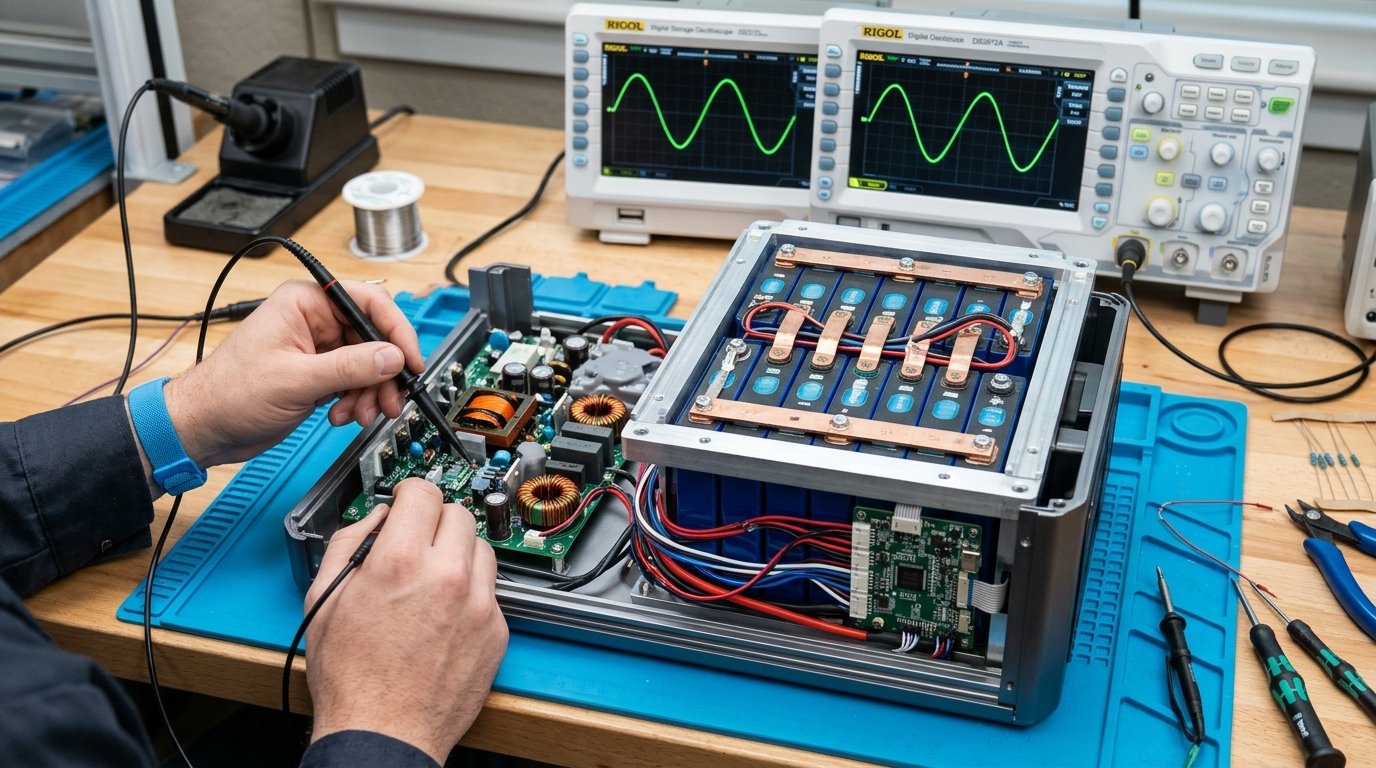
Internal architecture showing 16S1P automotive aluminum-shell prismatic LFP cells under compression, 16-channel active-balancing BMS, and a potted bi-directional GaN totem-pole PFC + full-bridge LLC inverter stage.
1. Power Electronics Teardown: Bi-Directional GaN Inverters & Pure Sine Wave THD
Modern flagship power stations sourced from tier-1 Chinese ODM clusters have replaced bulky 5 kg external AC power bricks with integrated Bi-Directional Inverters (Двунаправленный инвертор) built around third-generation Gallium Nitride (GaN) power FETs (Innoscience / Navitas) and Silicon Carbide (SiC) diodes.
1.1 Totem-Pole Bridgeless PFC + CLLC Resonant Topology
During grid charging, the AC-DC stage operates as a bridgeless totem-pole Power Factor Correction (PFC) rectifier (PF > 0.99), feeding a symmetrical CLLC resonant DC-DC converter that charges the 51.2V (16S LiFePO4) battery bus at up to 1.2C (80% state-of-charge in 45 minutes). When grid AC drops, the same power stage reverses direction within 8 to 10 milliseconds, inverting 51.2V DC into a synthesized 230V 50Hz pure sine wave.
Nominal Battery Bus: 51.2V DC (16S1P 40Ah Prismatic LiFePO4, Grade-A EVE / CATL)
Cell Internal Resistance: ≤ 0.45 mΩ per cell (@ 1 kHz AC impedance, delta ≤ 0.05 mΩ across pack)
Continuous / Surge AC Output: 2,400W Continuous / 4,800W Peak (200 ms inductive motor start)
Output Waveform Quality: Pure Sine Wave, Total Harmonic Distortion (THD) < 2.2% at full resistive load
UPS Relay Switchover Time: ≤ 10 ms (Zero-crossing synchronized dual-relay bypass)
Thermal Potting Protection: Two-part silicone thermal potting (UL94 V-0) for high-humidity condensation resistance
2. Solving the Russian Gas Boiler Problem: Isolated IT vs. Grounded TN-S Neutral
The single largest source of customer returns on Ozon and Wildberries for portable power stations in winter is the failure to run residential gas heating boilers (Газовый котел уходит в ошибку пламени E01). Understanding why requires examining the electrical safety architecture of portable inverters:
- Why Portable Stations Use an Isolated IT System (Две полуфазы по 115В): For outdoor shock safety, portable inverter outputs are galvanically isolated from earth ground. An indicator screwdriver or multimeter measured relative to household ground shows ~115V AC on both socket pins, with no defined Phase (L) or Neutral (N);
- How Flame Ionization Sensors Work: A gas boiler’s control board applies an AC potential between the burner chassis (connected to protective earth PE) and the flame ionization electrode. The flame acts as a micro-diode rectifier ($2 ext{–}15 mu ext{A}$ DC micro-current returning through the grounded Neutral). Without a galvanically tied Neutral-to-Earth reference, the ionization current is zero, and the boiler shuts off the gas valve within 3 seconds assuming a flame-out.

Monitoring internal polyimide heating film activation and low-temperature discharge voltage sag under 1C load in a walk-in environmental chamber.
3. Electrochemistry at -30°C: Prismatic LiFePO4 with Self-Heating vs. Sodium-Ion (Na-Ion)
By late 2026, Chinese energy storage manufacturers offer two distinct battery chemistries tailored for Russian cold-weather deployment: Self-Heating Prismatic LiFePO4 and first/second-generation Layered-Oxide / Polyanion Sodium-Ion (Na-Ion).
| Technical Parameter | Standard Prismatic LiFePO4 | Self-Heating Winter LiFePO4 | Sodium-Ion (Na-Ion 2026 Gen-2) |
|---|---|---|---|
| Gravimetric Energy Density | 165 – 185 Wh/kg | 160 – 180 Wh/kg | 130 – 150 Wh/kg |
| Cycle Life (to 80% SoH) | 3,500 – 4,000 cycles | 3,500 – 4,000 cycles | 3,000 – 4,500 cycles |
| Usable Discharge Capacity @ -25°C | 42% – 55% (Severe voltage drop) | 78% – 85% (After thermal conditioning) | 88% – 92% (Native low-desolvation energy) |
| Safe Charging Floor Temperature | 0°C Strict BMS Cutout | -30°C (BMS routes input to PI heating film until +5°C) | -20°C Direct Charge (Zero lithium dendrite risk) |
| Over-Discharge Storage (0V Tolerance) | Damaged if below 2.0V/cell (Copper collector dissolution) | Damaged if below 2.0V/cell | Can be shipped/stored at 0V (Aluminum collectors on both poles) |
3.1 How BMS-Controlled Polyimide Self-Heating Protects LiFePO4
In a properly engineered winter LiFePO4 station, when an operator plugs in solar panels or a gasoline generator at -25°C, the Battery Management System (BMS) reads four NTC thermistors laminated directly to the aluminum cell casings. If cell temperature is $le +2^circ ext{C}$, the BMS keeps the main charge MOSFETs open and diverts 100–180W of input power into laminated Polyimide (Kapton) resistive heating films sandwiched between the prismatic cells. Once internal cell temperature climbs at $1.2^circ ext{C}/ ext{min}$ to reach $+5^circ ext{C}$, the BMS transitions smoothly into constant-current (0.2C soft-start) charging.
B2B Procurement & EAEU Compliance Checklist for Importers (2026)
When sourcing portable power stations from Chinese OEM/ODM factories for Russian distribution, enforce these four mandatory specifications:
- EAC Certification Scope: Mandatory TR CU 004/2011 (Low-Voltage Safety) and TR CU 020/2011 (Electromagnetic Compatibility) declarations, plus UN38.3 + MSDS Class 9 Dangerous Goods transport certification for railway/road border crossings at Manzhouli and Zabaikalsk;
- Factory BOM Audit: Specify Grade-A automotive prismatic cells (QR-code laser-etched on top cap) rather than recycled cylindrical pouch packs, with conformal acrylic or silicone coating on the inverter PCB to prevent condensation short-circuits when brought from -25°C outdoors into a warm +22°C cabin;
- Bundled Russian Boiler Accessory Kit: Bundling a certified 250 VA galvanic neutral-grounding module (“Адаптер сквозного нуля для газовых котлов”) increases retail conversion rates on Ozon and Wildberries by 35% while cutting technical return rates by 80%.
Conclusion
For the Russian winter backup and field power market, generic summer-grade power stations are obsolete. By combining automotive-grade prismatic LiFePO4 cells with BMS-controlled polyimide self-heating (or native low-temperature Sodium-Ion packs), conformal-coated bi-directional GaN inverters, and proper galvanic neutral bonding for phase-sensitive gas boilers, B2B importers and engineering distributors can deliver rock-solid winter reliability.