Over the past four years, the large-scale parallel importation of China-market passenger vehicles into the Russian Federation has crossed an important operational threshold. As hundreds of thousands of imported vehicles surpass 40,000 to 90,000 kilometers of real-world driving under diverse operating conditions, the market is decisively transitioning from sales distribution into a long-term aftermarket maintenance and repair phase.
Among the most prevalent crossover platforms in this category is the FAW-Volkswagen Tayron (探岳), equipped with the 2.0 TSI (EA888 Gen3B) engine paired with the 7-speed wet dual-clutch transmission known as the DQ381 (VAG code: 0GC).
Independent repair facilities across Moscow, St. Petersburg, and regional hubs are encountering recurring electro-hydraulic issues within the DQ381 mechatronics unit (Мехатроник). Historically, franchised dealer networks resolved such issues primarily through full assembly replacement. Today, traditional European supply channels face prolonged lead times and high logistics markups, making full assembly swaps economically impractical for many vehicle owners.
This intelligence report analyzes the electro-hydraulic architecture of the DQ381, examines observed failure patterns, outlines a standardized diagnostic methodology, and evaluates how component-level supply chains offer a reliable and cost-effective solution for the Russian aftermarket.
1. Real Market Challenge: The Aftermarket Shift in Russia
The rapid growth of Chinese-specification vehicles in Russia has reshaped the automotive aftermarket landscape, creating three immediate operational challenges for vehicle owners and independent repairers:
- Specialized Diagnostic and Calibration Gaps: Chinese-market VAG platforms frequently utilize regional engine management codes (such as DKV and DPL) and specific transmission software calibration revisions that require updated diagnostic equipment and accurate parameter mapping.
- Supply Chain Disruption: Conventional procurement routes for European OEM transmission assemblies have experienced substantial friction. Long delivery windows and volatile intermediary pricing have created an urgent need for direct, verified supply lines.
- The Demand for Component-Level Repair: When faced with high replacement estimates, commercial fleets and private owners actively seek component-level repairs (such as targeted sensor replacement, valve body servicing, and auxiliary pump rebuilding) rather than replacing entire gearboxes.
2. Vehicle and Transmission Architecture Background
The Volkswagen Tayron is an MQB-based mid-size crossover manufactured in China by FAW-Volkswagen. Its balance of body rigidity, fuel efficiency, and modern VAG diagnostic architecture has made it one of the most widely imported non-domestic crossovers in the region.
| Parameter | Specification |
|---|---|
| Engine Application | 2.0 TSI EA888 Gen3B (DKV / DPL: 137 kW / 186 hp / 320 Nm) |
| Transmission Model | DQ381-7F (Front-Wheel Drive) / DQ381-7A (4Motion AWD) |
| Transmission Family | 0GC Series (Transverse 7-Speed Wet Dual-Clutch Transmission) |
| Maximum Rated Torque | 420–430 Nm nominal operational capacity |
| Electro-Hydraulic Unit | Integrated Mechatronics Module (0GC927711x / 0GC325025x) |
| Lubrication Specification | ~6.5–7.0 L total dry fill (G 055 529 A2 dual-clutch fluid) |
The DQ381 was developed by Volkswagen as an efficient successor to the DQ380 (0DE) and a lighter alternative to the high-torque DQ500 (0BT/0BH). Engineered to lower internal friction and reduce parasitic drag, the DQ381 incorporates lower-viscosity fluid, optimized gear coatings, and a dual-pump architecture: a downsized mechanical displacement pump supplemented by a 12V brushless auxiliary electric oil pump (V475) that maintains rail pressure during engine start-stop and coasting phases.
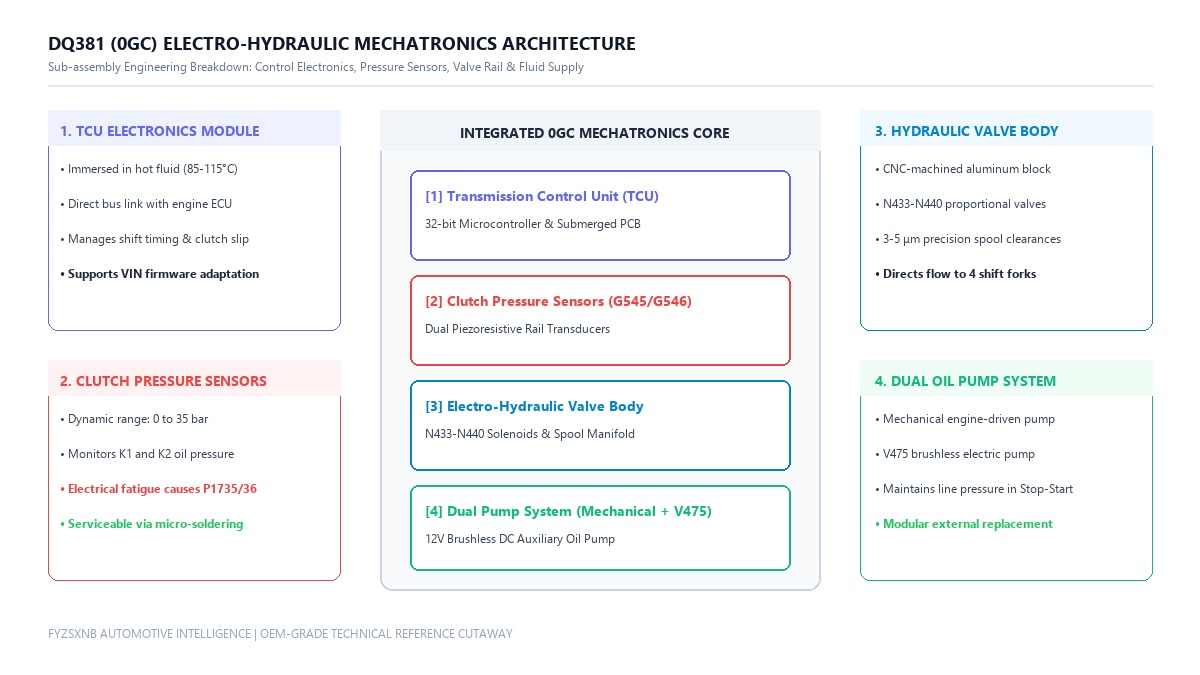
Integrating the electronic Transmission Control Unit (TCU), hydraulic valve body, shifting actuators, and pressure sensors into a single fluid-immersed mechatronics unit provides packaging advantages, but also subjects electronic components to intense thermal and mechanical stress.
3. Common Observed Failure Patterns in DQ381 Mechatronics
Field data from transmission rebuilding specialists, technical communities, and workshop feedback indicates that DQ381 mechatronics issues typically manifest in three distinct operational patterns rather than widespread mechanical gear failure.
Pattern A: Clutch Pressure/Position Sensor Electrical Faults
- Associated Fault Codes:
P173500(Clutch Position/Pressure Sensor 1 Electrical Malfunction) andP173600(Clutch Position/Pressure Sensor 2 Electrical Malfunction). - Technical Mechanism: The mechatronics sub-board incorporates two piezoresistive pressure sensors (G545 for Clutch K1 and G546 for Clutch K2, commonly based on the Bosch SMP132 series). These sensors monitor hydraulic pressure supplied to each multi-plate wet clutch pack. Operating in hot transmission fluid under continuous cyclical pressure shifts, internal micro-connections can experience electrical contact fatigue over extended mileage.
- Operational Consequence: When the TCU detects abnormal, implausible, or static out-of-range sensor voltage signals across measuring channels, it triggers a protective limp-home routine. To prevent dual-clutch binding, the system disengages the affected sub-transmission, resulting in the loss of odd gears (1, 3, 5, 7) or even gears plus reverse (2, 4, 6, R).
- Industry Context: Volkswagen technical documentation and field service information have noted similar sensor signal behavior across DQ381 and DQ500 transmissions.
Pattern B: Auxiliary Electric Transmission Fluid Pump (V475) Malfunction
- Associated Fault Codes:
P0C2A00(Auxiliary Transmission Fluid Pump Motor Control — Open Circuit) andP0C2900(Auxiliary Transmission Fluid Pump Motor Control — Performance Implausible). - Technical Mechanism: The auxiliary electric pump supplements line pressure during start-stop events. Over extended duty cycles, the pump’s solid-state motor driver or internal brushless rotor assembly can degrade.
- Operational Consequence: When moving from a standstill after an auto-stop event, delayed hydraulic pressure buildup causes hesitation, harsh engagement shocks, or temporary drive refusal until the ignition is cycled.
Pattern C: Hydraulic Siltation and Solenoid Sticking
- Associated Fault Codes:
P072C00(Stuck in Gear 3),P072D00(Stuck in Gear 4),P175E00/P176F00(Clutch 1/2 Closes Inadvertently). - Technical Mechanism: Wet clutch friction material generates micro-particulate wear debris. If fluid service intervals are delayed beyond recommended maintenance schedules, fine silt can bypass the filter and settle in the close-tolerance bores of the proportional electro-hydraulic solenoids (N433 through N440).
- Operational Consequence: Reduced hydraulic modulation precision leads to shift delays, harsh 2-to-3 or 4-to-3 transitions, and potential clutch slip.
4. Professional Diagnostic Workflow: From Symptoms to Root Cause
Accurate diagnosis separates minor electronic issues from mechanical damage, avoiding unnecessary complete unit replacements. Independent workshops should apply a structured five-step diagnostic flow:
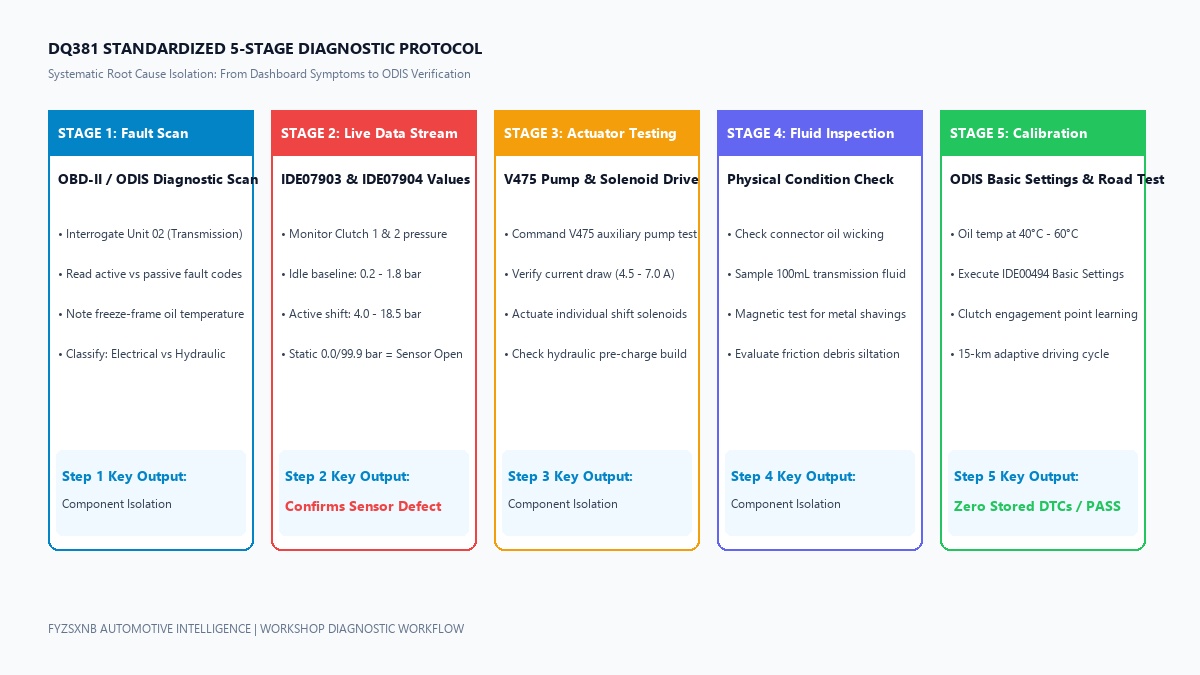
Standardized Diagnostic Steps
- Step 1: Fault Memory Interrogation: Connect via ODIS, VCDS, or equivalent tool to access
02 - Transmission Electronics. Record active and passive codes, noting freeze-frame parameters (fluid temperature, engine speed, and commanded gear). - Step 2: Live Data Stream (Measuring Blocks) Evaluation: Monitor live parameters for
Clutch 1 Actual Pressure(IDE07903) andClutch 2 Actual Pressure(IDE07904). Under normal conditions, idle baseline pressure ranges between 0.2 and 1.8 bar, ramping up smoothly to 4.0–18.5 bar during engagement. Abnormal invariant readings or out-of-range data stream values may indicate sensor circuit open/short conditions, warranting physical sensor inspection. - Step 3: Actuator Routine Testing: Perform functional testing of the V475 electric pump and individual shift solenoids to verify current draw and hydraulic actuation.
- Step 4: Fluid Inspection: Check for transmission fluid capillary wicking at the main electrical connector. Extract a fluid sample to inspect for discoloration or metallic particles.
- Step 5: Calibration and Adaptation: After component replacement, perform basic settings for valve calibration and clutch engagement adaptation with transmission fluid brought to manufacturer-specified calibration temperatures (typically 40°C to 60°C), followed by an adaptive road test.
5. Repair Options and Economic Comparison
Workshops and owners evaluate repair paths based on budget, vehicle downtime, and available technical capabilities:
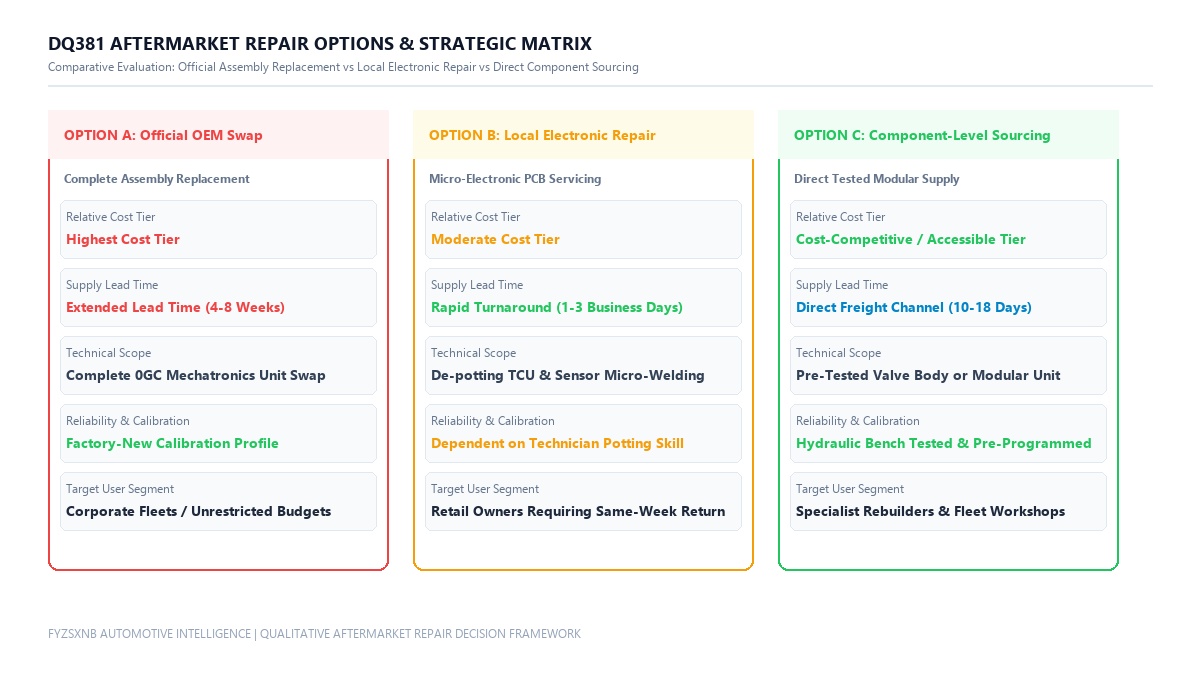
| Dimension | Option A: Official OEM Swap | Option B: Local Electronic Repair | Option C: Direct Component Sourcing |
|---|---|---|---|
| Primary Method | Complete brand-new OEM mechatronics replacement | Disassemble TCU, micro-weld replacement SMP sensor on PCB | Source tested mechatronics unit, pre-calibrated valve body, or sensor kit |
| Relative Cost Tier | Highest | Moderate | Cost-Competitive / Accessible |
| Typical Lead Time | Extended (4 to 8 Weeks) | Rapid (1 to 3 Business Days) | Direct Freight (10 to 18 Days) |
| Technical Scope | Complete sub-assembly swap | Precision micro-soldering & re-sealing | Modular component replacement or plug-and-play assembly |
| Typical Warranty | Limited dealer coverage | 6 Months / 10,000 km | 12 Months / 30,000 km |
| Best-Fit Scenario | Fleets requiring factory-new original parts | Retail owners requiring immediate same-week turnaround | Independent specialist workshops & rebuilding centers |
Note: Actual costs vary significantly based on regional workshop labor rates, currency fluctuations, logistics channels, and repair depth.
6. Strategic Value of the Chinese Component-Level Ecosystem
Rather than simply providing lower-cost alternatives, the Chinese automotive aftermarket offers a specialized, component-level engineering and remanufacturing ecosystem developed over years of servicing high-volume domestic vehicle fleets:
- Component-Level Availability: Where traditional Western channels supply only the entire mechatronic casting as an indivisible part, Chinese specialized suppliers unbundle the assembly into serviceable elements: standalone pressure sensor modules, valve body sub-plates, and V475 pump units.
- Automated Testing Infrastructure: Dedicated transmission remanufacturers in key industrial regions utilize automated hydraulic test benches that simulate real operating temperatures (20°C to 110°C) and pressure cycles prior to shipment.
- Firmware and Diagnostic Compatibility: Suppliers provide pre-programmed TCU units matched to specific vehicle VINs, transmission hardware codes (
0GC927711series), and regional software revisions, facilitating straightforward installation in independent workshops.
7. Operational Limitations and Diagnostic Scope
It is important for service managers and vehicle owners to recognize that transmission failure patterns vary considerably based on real-world factors. Mileage, maintenance history (specifically regular dual-clutch fluid and filter replacement at 60,000 km intervals), towing duty cycles, and operating in severe cold environments all influence component degradation rates.
Electronic sensor replacement resolves signal circuit faults (such as P173500 and P173600), but cannot compensate for mechanical clutch pack friction burn or severe hydraulic valve body scoring resulting from prolonged operation with contaminated fluid. A thorough diagnostic inspection as outlined in Section 4 is essential before finalizing a repair plan.
Conclusion: Building Practical Aftermarket Solutions
The mechatronics challenges observed in Volkswagen Tayron DQ381 transmissions are manageable electronic and hydraulic issues with proven diagnostic and repair paths. The P173500 and P173600 sensor fault codes, along with related hydraulic concerns, can be accurately identified using standard diagnostic workflows.
By combining systematic diagnostics with the availability of component-level parts from Chinese supply chains, vehicle owners, independent workshops, and fleet operators can maintain vehicle reliability with sensible economics.
This report is produced by FYZSXNB Automotive Intelligence, providing cross-border technical insights, diagnostic frameworks, and supply chain analysis.